Tesla Invites Guests to Semi Rollout in Nevada
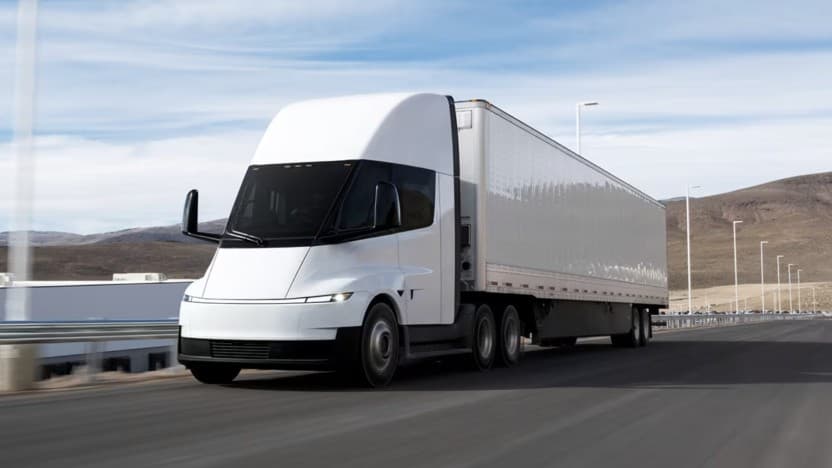
Tesla is sending out invitations for a Semi event on September 24, 2026. The venue is the new dedicated factory in Sparks, Nevada, where the electric heavy-duty truck is set to be produced in significantly larger volumes in the future.
The event therefore marks more than just another vehicle presentation. Following pilot production and limited deliveries, Tesla intends to show how the Semi will transition to industrial-scale mass production. It has not yet been confirmed whether the event will be streamed publicly.
For Tesla, the Semi rollout is primarily a production event: the aim is to turn a pilot project into a scalable commercial vehicle program.
New Tesla Factory to Build Up to 50,000 Semis
The new plant covers around 158,000 m² and is designed for a long-term capacity of up to 50,000 vehicles per year. However, this figure represents the planned capacity target, not the annual production volume expected immediately after production begins.
The focus is likely to be on the new assembly lines, battery-pack production, and Tesla’s vertical integration. The event is also expected to offer insights into the revised production version, as well as ride-alongs that could demonstrate features including cabin comfort, noise levels, and the independent front suspension.
Tesla Semi Technical Specifications
Tesla plans to offer the Semi in two range variants. Both use three independently controlled electric motors on the rear axles and are expected to deliver up to 800 kW of power.
| Specification | Standard Range | Long Range |
|---|---|---|
| Range | around 523 km | around 805 km |
| Energy consumption | around 106 kWh/100 km | around 106 kWh/100 km |
| Charging power | up to 1.2 MW | up to 1.2 MW |
| Charging time | up to 60% in 30 minutes | up to 60% in 30 minutes |
| Charging system | MCS | MCS |
| Powertrain | three electric motors | three electric motors |
| Power output | up to 800 kW | up to 800 kW |
| Unladen weight | under 9.1 tonnes | around 10.4 tonnes |
| Electric power take-off | up to 25 kW | up to 25 kW |
The electric power take-off can supply trailer functions such as refrigeration for temperature-controlled cargo. This means a refrigerated trailer does not need a separate diesel generator, potentially reducing energy consumption, noise, and local emissions.
Megacharging and 48-Volt Technology
The production version will have access to dedicated Megachargers designed to deliver up to 1.2 MW of DC power. For a truck with a very large battery, this level of power is crucial for replenishing meaningful amounts of energy during legally mandated driving breaks.
Tesla is also using a 48-volt low-voltage architecture, electric power steering, and modified 4680 cells. A redesigned front end with a continuous light bar further distinguishes the production model from the early pilot vehicles.
However, high charging power alone is not enough in everyday operation. Fleets need suitable grid connections, charging depots, and intelligent load management. Without this infrastructure, the time advantage of a megawatt charging system cannot be fully utilized.
Autonomous Driving Remains an Important Factor
Tesla has announced plans for a supervised version of Full Self-Driving for the Semi. Test vehicles equipped with the corresponding sensors have already been spotted on public roads, but no specific date has yet been announced for a broad release.
At the event, Tesla could link its commercial vehicle plans to its current FSD roadmap. In freight transport in particular, driver-assistance systems could provide long-term benefits for safety, driving comfort, and fleet utilization. In Europe, practical deployment will also depend on approval and regulation.
What the Tesla Semi Means for Europe
According to current plans, Tesla intends to begin customer deliveries in Europe in 2027. However, the US Semi cannot be transferred unchanged to the DACH market—Germany, Austria, and Switzerland—because regulations governing vehicle dimensions, axle loads, gross vehicle weight, and drivers’ working hours differ significantly.
The charging network will also need to expand. MCS, the Megawatt Charging System, is intended to become a manufacturer-independent standard for electric heavy-duty vehicles, but it is still at an early stage in Europe. Tesla could accelerate deployment with its own infrastructure, as it did with the Supercharger network for passenger cars.
The Semi is aimed at heavy-duty long-haul transport and therefore serves a different use case from electric delivery vans. Models such as the announced Kia PV7 primarily target regional transport, while Tesla is addressing long distances and high daily mileage.
From Pilot Project to Commercial Production
Tesla first unveiled the Semi in 2017 but did not begin limited deliveries until late 2022. Since then, selected fleets have gathered real-world experience while Tesla continued to develop the vehicle and its production process.
September 24 is now likely to reveal how far production at the new factory has actually ramped up. Reliable production volumes, high availability, and predictable operating costs will matter more than spectacular individual figures. These are precisely the areas in which the Tesla Semi must prove itself in day-to-day commercial fleet operations.