Kia PV7 expands the electric commercial vehicle range
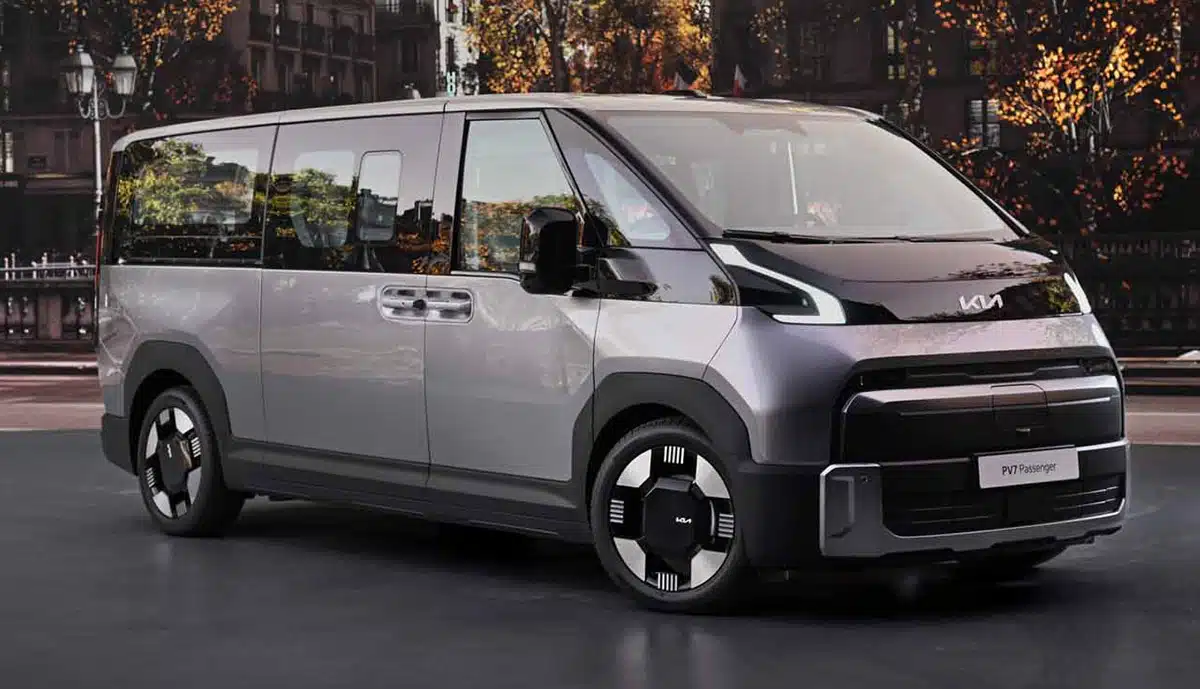
Kia is expanding its electric commercial vehicle lineup above the PV5. The new Kia PV7 is scheduled to launch in Europe in the second half of 2027 and will be offered in Cargo and Passenger versions. Prices for Germany, Austria and Switzerland have not yet been announced.
At up to 5.35 meters long, the PV7 is aimed at delivery services, fleets, tradespeople and shuttle operators. It is based on the E-GMP.S platform, developed specifically for electric commercial vehicles and featuring a completely flat floor. Kia previously offered an initial preview with the announced motor show appearance of the Kia PV7.
Key specifications of the Kia PV7
| Specification | Kia PV7 |
|---|---|
| European launch | Second half of 2027 |
| Body styles | Cargo and Passenger |
| Maximum length | 5.35 m |
| Batteries | 71.5 or 96.2 kWh NMC |
| Maximum power | 200 kW |
| Torque | 420 Nm |
| Drivetrain | Front-wheel drive, all-wheel drive planned later |
| Range | Up to around 460 km based on preliminary WLTP testing |
| Charging | 10% to 80% in around 25 minutes |
| Maximum cargo volume | 8 m³ |
| Maximum payload | 1,200 kg |
The range figure applies to the PV7 Cargo with the larger battery and is still based on the manufacturer’s internal testing under WLTP criteria. Homologation of the German-spec version is still pending, so the final figure may vary depending on body configuration, equipment and payload.
800 volts shorten charging stops
The 800-volt architecture is intended to charge the battery from 10% to 80% in around 25 minutes at a suitably powerful fast-charging station. Kia cites a 350 kW station, although its rated output does not automatically correspond to the vehicle’s maximum charging power. The charging curve across the entire session is what matters.
For an electric van, a short and predictable charging stop is particularly important. High daily mileages and fixed routes are easier to manage if the vehicle can recover a large proportion of its range during a break. Our comparison of 800-volt and 400-volt architectures in electric cars explains the technical differences.
Large battery plus 800 volts: The PV7 is designed not only to carry plenty of cargo, but also to spend as little of the working day as possible at charging stations.
PV7 Cargo has room for three Euro pallets
The PV7 Cargo will be offered with two or three seats. The long-wheelbase version provides up to 6.1 m³ of space and can accommodate up to three Euro pallets, the standardized pallets widely used in European logistics. With a high roof, cargo volume increases to up to 8 m³.
Depending on the version, the van can carry a payload of up to 1,200 kg. The loading sill is just 55 cm high, making it easier to load and unload heavy or bulky goods. Tradespeople are also likely to find the flat vehicle floor useful for installing shelving and carrying out custom conversions.
V2L powers tools and mobile equipment
The PV7 will have AC and DC charging ports at the front. An additional AC port at the rear is expected to be available as an option. This can be practical in commercial use when the van is parked close to a loading dock or inside a workshop.
Vehicle-to-Load, or V2L, also gives the Kia 230-volt outlets inside and outside the vehicle. These can power tools, measuring equipment or other business equipment directly from the vehicle battery. In some applications, this could eliminate the need for external generators or separate portable batteries.
Passenger version with up to nine seats
The PV7 Passenger is intended for shuttle services, rental companies, tourism businesses and large families. It is expected to be offered with up to nine seats in Europe. The seven-seat model is planned to have seats that can slide lengthwise and be removed, allowing passenger and luggage transport to be combined flexibly.
Planned equipment includes separate climate control for the rear, multiple storage compartments and USB-C ports delivering up to 100 watts. This will allow even more powerful laptops to be charged while driving. Below the PV7, Kia positions the already launched PV5, which will come to Germany in several forms, including the wheelchair-accessible Kia PV5 WAV.
Android Automotive and numerous body configurations
In the cockpit, Kia uses Pleos Connect based on Android Automotive OS. The system combines connected navigation, customizable screen layouts, an app marketplace and over-the-air updates via the mobile network. Gleo AI is intended to provide voice control for vehicle functions, navigation and messages.
After the market launch, Kia plans to gradually expand the PV7 family to a total of 23 variants. In addition to Cargo and Passenger models, a Chassis Cab and various conversions are planned. This could allow the PV7 to cover a broad range of applications, from a conventional delivery van to specialized vehicles for specific industries.
A serious electric van contender for Europe
On paper, the Kia PV7 combines the key qualities of a modern electric commercial vehicle: plenty of cargo space, a high payload, a practical range and short fast-charging times. It also offers V2L and a platform designed to facilitate different body configurations. Whether the overall package is compelling will ultimately depend above all on its price, real-world energy consumption and the range of variants available at its European launch.