936 km in a production-spec Škoda Peaq 90
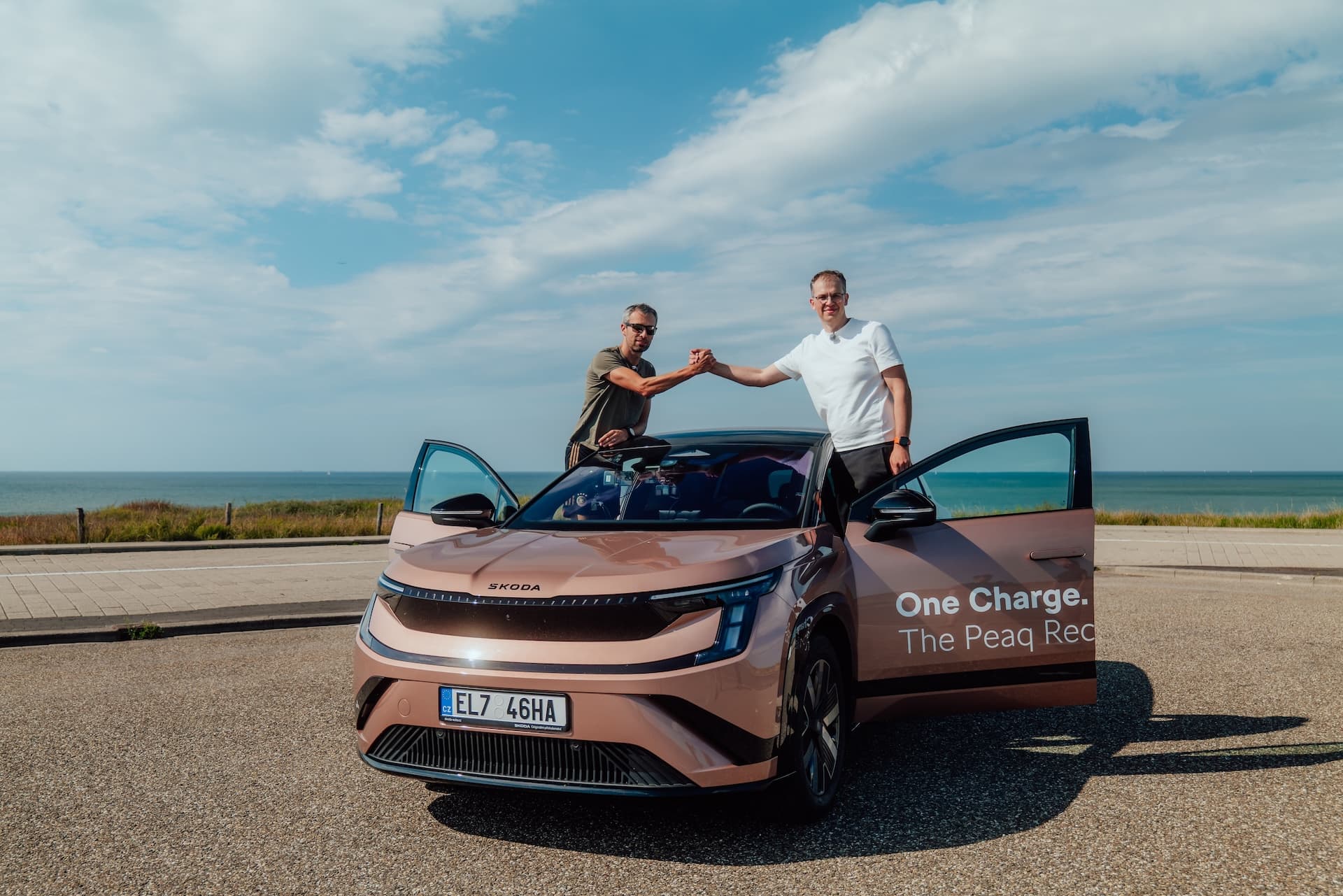
The new Škoda Peaq 90 covered 936 km without recharging. The journey began at Škoda’s headquarters in Mladá Boleslav, passed through Germany and ended in Zandvoort in the Netherlands. Driver changes and rest breaks were scheduled, but the battery was not charged along the way.
A production-spec rear-wheel-drive vehicle with 19-inch wheels and standard tires optimized for low rolling resistance was used. The run was monitored by TÜV Süd, a German technical inspection and certification organization. Škoda describes the result as a range record for seven-seat electric SUVs.
| Metric | Škoda Peaq 90 |
|---|---|
| Distance traveled | 936 km |
| WLTP range | up to 647 km |
| Average consumption | 9.2 kWh/100 km |
| Battery capacity | 91 kWh gross, 86 kWh net |
| Power output | 210 kW |
| Drivetrain | Rear-wheel drive |
Extremely low energy consumption makes the record possible
At 9.2 kWh/100 km, the large seven-seater achieved an energy consumption level that is exceptionally low even for significantly smaller electric cars. Extrapolated over 936 km, it required around 86 kWh—virtually the entire usable net battery capacity.
The drivers deliberately selected the route and consistently adapted their driving style for maximum efficiency. No average speed has been disclosed. The result should therefore be regarded as a controlled efficiency run, not as a forecast for fast highway journeys.
The 936 km demonstrates the Peaq’s technical efficiency potential, while the WLTP figure of up to 647 km remains the more meaningful benchmark for buyers.
289 km more than the homologated WLTP figure
The Peaq exceeded its WLTP range by 289 km, or almost 45%. Such a difference is possible when speed, route profile and driving style are consistently optimized for low energy consumption. In everyday use, payload, heating, air conditioning, weather and highway speeds all have the opposite effect.
Prospective buyers in the DACH region—Germany, Austria and Switzerland—should therefore not plan on achieving 936 km, particularly given the region’s long highway journeys and cold winter months. Our 2026 range ranking is also based on homologated figures so that different models remain comparable. Anyone unsettled by individual range figures can find practical context in our guide to electric-car range anxiety.
New flagship with seven seats
The Peaq is the largest SUV in the Škoda portfolio and is positioned above the Škoda Enyaq. The electric flagship is produced at the company’s main plant in Mladá Boleslav. More than 10,000 orders are reportedly already on the books.
New equipment features include flush door handles, a panoramic glass roof with electronically controlled shading and bidirectional charging. The latter could eventually make the Peaq attractive as a mobile energy storage system. However, this will depend on the specific functionality enabled, supported standards and compatible charging infrastructure.
The record is therefore no substitute for a realistic range test, but it sends a strong technical signal. Achieving 9.2 kWh/100 km in a large seven-seat electric SUV demonstrates the potential of its drivetrain, aerodynamics and low rolling resistance.