VW Mission Efficiency Prioritizes Efficiency Over Battery Size
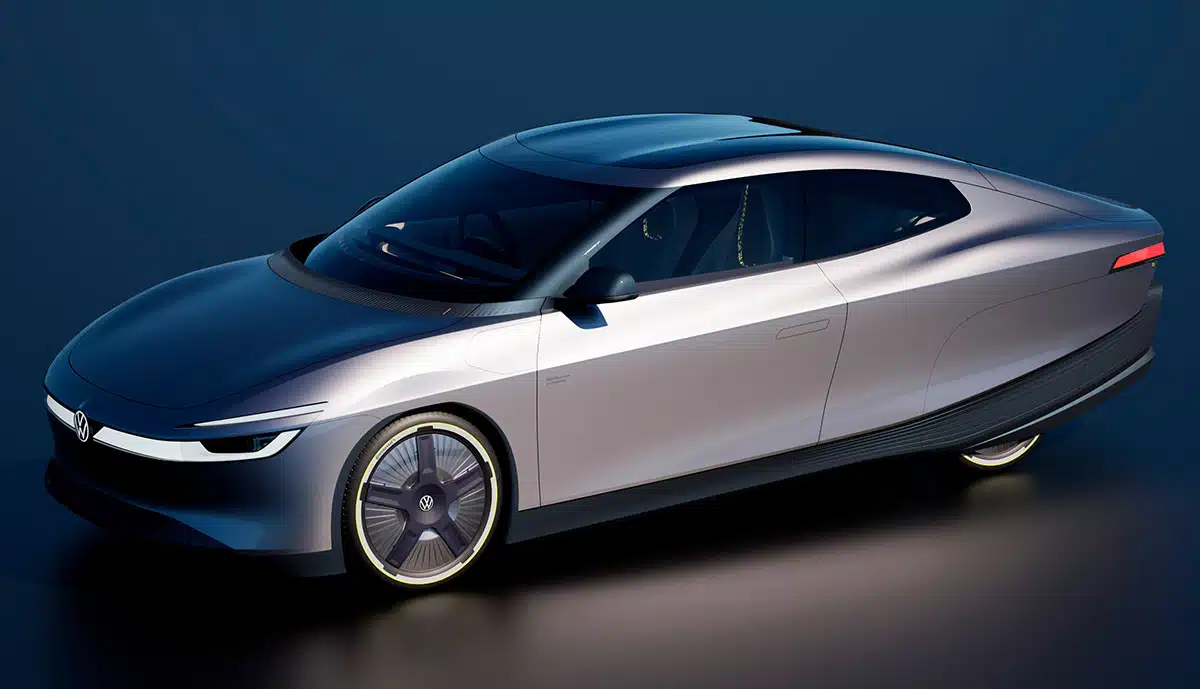
Volkswagen has now fully unveiled the Mission Efficiency. The electric concept vehicle is not intended for sale, but according to the manufacturer it is approved for use on EU roads and uses numerous components from the forthcoming MEB+ modular EV platform.
The focus is not on maximum power, but on minimizing energy demand. VW quotes a drag coefficient of 0.158, WLTP consumption of 8.4 kWh/100 km and 6.48 kWh/100 km during a best-case test drive.
The Mission Efficiency shows that greater range does not come from larger batteries alone. Lower aerodynamic drag and reduced energy losses can be at least as important.
More Than 1,278 km With Just One Charging Stop
During a documented drive, the concept covered around 1,278 km from Wolfsburg via Poznań and Olomouc to Vienna. Consumption including charging losses was 7.51 kWh/100 km; excluding charging losses, it was 6.89 kWh/100 km.
The average speed was just under 68 km/h, with a top speed of 138 km/h. VW stopped to charge once along the way. At the destination, the vehicle still showed 164 km of remaining range.
Figures like these are not directly comparable with a typical highway journey at a consistently high speed. Nevertheless, the result illustrates the potential of uncompromising aerodynamics, especially since energy demand above 80 km/h is heavily influenced by aerodynamic drag.
VW Mission Efficiency Technical Specifications
| Specification | Figure |
|---|---|
| Drivetrain | Front-wheel drive, electric motor |
| Power | 99 kW |
| Usable battery capacity | 54.9 kWh |
| Maximum DC charging power | 105 kW |
| WLTP consumption | 8.4 kWh/100 km |
| Best-case test-drive consumption | 6.48 kWh/100 km |
| Drag coefficient | 0.158 |
| Length | 4.775 m |
| Width | 1.744 m |
| Height | 1.392 m |
| Frontal area | 2.08 m² |
The 99 kW front-wheel-drive system, the front axle including the steering, and parts of the rear-axle design are related to the technology in the forthcoming ID. Polo. Together with the ID. Cross, it is one of the VW Group’s new entry-level electric cars.
The Body Makes the Biggest Difference
At 4.775 m, the Mission Efficiency is considerably longer than the ID. Polo. However, the additional space is not primarily intended for passengers. Instead, it enables a teardrop-shaped body with an extended wheelbase and a long rear overhang.
Fully enclosed rear wheels, a sealed underbody and three active cooling-air flaps further reduce turbulence. Combined with the comparatively small frontal area, this produces exceptionally low aerodynamic drag.
VW puts the consumption advantage over the ID. Polo at more than 30% from 80 km/h onward. This matters in everyday driving: as speed increases, aerodynamic drag becomes disproportionately more significant. Efficient shapes therefore deliver additional range particularly on rural roads and highways.
Less Friction and Lower Auxiliary Power Consumption
VW has also reduced losses beyond the vehicle body. The front axle uses conventional hydraulic brakes, while a new electromechanical system is fitted at the rear. It is designed to operate with virtually no continuous friction losses.
There is no permanently installed infotainment display or conventional speaker system. Instead, the concept relies on mobile devices and a Bluetooth speaker. Such omissions would not appeal to everyone in a production car, but they save weight and energy in an efficiency-focused project.
The glass roof and tailgate also incorporate a photovoltaic system rated at 370 watts. It primarily powers the vehicle’s auxiliary electrical systems and is intended to generate enough energy for up to 30 km of additional range per day under favorable conditions.
This peak figure is likely to depend heavily on sunlight, location and the time of year. In the DACH region—Germany, Austria and Switzerland—output will therefore be lower in winter. The principle remains interesting, however, because solar energy can reduce the load from auxiliary systems without requiring additional charging time.
What Could Make It Into Production Models
There are no plans to put the Mission Efficiency into series production. The records claimed by VW should also be treated as manufacturer figures, particularly since terms such as near-production electric car can be defined in different ways.
The transfer of technology is more important. Front-wheel drive, MEB+ components and a moderate DC charging power of 105 kW show that the low consumption figures do not depend on extreme high-performance technology.
Future VW models are unlikely to adopt enclosed rear wheels or a completely stripped-down cockpit. Improved underbodies, active air flaps, lower-friction brakes and more efficient auxiliary systems, by contrast, can gradually be incorporated into mass-production vehicles. The VW ID.3 after 220,000 km also demonstrates the long-term importance of such optimizations, with both consumption and battery condition determining everyday usability.
Efficiency Is the Most Affordable Way to Add Range
The Mission Efficiency is not a preview of an imminent production model. Instead, it serves as a rolling development laboratory that demonstrates the impact of aerodynamics, friction, weight and auxiliary power consumption.
Low energy consumption allows for smaller, less expensive batteries, shortens charging times and reduces electricity costs. That is the project’s real benefit: greater range does not automatically have to mean a larger battery.