FSD now monitors the person behind the wheel too
Tesla is adding a new safety feature to Full Self-Driving (Supervised) with software version 14.3.9. The assistance system will now be able to intervene even when the driver is operating the electric car manually.
The feature is intended for situations in which a collision is imminent and automatic emergency braking alone may not be enough. FSD can then temporarily take over the driving task, stabilize the vehicle and subsequently continue the journey.
The key change: The driver no longer just supervises FSD; FSD can now also help protect the vehicle during manual driving.
FSD is designed to intervene in these situations
| Detected situation | System response |
|---|---|
| A head-on collision is imminent and braking alone may not be sufficient | FSD is activated and can correct the vehicle’s direction in addition to slowing it down |
| The driver is severely distracted or FSD may have been disengaged unintentionally | The system temporarily takes control of the vehicle and continues driving in a controlled manner |
This takes the feature beyond conventional automatic emergency braking. Instead of merely reducing speed, the vehicle can also adjust its planned trajectory. This can be crucial when obstacles appear suddenly and the remaining braking distance is insufficient.
Not a step toward unsupervised driving
Despite its expanded ability to intervene, FSD remains a driver-assistance system that requires supervision. The person behind the wheel remains responsible and must be ready to intervene at any time. This does not constitute approval for fully autonomous driving without the driver paying attention.
The word “Supervised” is therefore crucial. FSD can already handle complex routes, including navigation, turns and lane changes, but it must not be confused with a driverless system. Further planned development steps involving Tesla FSD v15 and HW4 do not initially change this legal classification.
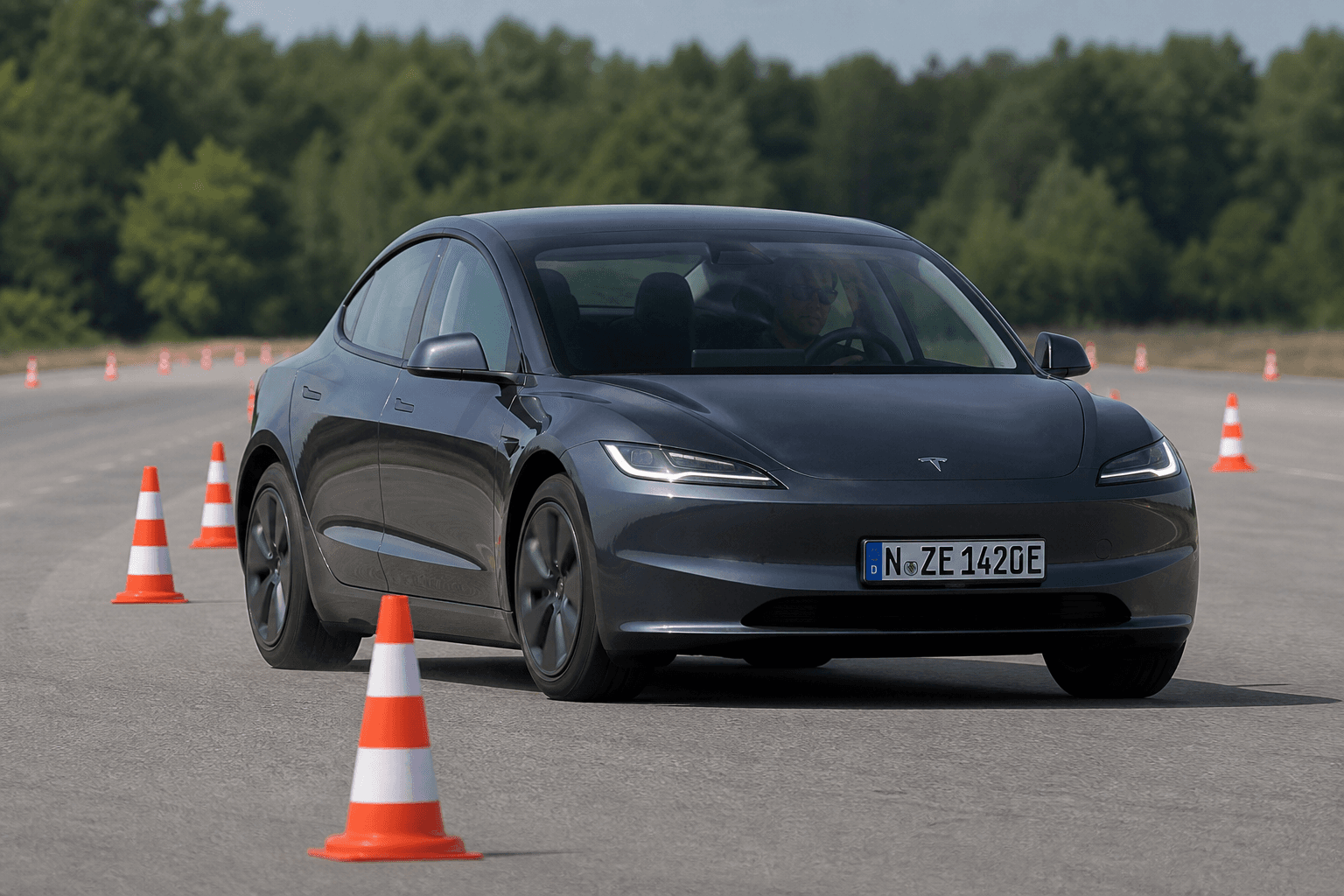
Owners of a Tesla Model Y or Tesla Model 3 should also note that actual availability depends on the market, regulatory approval and the vehicle’s hardware and software versions.
Slovenia approves FSD (Supervised)
Alongside the software update, Tesla is making progress with European approval. Slovenia has approved FSD (Supervised) for use on public roads, making it the sixth European country to grant such approval after the Netherlands, Denmark, Belgium, Estonia and Lithuania.
These national decisions do not yet mean an automatic, EU-wide launch. However, they give Tesla additional real-world experience and could support the process for broader approval. A possible European vote is scheduled for October 6, 2026.
Tesla publishes FSD safety data
As part of the documentation for type approval by the Dutch vehicle authority RDW, Tesla has provided a publicly accessible FSD dashboard. Among other things, it lists distances driven and reported crashes involving FSD (Supervised).
Tesla argues that the system is already improving road safety. The publication provides greater transparency, but it is no substitute for independent analysis. Meaningful comparisons require not only crash figures but also mileage, road type, weather, fleet size and a precise definition of when the system is considered active.
Why the new feature matters in everyday driving
The practical benefit is not limited to automated driving. Even drivers who rarely activate FSD could benefit from the additional monitoring during manual operation. Driver reacts too late → assistance system briefly takes over and attempts to defuse the critical situation.
This is a sensible expansion of the existing sensors and computing power. However, the crucial questions remain how reliably FSD identifies genuine hazards, avoids incorrect responses and makes its interventions understandable to the driver.