VW ID. AURA T6 Launches on September 20
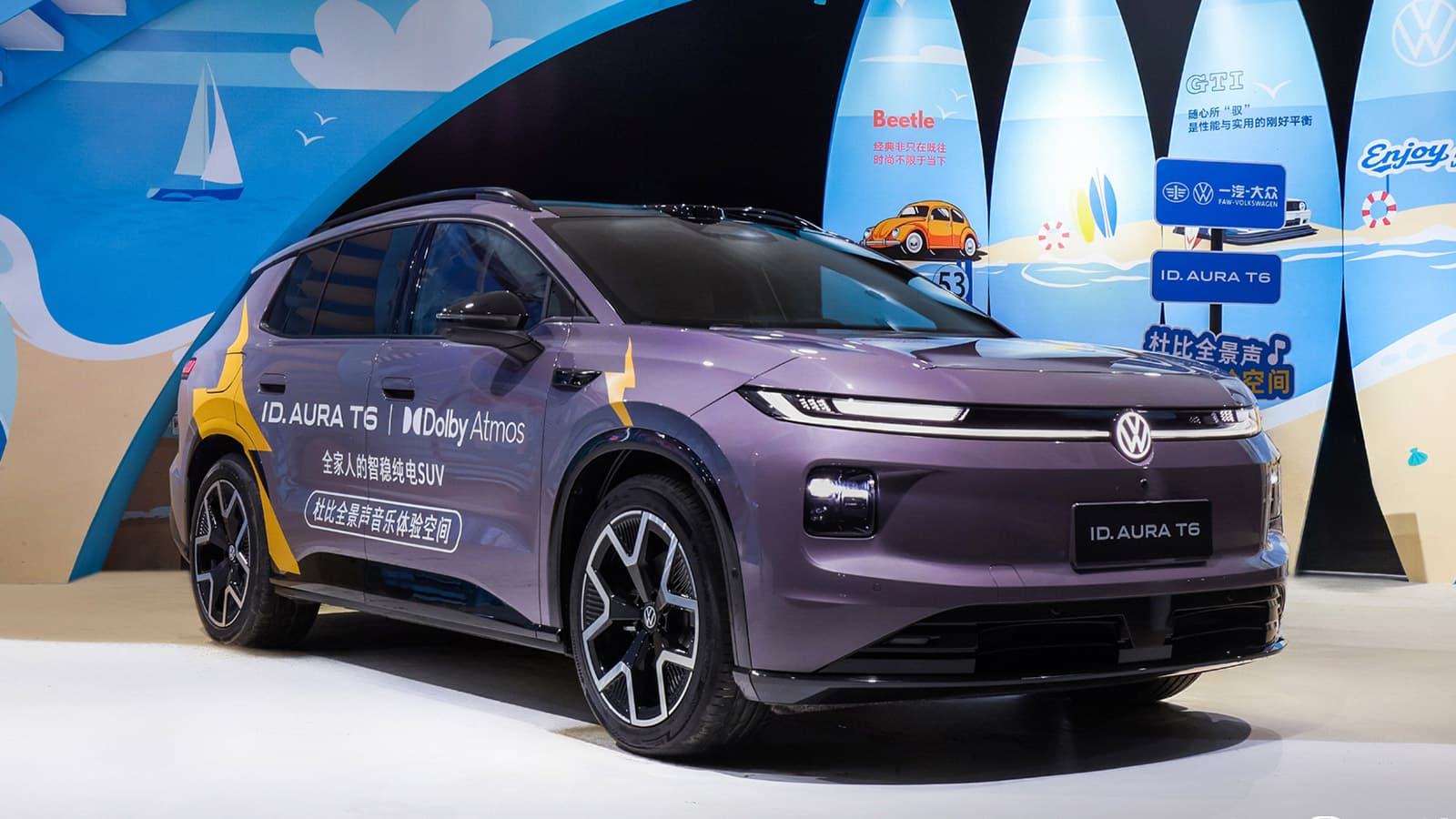
FAW-Volkswagen, Volkswagen’s Chinese joint venture with FAW, will officially launch the ID. AURA T6 in China on September 20, 2026. Pre-sales have been underway since August 28 and include four variants priced from 135,900 to 169,900 yuan, roughly equivalent to €17,000 to €21,500.
However, these prices cannot be applied directly to Germany, Austria or Switzerland. Taxes, equipment, homologation and distribution costs would significantly affect any potential European price. A launch outside China has not yet been announced.
The five-seater is the first model in FAW-Volkswagen’s new AURA range. It is also Volkswagen’s first all-electric SUV equipped with LiDAR sensors.
ID. AURA T6 Specifications
| Specification | Figure |
|---|---|
| Length | 4.81 m |
| Width | 1.88 m |
| Height | 1.65 m |
| Wheelbase | 2.84 m |
| Powertrain | Single electric motor |
| Power | 170 kW |
| Battery supplier | CATL |
| Range | 540 or 660 km under CLTC |
| Seats | 5 |
At 4.81 m long, the ID. AURA T6 is a full-size midsize SUV. Both range figures are based on China’s CLTC test cycle, which generally produces more optimistic real-world figures than Europe’s WLTP cycle. It is therefore still too early to make a direct range estimate for European conditions.
CEA Architecture Developed Jointly with Xpeng
Under the bodywork is the China Electronic Architecture, or CEA. Volkswagen developed this electronic architecture jointly with Xpeng. It combines a central high-performance computer with zone controllers, with the aim of simplifying wiring harnesses, control units and software structures.
For drivers, its update capability is particularly relevant. CEA supports software updates for the entire vehicle and has a separate computing module for the integrated AI assistant. In principle, this allows new features to be rolled out faster than with an architecture based on highly distributed control units.
LiDAR and 420 TOPS for the Higher-End Versions
The two higher-end variants are equipped with a 192-channel LiDAR. The associated hardware and software solution comes from Carizon, a joint venture between Volkswagen and Horizon Robotics. The computing platform is the Journey 6H, delivering 420 TOPS, or trillion operations per second.
The system supports navigation-based driver assistance in urban traffic. It also offers automated parking maneuvers across multiple floors and over distances of up to 3 km, as well as reversing along a previously recorded route for up to 200 m.
The extensive sensor suite does not make the ID. AURA T6 an autonomous vehicle. The functions described remain driver-assistance systems, and the driver remains responsible.
Large Displays and Onboard AI in the Cockpit
Inside, Volkswagen uses a 15.6-inch central display with 2.5K resolution. It is complemented by a 10.25-inch instrument display and a 25.8-inch augmented-reality head-up display.
The infotainment system uses a 4-nanometer chip with around 20 TOPS of computing power. This allows large AI models to run partly within the vehicle itself. That should enable faster response times and, for suitable functions, reduce reliance on a permanent cloud connection.
What the ID. AURA T6 Means for Volkswagen
The ID. AURA T6 shows how extensively Volkswagen now tailors its Chinese models to local expectations. Large displays, LiDAR, AI features and aggressive pricing carry far more weight there than maintaining identical global platforms. The VW ID. Unyx 09 also follows this more regionally focused approach.
Volkswagen plans to launch a total of 13 new models in China in 2026, including seven electrified vehicles. FAW-Volkswagen is expected to contribute four models, two of which will belong to the new AURA family. By 2029, the group aims to introduce more than 30 new electrified models to the Chinese market.
For Europe, the ID. AURA T6 is initially likely to be of interest primarily as a technology showcase. For upcoming models such as the potential VW ID. Tiguan, the group is using different platforms and product planning geared more closely toward Europe. Nevertheless, individual elements of CEA, such as centralized computers and faster software development, could eventually have an impact beyond China.