Autonomous VW ID. Buzz Shuttles Enter Munich City Traffic
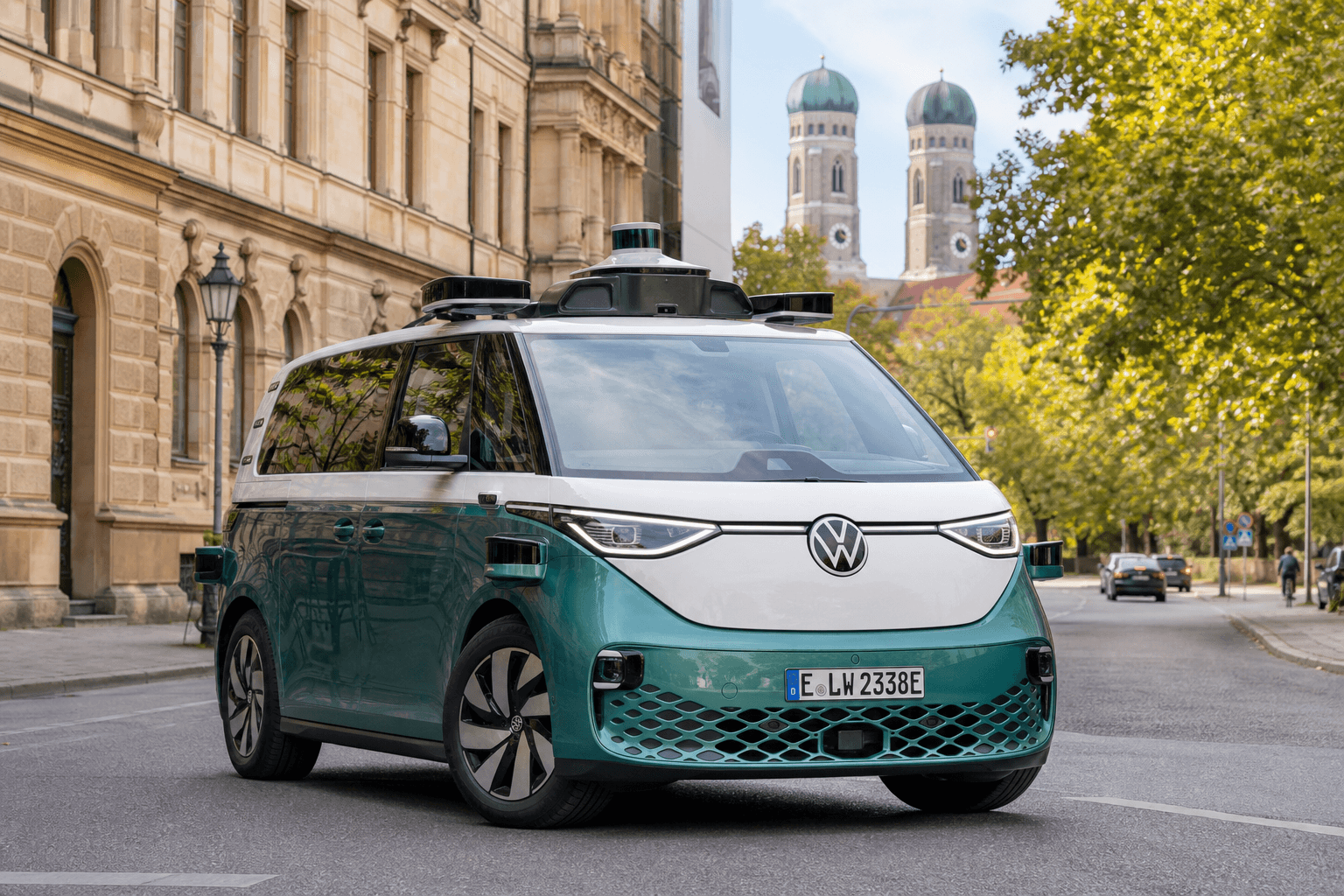
Three autonomous electric shuttles based on the VW ID. Buzz have begun operating on public roads in Munich. The vehicles are being tested in the Gern neighborhood of the Neuhausen-Nymphenburg district and are initially traveling on predefined routes.
For now, this is explicitly not a public passenger service. During the first phase, the minibuses will operate without passengers, while safety drivers monitor the system and can intervene at any time.
The trial is intended to determine whether autonomous on-demand shuttles are technically safe, operationally stable and suitable for integration into the existing public transport network.
What the Autonomous Electric Shuttles Detect
The research vehicles have been equipped with additional sensors and automated-driving software. This enables them to detect their surroundings, analyze traffic situations and follow the predefined routes independently.
During the journeys, data is collected on aspects including driving behavior, perception of the surroundings and interaction with other road users. Operational stability is equally important, as a shuttle must not only handle individual driving situations but also operate reliably over extended periods.
Unlike spectacular demonstrations such as an autonomous maneuver without road markings, the Munich trial focuses on controllable, real-world practicality. Roadworks, cyclists, parked cars and dense urban traffic place high demands on the vehicles’ perception and decision-making systems.
From Trial Operations to Bookable Ridepooling
The project is divided into several expansion stages. Deployment will only be extended gradually once the vehicles are operating safely and reliably in the current area.
| Phase | Planned operation |
|---|---|
| Current trial | Predefined routes, no passengers, safety drivers on board |
| Next expansion stage | Larger operating area and integration of an on-demand system |
| Later testing | App-based booking, pooled trip requests and selected test users |
Once the on-demand system is integrated, the shuttles will receive their routes based on short-notice trip requests. Multiple bookings heading in similar directions can be combined in a single vehicle. This kind of ridepooling will determine whether small autonomous vehicles can efficiently complement conventional scheduled public transport.
Safety and Regulatory Approval Take Center Stage
The journeys are being conducted under a German testing permit issued in accordance with the Regulation on the Approval and Operation of Motor Vehicles with Autonomous Driving Functions, known by its German abbreviation AFGBV. Such approval is not a blanket authorization for regular driverless operation; instead, it defines the framework for controlled testing.
In addition to vehicle technology, the project is therefore examining passenger information, interior design, safety concepts and integration with operations management and the control center. The sensors work → that alone does not make the service ready for everyday use. Only when all components work together can a research vehicle become a robust mobility service.
The test vehicles are clearly marked as research vehicles and are intended to drive defensively and anticipate potential hazards. No special rules apply to other road users. Nevertheless, maintaining sufficient distance is advisable, as unfamiliar but controlled braking or driving maneuvers may occur.
MINGA Is Testing More Than Autonomous Minibuses
The shuttle trial is part of the MINGA research project, which involves a total of 16 partners. The acronym stands for Munich’s automated local public transport with ridepooling, solo buses—a standard non-articulated bus—and bus platoons.
By mid-2027, the project also aims to test an autonomous scheduled-service bus and an electronically coordinated bus convoy under real-world conditions. Germany’s Federal Ministry for Transport is supporting the overall project with around €13 million.
Munich is thus providing Germany with valuable practical experience at the intersection of autonomous driving and public transport. The findings are also relevant to cities in Austria and Switzerland, even though approvals and legal requirements are regulated separately in each country.