Tesla Accelerates Optimus Production
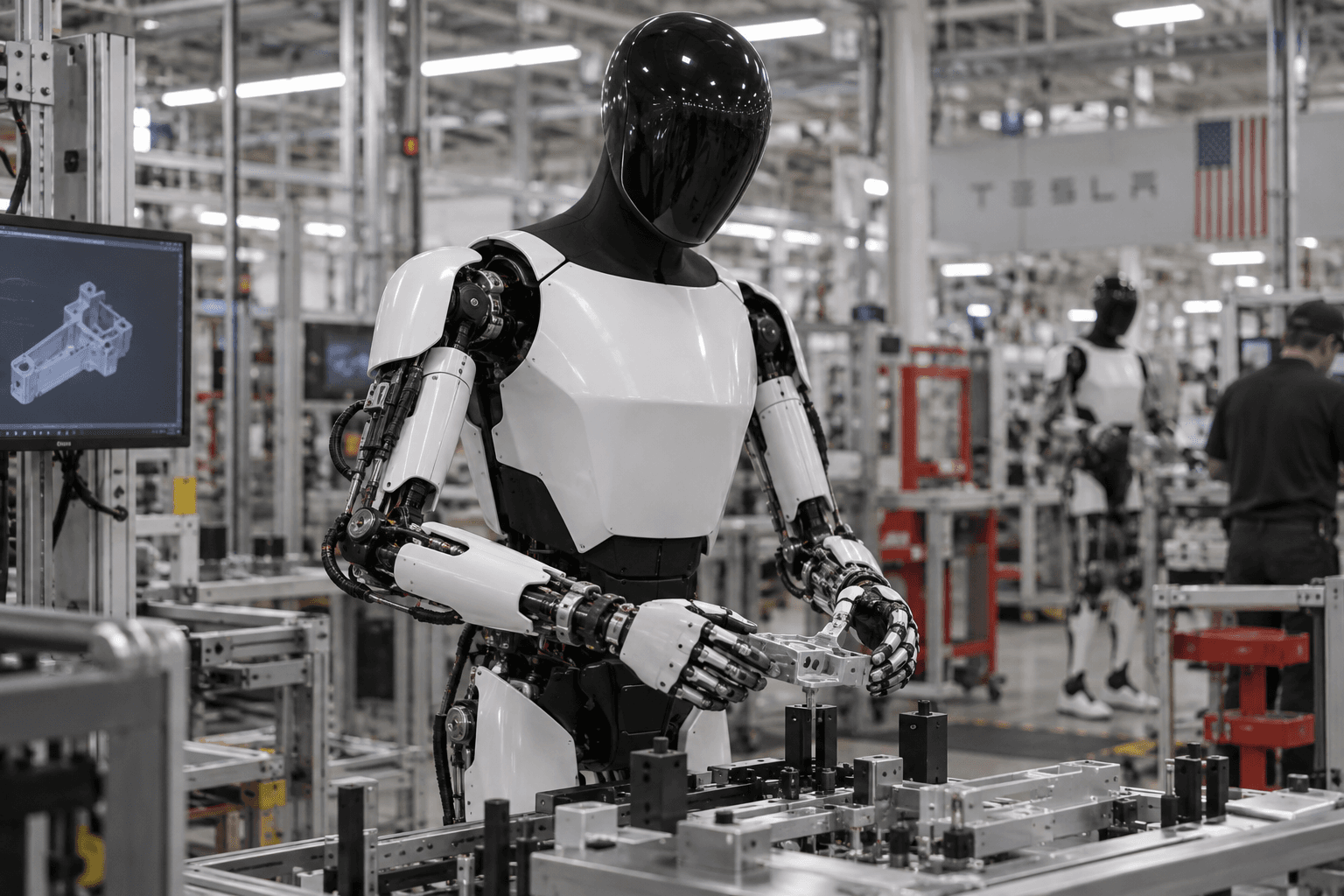
Tesla has reportedly significantly ramped up production of its Optimus humanoid robot at its Fremont factory. According to a recent report, several hundred units per week were being produced in August 2026. In the second quarter, that figure was reportedly only a few dozen.
That would mark important progress toward industrial-scale production. Tesla plans to automate the assembly line further and increase capacity to more than 1,000 robots per week by the end of 2026. The long-term target is said to be around 20,000 units per week, although no specific timeline has been announced.
| Metric | Reported Status |
|---|---|
| Production in the second quarter of 2026 | A few dozen per week |
| Production in August 2026 | Several hundred per week |
| Target by the end of 2026 | More than 1,000 per week |
| Long-term target | Around 20,000 per week |
| Training data collected | More than 500,000 hours |
The new line is expected to occupy the area where the Model S and Model X were previously built. Tesla ended production of the two premium models and shifted resources to its robotics program. The resulting farewell to the Tesla Model S and Model X underscores the strategic importance Optimus has now gained.
High Production Volumes Do Not Yet Mean Commercial Deployment
Most of the robots produced are expected to remain within Tesla. They are used for testing, data collection, and AI training. Although individual systems are already operating in factories, they are apparently limited to controlled areas, working under supervision and on clearly defined tasks.
Scaled production proves that Tesla can build robots. It does not yet prove that Optimus can operate economically and flexibly.
The V3 generation currently in production is also not expected to match the final customer version. Before a commercial launch, Tesla must improve durability, repeatability, and operational reliability in particular. These factors will determine whether the robot genuinely pays for itself over several years.
The Hands Remain the Biggest Mechanical Challenge
The hands and forearms of a humanoid robot are considerably more complex than many conventional vehicle components. The Optimus module reportedly contains more than 100 screws and small parts, some of which are still assembled by hand. Even minor deviations can mean that joints, sensors, or electronic components need reworking.
There are also reportedly problems with certain touch sensors. As a solution, Tesla is apparently developing a replaceable sensor glove. If the sensors fail, the entire hand would no longer need to be replaced, potentially reducing maintenance time and costs.
The supply chain presents another challenge. Precision gearboxes and compact electric motors can be manufactured relatively effectively in small quantities. At several hundred or thousands of units per week, maintaining consistent quality becomes significantly more difficult. Tesla can draw on its vehicle manufacturing experience here, although tolerances for robot hands are sometimes tighter than in automotive production.
Generalization Is the Real AI Hurdle
Mechanical reliability alone is not enough to make Optimus universally deployable. The AI must be able to transfer familiar movements to new tasks and changing environments. At present, teaching it even simple activities reportedly takes several days in some cases.
To address this, Tesla is developing a library of basic movement sequences that Optimus is expected to combine. The principle sounds logical: grasping, lifting, turning, and setting down are assembled into more complex workflows. However, unfamiliar objects, changed positions, or unexpected obstacles can still throw the system off course.
More than 500,000 hours of data are reportedly already available for training. Tesla aims to double this volume by the end of 2026. The company uses specialized data collectors equipped with cameras and motion-capture technology, and parts of its team that previously processed driving data are now also working on Optimus.
The strategy is reminiscent of Tesla’s approach to autonomous driving: deploy hardware, collect real-world data, and improve capabilities through software. The advances Tesla is promising for FSD, HW4, and Optimus illustrate how closely connected the company’s AI projects are.
Leasing Could Make the Initial Rollout More Manageable
Tesla is reportedly considering leasing Optimus to selected companies rather than initially offering it for unrestricted sale. The focus would be on factories and warehouses whose workflows resemble those at Tesla’s own plants. A familiar environment reduces the number of unknown situations while also making it easier to collect additional training data.
This would be a sensible interim step for Tesla. The manufacturer could control maintenance, software versions, and operating conditions, while customers would not have to bear high upfront costs. However, pricing, contract terms, and binding performance specifications are not yet known.
What This Means for Europe
There is currently neither a confirmed market launch nor any specific pilot customers in Germany, Austria, or Switzerland. In addition to technical maturity, occupational safety, machinery approval, and data protection would be key issues in these markets. The processing of camera footage inside production facilities in particular is likely to require clear rules.
With its manufacturing expertise, large volumes of data, and proprietary AI infrastructure, Tesla has strong foundations. At the same time, previous Optimus targets have been missed, including the announced number of robots in practical use. Scaling production to several hundred units per week is therefore notable, but only sustained deployment will show whether Optimus can become an economically significant product.
Competitors are also developing automated production lines for humanoid robots. However, the race will not be decided by production volume alone. Reliable hardware plus fast-learning AI → only this combination makes a humanoid robot valuable in everyday use.