Tesla Brings In-House Cathode Material to the Cybercab
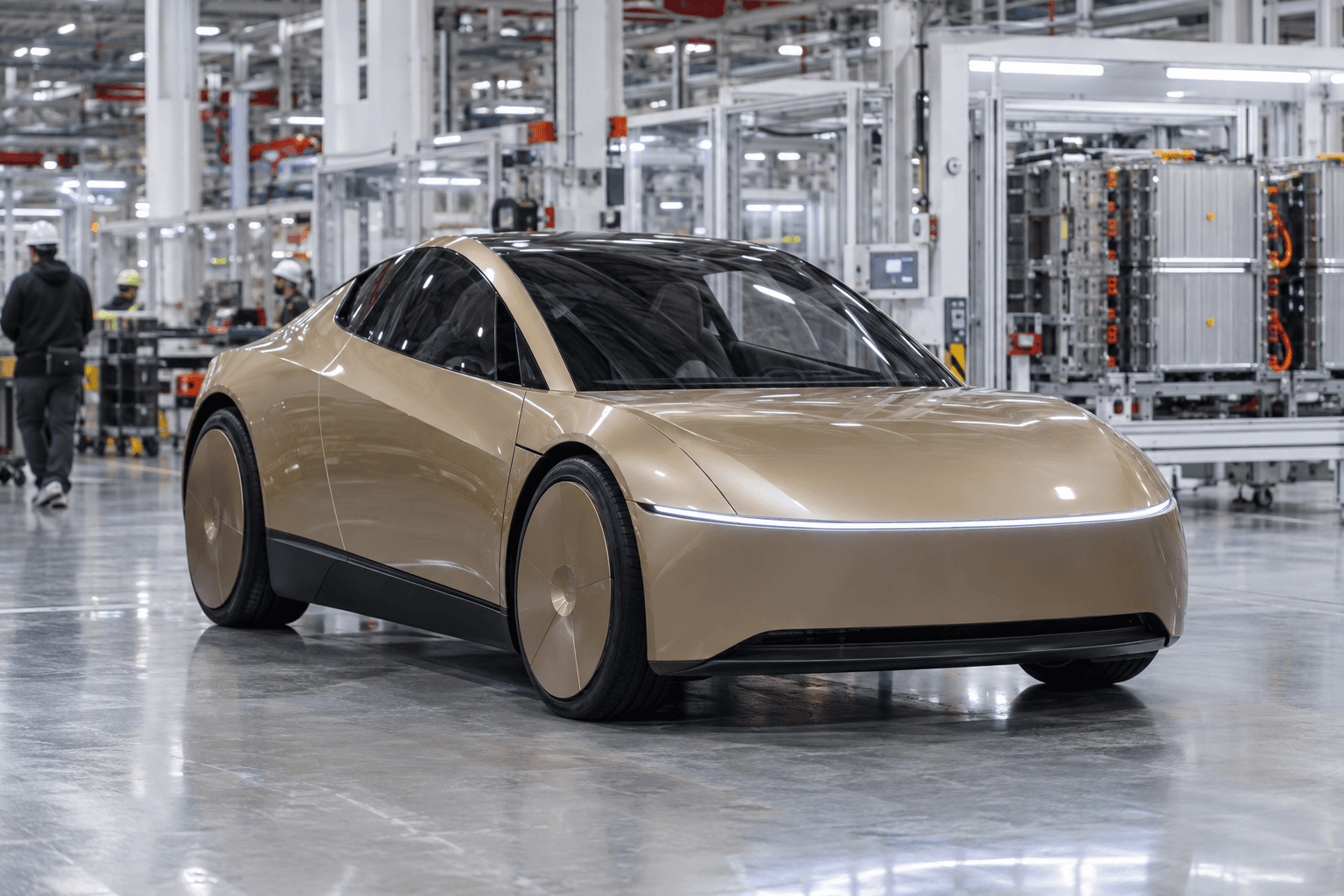
For the first time, Tesla has manufactured a Cybercab at Gigafactory Texas using active cathode material from its own production facilities. This marks an important milestone in the company’s vertical integration of its 4680 battery cells.
The material comes from Tesla’s new cathode facility at its Austin site. According to the company, it is the first large-scale production facility of its kind in North America. The facility has been operating since August 2026.
From cathode powder and the 4680 cell to the vehicle itself, Tesla is consolidating an increasing number of production steps at a single site.
How the Cathode Material Is Produced in Texas
The process begins with a precursor made from nickel, manganese and cobalt. This is mixed with lithium hydroxide, compacted and then heat-treated in industrial furnaces. Special screens subsequently remove magnetic contaminants before the finished active cathode material is sent to cell production.
An important distinction is that Tesla is producing the active cathode material itself, but does not necessarily extract the raw materials it contains from its own mines. The greater level of control begins with processing and extends through integration into the battery cell.
The short transport distances are intended to reduce logistics costs and reliance on international supply chains. Tesla puts the greenhouse gas emissions advantage over conventional Tier 1 suppliers at 74%. However, no independently verified life-cycle assessment supporting this figure has yet been published.
4680 Cells With a Dry Electrode Process
The cathode material is used in Tesla’s 4680 cells, which are intended for the Cybercab’s structural battery pack. The dry electrode process eliminates some of the energy-intensive, solvent-based coating and drying stages. This can reduce energy consumption, space requirements and production costs, provided manufacturing remains stable and achieves high yields.
| Feature | Figure | Context |
|---|---|---|
| Cell format | 4680 | Cylindrical Tesla cell |
| Battery capacity | Estimated 47.6 kWh usable | Not officially confirmed by Tesla |
| Powertrain | One electric motor | Designed for low energy consumption |
| Efficiency | According to Tesla, almost 40% better than the Model Y | Test conditions were not specified |
| Powertrain production | One unit every 10 seconds | Figure for the automated assembly line |
The estimated usable capacity of 47.6 kWh appears relatively compact for a robotaxi. This is plausible because the Cybercab is being optimized not for maximum long-distance range, but for low energy consumption and operating costs.
Tesla uses the Tesla Model Y as its benchmark. The Cybercab is said to be almost 40% more efficient, although it remains unclear whether this figure refers to energy consumption, the entire powertrain or specific driving cycles.
Why Local Battery Production Is Crucial
For a robotaxi, the purchase price is not the only factor that matters. Energy consumption, maintenance, production costs and vehicle utilization determine whether operations will be economically viable. In the long term, Tesla is targeting costs of less than approximately US$0.13 per km.
The automated powertrain line is expected to be capable of assembling one complete unit every ten seconds. However, this does not mean that one finished Cybercab can be produced every ten seconds, as body production, battery integration, final assembly and quality control also determine actual vehicle output.
In addition, the Cybercab’s success depends on Tesla’s autonomous driving software. Statements about FSD v15 and the hardware strategy show how closely the vehicle, computing platform and software development are interconnected.
The Impact on Europe Will Initially Be Indirect
The new cathode production facility is primarily relevant to Tesla’s US manufacturing operations. In the German-speaking DACH region—Germany, Austria and Switzerland—the Cybercab is unlikely to play a role until regulatory questions concerning the approval, liability and operation of fully driverless vehicles have been resolved.
Nevertheless, the industrial progress is significant. A functioning local supply chain for cathode material, 4680 cells and powertrains could help Tesla cut costs and ramp up production more quickly. However, whether the promised efficiency gains can be achieved in everyday robotaxi operations has yet to be demonstrated under real-world conditions.