Li Auto prepares its chip division for investors
Li Auto is apparently moving quickly to establish its semiconductor development operations as an independent business. The new chip division is expected to raise several billion yuan in its first external funding round and be valued at around 15 billion yuan before the capital injection.
The financing has not yet been officially completed. However, corporate registry filings in Hong Kong and Shanghai show that Li Auto has been building a separate structure for its chip business since July 2026. Parts of the development team are expected to be transferred gradually to these companies.
What began as an internal development department could become an independent semiconductor supplier that may later also serve other automakers.
Comparison with Nio’s chip division
| Metric | Li Auto | Nio |
|---|---|---|
| Status | Funding planned | First round completed |
| Capital raised | Several billion yuan targeted | 2.257 billion yuan |
| Valuation | Around 15 billion yuan before funding | Around 8.27 billion yuan after funding |
| Technical focus | Vehicle and cloud chips | AI chips and platform technology |
The valuations are not directly comparable because Li Auto’s target refers to the company’s value before the capital injection. Nio’s figure, by contrast, is its valuation after the funding round was completed.
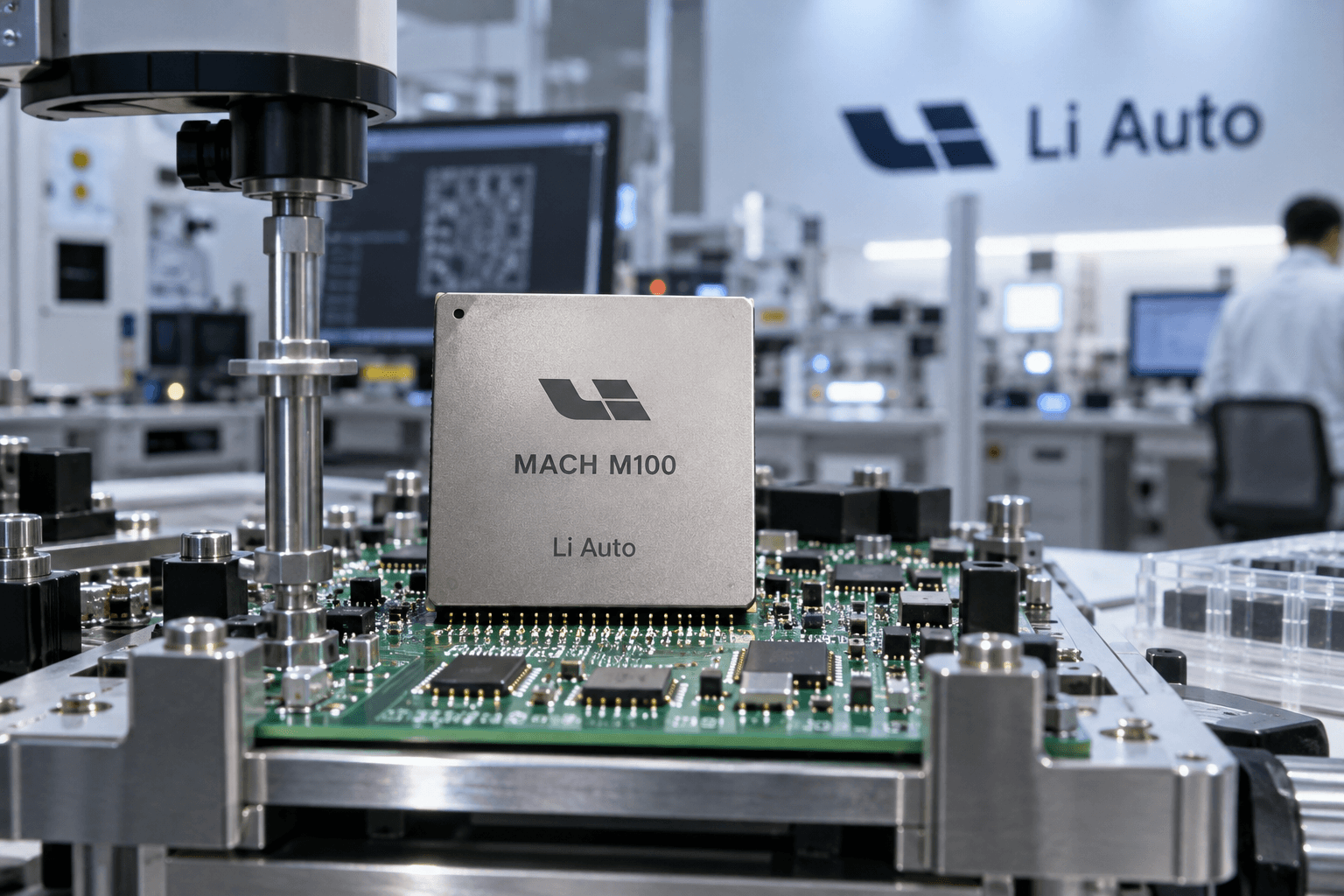
Mach M100 delivers 1,280 TOPS per chip
The main product developed by the chip team of around 200 people is the Mach M100. The automotive chip is manufactured using a 5 nm process and, according to the company, delivers computing performance of 1,280 TOPS. It is already being used in several new or updated Li Auto vehicles.
Instead of a conventional GPGPU structure, Li Auto uses a dataflow architecture. This links computing operations more closely to the actual flow of data, potentially enabling high efficiency for suitable AI workloads. However, it requires particularly close coordination between the hardware, software, and neural networks.
At the same time, the company is developing a cloud chip for AI inference. It is intended to handle some of the tasks currently performed by graphics processors. The decisive factor is not maximum computing performance alone, but whether Li Auto can reduce the cost of the overall system to a competitive level.
Independent funding intended to secure development
Developing modern AI chips requires sustained, substantial investment. Li Auto recorded a net loss of 3.98 billion yuan in the first half of 2026. External investors could spread the development risk while giving the chip division greater entrepreneurial freedom.
Retaining specialized talent is also likely to play a role. An independent company can establish equity participation programs tailored more specifically to developers and executives. Competition for experienced staff is particularly intense in China’s AI and semiconductor markets.
Strategically, Li Auto is following a familiar pattern. Tesla also develops key hardware and software for automated driving in close coordination, while Nio has already opened its chip business to external investors. The potential importance of combining hardware with AI models can also be seen by looking at Tesla FSD and HW4.
Li Auto is considering external customers
In the long term, Li Auto could also sell chips and silicon carbide modules to other manufacturers. Such components are easier to standardize than complete battery packs, which must be closely tailored to the vehicle platform, available installation space, and planned production volume.
This would transform Li Auto from a pure vehicle manufacturer into a technology supplier. Several companies in China are pursuing this path, while automakers such as Xpeng are also trying to keep more AI and software value creation in-house with systems such as VLA 2.0 for autonomous driving.
What the development means for Europe
The planned funding round will initially have no direct impact on Germany, Austria, or Switzerland—the DACH region. Li Auto does not yet officially sell its vehicles in these markets, and no specific European customers for the Mach M100 have been named.
The development will become relevant if Li Auto does in fact supply standardized chips and power electronics to other brands. Successful in-house products could intensify competition in driver assistance, AI features, and production costs. Before that can happen, however, the chip division must prove that it can operate its architecture reliably at high production volumes and support it with a mature software platform.
The targeted valuation of 15 billion yuan is therefore primarily a vote of confidence. The Mach M100 is technically ambitious, but commercial success will ultimately depend on capacity utilization, development costs, and paying customers outside Li Auto’s own group.