Zeekr 009 Survives Unusual Seat Foam Test
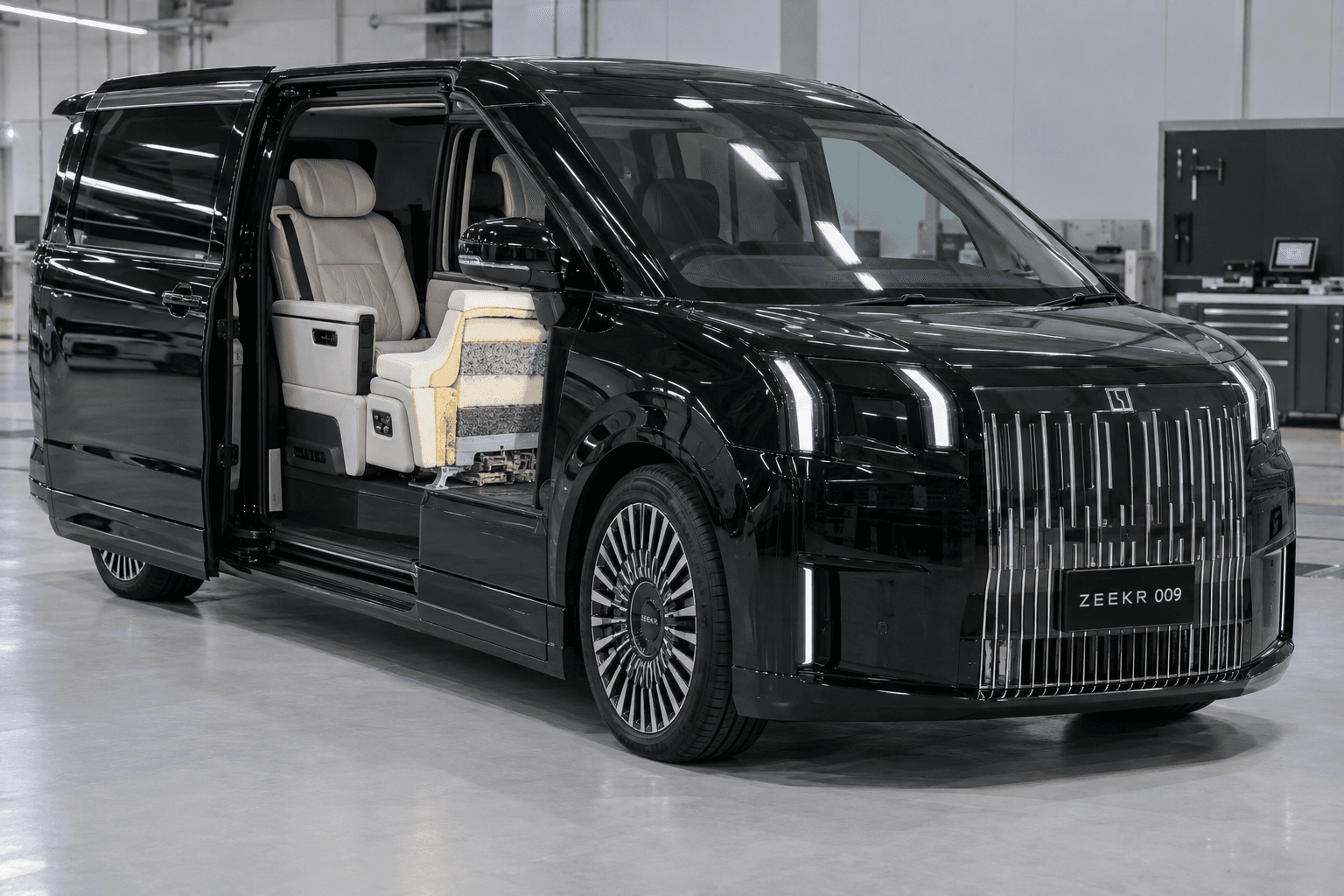
Zeekr has subjected the 009 to an unusual extreme test: A piece of the seat foam used in the vehicle was first driven over by nine passenger cars and then by a 20-metric-ton truck. According to the manufacturer, the material subsequently showed neither permanent deformation nor any measurable deterioration in its vibration damping.
The published test relates to the 2026 model year of the large electric van. It is primarily intended to demonstrate the durability of the multilayer seat construction, but it is not an independent long-term test.
The test provides an impressive demonstration of how quickly the foam returns to its original shape after extreme stress. However, it alone cannot support conclusions about wear over many years.
Three Layers of Foam for Comfort and Stability
Zeekr describes the design as a sandwich construction. Highly resilient foam is used on top, with a denser, fast-response layer underneath. A softer bottom layer is intended to reduce pressure peaks and better isolate occupants from movements coming through the vehicle floor.
According to the manufacturer, the construction delivers 1.5 times greater vibration damping than conventional car-seat foam. In everyday use, this could be particularly relevant on long journeys, as subtle body movements and road imperfections would be transmitted less noticeably to passengers.
How the Demonstration Was Conducted
First, nine vehicles from the brand drove over the piece of foam. They ranged from the approximately 1.9-metric-ton Zeekr X to the roughly 2.9-metric-ton Zeekr 009. Together, the vehicles weighed around 20 metric tons.
The lineup also included the Zeekr 007, 7 GT, 7X, 001, Mix, 8X, and 9X. The Zeekr 7X with 900-volt technology, which also took part, is one of the brand’s most important international models.
A 20-metric-ton Farizon Homtruck H then drove over the material. According to Zeekr, a subsequent inspection found no deterioration in damping performance. The visible structure also remained intact.
What the Test Actually Shows
Driving over the foam generates enormous short-term compressive stress and illustrates the material’s ability to recover its shape. However, other factors are crucial to a seat’s service life, including millions of small load cycles, heat, cold, moisture, and sustained stress on specific areas of the seat.
A complete demonstration of durability would therefore require standardized laboratory testing with documented measurements. The published test remains primarily a vivid manufacturer demonstration, but it offers an interesting insight into the effort Zeekr puts into seat comfort.
The Zeekr 009 Focuses on Second-Row Luxury
The 009’s seats are upholstered in Nappa leather. The two individual seats in the second row can rotate 180 degrees and offer a zero-gravity mode, power-adjustable leg rests, and heating and ventilation functions. They also feature a massage function with 22 contact points.
At around 5.22 meters long, 2.02 meters wide, and 1.81 meters tall, the 009 clearly belongs to the luxury class of electric vans. Its wheelbase measures 3.21 meters, creating ample room for the elaborately designed individual seats.
Powertrain and Range of the Zeekr 009
| Variant | Power | Battery | Range |
|---|---|---|---|
| Front-wheel drive | 310 kW | 108 kWh NMC | 740 km CLTC, around 607 km on a WLTP-equivalent basis |
| All-wheel drive | 680 kW | 115 kWh NMC | 720 km CLTC, around 590 km on a WLTP-equivalent basis |
The stated WLTP figures should not be regarded as equivalent to official European type approval. Particularly with Chinese vehicle variants, equipment, software, and tires may differ from later export models.
In China, the Zeekr 009 costs between 439,800 and 469,800 yuan, depending on the version. From January through August 2026, 12,405 vehicles were delivered, around 12.8% fewer than in the same period of the previous year. The seat demonstration does not provide any indication of specific pricing for Germany, Austria, or Switzerland.