Geely EX5 receives a comprehensive technology upgrade
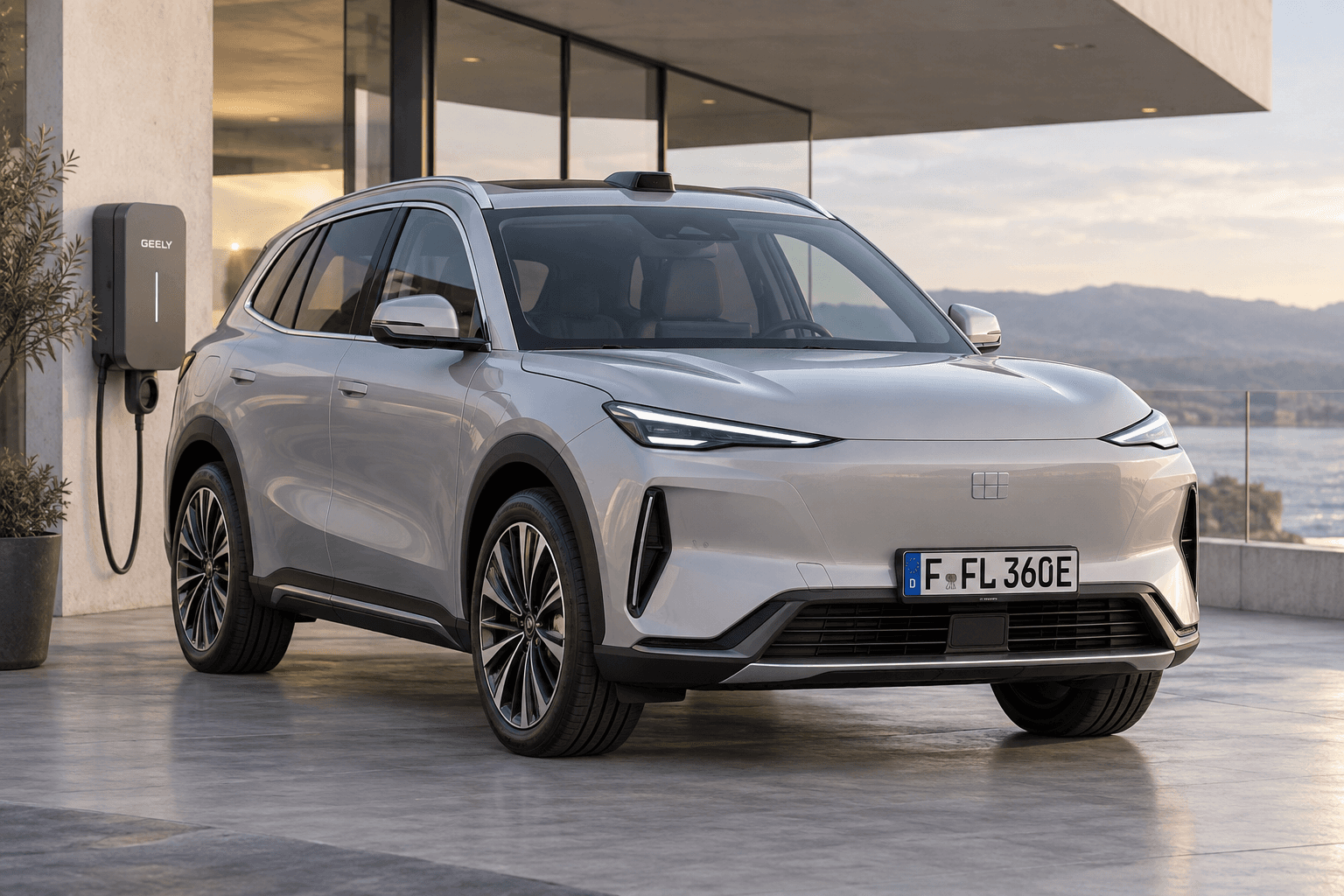
Geely has officially unveiled the new generation of the EX5. The compact electric SUV will launch in China on September 23, 2026, under the Galaxy E5 name, bringing significantly more capable technology than the current model.
The key upgrades include an 800-volt architecture, rear-wheel drive with 245 kW, and two battery sizes. Geely has largely retained the familiar design but added conventional door handles, new bumpers, and additional sensors.
Up to 521 km of WLTP range
The base version uses a 61.5 kWh battery and is expected to achieve the equivalent of around 451 km under WLTP. Above it sits a 70 kWh battery offering up to 521 km of WLTP range. Depending on the version, the current model manages approximately 430 to 475 km.
| Specification | Geely EX5 Base | Geely EX5 Top Version |
|---|---|---|
| Drivetrain | Rear-wheel drive | Rear-wheel drive |
| Power | 245 kW | 245 kW |
| Battery | 61.5 kWh | 70 kWh |
| CLTC range | 550 km | 635 km |
| WLTP range | around 451 km | around 521 km |
| Electrical architecture | 800 volts | 800 volts |
Geely has not yet specified a maximum charging rate or charging time. High system voltage alone does not guarantee short charging stops, but it provides the technical foundation for higher charging rates and lower current levels. Our comparison of 800-volt and 400-volt architectures in electric cars shows the practical benefits.
Compact dimensions, unusually large frunk
The new EX5 measures 4.64 meters long, 1.92 meters wide, and 1.67 meters tall. Its wheelbase is 2.75 meters. This places it in the compact electric SUV segment, and it is only slightly shorter than the Skoda Enyaq.
A practical highlight is located beneath the power-operated hood. The front trunk offers 160 liters of capacity and can carry up to 50 kg. For charging cables, crates of drinks, or smaller travel bags, this is considerably more useful in everyday life than the often tiny storage compartments offered by many competitors.
The EX5 rides on 19-inch wheels. The charging port is located on the rear fender on the driver's side, which can be convenient depending on the position of the charger. However, at some European fast-charging stations with short cables, it may require careful parking.
LiDAR and more physical controls
Inside, Geely combines a freestanding central touchscreen with a digital instrument cluster and a head-up display. Alongside a wireless smartphone charging pad, there is a rotary controller and several physical buttons. This should make key functions easier to access while driving.
Other features include a large panoramic roof, a rear center armrest, and a Flyme sound system. Another notable feature is the roof-mounted LiDAR sensor, supplemented by additional sensors in the front fenders.
The G-Pilot H5 driver-assistance system supports navigation-based driving functions in cities and on highways. This remains assisted driving rather than an autonomous vehicle. Whether all functions could be offered in Europe will also depend on homologation, map data, and regulatory approval.
The new EX5 combines significantly more power with greater range and an unusually large frunk. The key remaining questions are what charging rate and price Geely will ultimately announce.
What does the new EX5 mean for Europe?
Geely has initially confirmed the model for the Chinese market, where the EX5 is called the Galaxy E5. There has not yet been a firm announcement for this revised version in Germany, Austria, or Switzerland.
Technically, however, the SUV would be a good fit for the European market. Its dimensions place it in a highly sought-after segment, while the 800-volt architecture, up to 521 km of WLTP range, and large frunk would be clear selling points. Geely is also preparing other models for Europe, including the more affordable Geely E2 electric subcompact.
A total of 40,776 EX5s were delivered in China between January and August 2026. This represented a decline of 45.9% compared with the same period a year earlier. The comprehensive upgrade is therefore likely intended not only to modernize the technology but also to give the model fresh momentum in China's fiercely competitive SUV market.