McLaren expands its proven formula
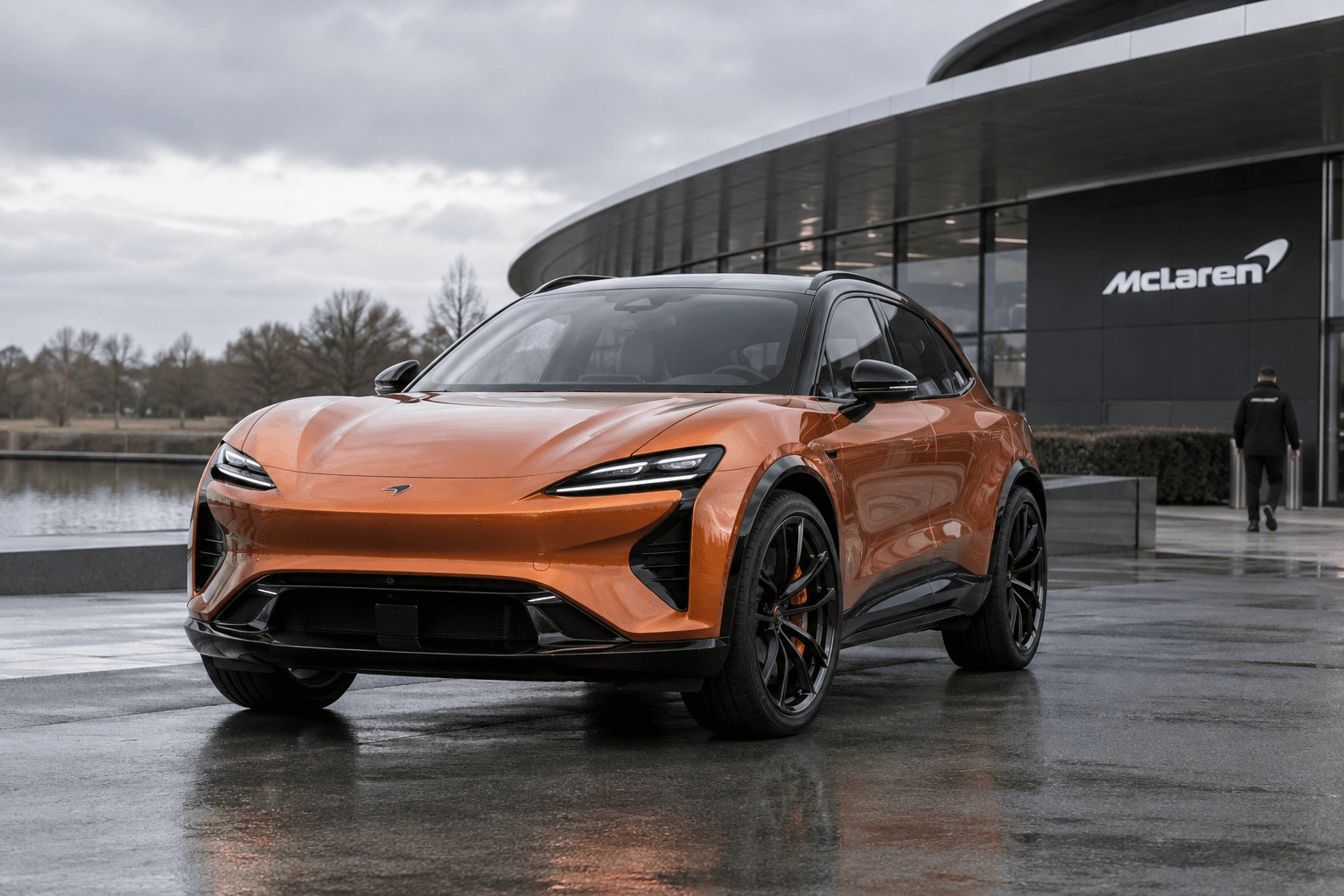
McLaren is preparing for one of the biggest changes in its recent history. A new performance SUV with a hybrid powertrain is intended to expand its range beyond the two-seat supercars that have dominated it to date and attract additional customer groups.
The move follows a difficult financial period. The company recorded annual losses from 2020 to 2024. Under its new owners from Abu Dhabi, higher production volumes, lower material costs and modernized manufacturing are intended to make McLaren profitable again.
The hybrid SUV is not intended to become a conventional mass-market model, but to bring McLaren’s focus on lightweight construction and performance to a new vehicle segment.
£500 million for the Woking site
An initial investment package of £500 million, equivalent to more than half a billion euros, has been earmarked for the Woking site. Key parts of the vehicle production and motorsport operations are based there.
McLaren plans to manufacture two new hybrid combustion powertrains and their associated transmissions in-house. Producing more components internally can reduce its dependence on suppliers and enable closer integration of the engine, electric assistance and transmission.
| Area | Planned measure | Objective |
|---|---|---|
| Woking | Modernization of the production center | More efficient vehicle manufacturing |
| Powertrain | In-house production of new hybrid systems and transmissions | Greater technical control and lower costs |
| Rotherham | Expansion of the carbon-fiber structure facility | Greater capacity for lightweight chassis |
| Jobs | At least 1,000 positions by 2032 | Strengthening the UK sites |
Carbon fiber remains a key component
The Composites Technology Centre in Rotherham is also set to be expanded. It produces the carbon-fiber structures used in McLaren’s supercars and the Artura plug-in hybrid.
This approach could be particularly important for a larger and heavier SUV. The hybrid battery, electric motor and power electronics increase the vehicle’s weight → a lightweight carbon-fiber structure can offset some of this disadvantage and help preserve the agile handling typical of McLaren.
By 2032, the investments are expected to create at least 1,000 direct and indirect jobs at McLaren’s UK sites. The company expects up to 3,000 additional jobs in the supply chain.
Higher sales while retaining strong exclusivity
Despite the expansion, McLaren does not intend to become a mass-market manufacturer. Annual sales are to remain limited to approximately 2,000 vehicles to preserve the brand’s rarity and pricing.
This is a difficult balancing act. Higher volumes improve purchasing terms and spread development costs across more vehicles, while expanding too far could dilute the brand’s exclusive character. An SUV is generally better suited to achieving this than another two-seat supercar.
A fully electric car is not a priority for now
Alongside the SUV, McLaren is planning an overhaul of its two-seat model range. A fully electric production model, by contrast, will not be developed until there is evidence of sufficiently strong customer demand.
McLaren is therefore initially opting for hybrid technology as a bridge. This strategy fits the brand’s current positioning but carries long-term risks if demand or regulation shifts toward fully electric powertrains more quickly.
No launch date, performance figures or prices have yet been announced for the planned hybrid SUV. What is clear, however, is that it is intended to be more than just another model: it is the central pillar of McLaren’s financial reset.