BYD Formula S GT Appears at Dealerships Ahead of Market Launch
The BYD Fang Cheng Bao Formula S GT has already arrived at the first dealerships in China, even though its official market launch is not scheduled until September. Early sightings like these are usually a fairly clear signal: delivery logistics are ramping up, and BYD wants to build visibility ahead of the launch.
For prospective buyers, this is particularly exciting because the Formula S GT targets a segment that has recently started growing again in Europe: large, sporty electric estates. At the same time, BYD is once again demonstrating how quickly new models can reach dealerships once production is up and running.
Denza-Inspired Design and Roof-Mounted LiDAR
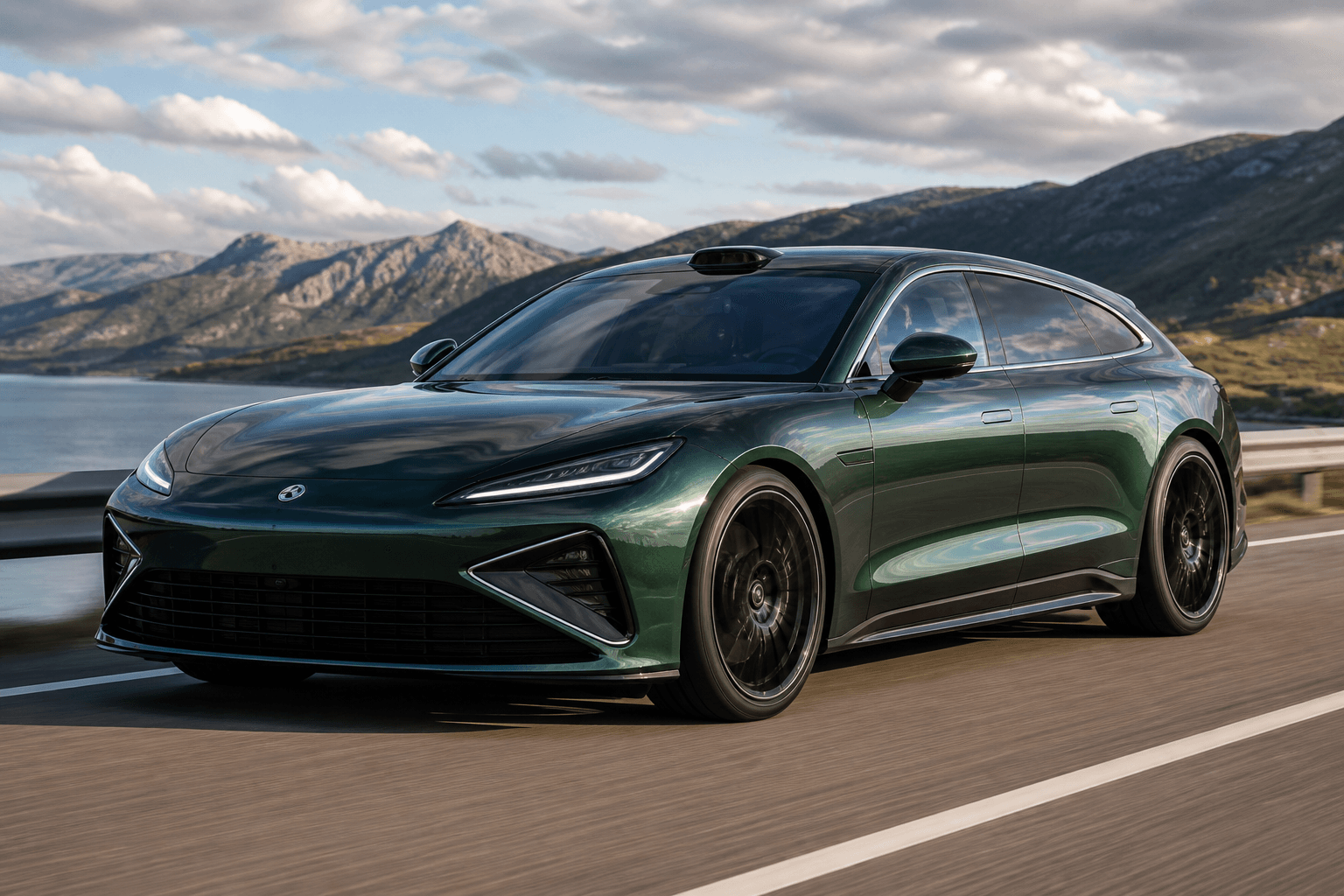
Visually, the Formula S GT follows the design language that BYD has recently emphasized more strongly with Denza. Notable features include slim LED headlights, sporty bumpers and a front end with an overall low-slung appearance. It also has semi-flush door handles, roof rails and a small ducktail spoiler.
From a technical perspective, the roof-mounted LiDAR stands out in particular. The sensor indicates that BYD is not relying on cameras alone and is preparing the hardware for more advanced driver-assistance functions.
Interior: Large Central Display Plus Physical Buttons
In the cockpit, BYD combines a large, freestanding central display with a smaller driver display. The center console houses a wireless charging pad, two cupholders and a bank of physical buttons—useful for functions that drivers need to access quickly while on the road.
Gears are selected using a stalk on the steering column. Despite the model’s sporty positioning, the layout therefore appears to have been designed with everyday usability firmly in mind.
Driver Assistance: DiPilot 300 With NOA in Cities and on Highways
The Formula S GT supports BYD’s DiPilot 300, also known as “God’s Eye B” in China. It includes an NOA (Navigate on Autopilot) function for city streets and highways. An important point for Germany, Austria and Switzerland—the DACH region—is that the availability of such functions in Europe depends heavily on homologation, legislation and map coverage. If the model comes to these markets, its capabilities may therefore differ.
Dimensions, Battery and Powertrain: 5.03 Meters Long, Up to 490 kW
At 5,025 mm long, 1,967 mm wide and 1,483 mm tall, this is a full-size estate, placing it more in the same league as large executive models. A towing capacity of up to 500 kg is also listed, making it more suitable for light loads than heavy trailers.
| Variant | Powertrain | Power | Battery | Range (CLTC) |
|---|---|---|---|---|
| RWD | Rear-wheel drive | 300 kW | 92.093 kWh (LFP) | 800 to 850 km |
| AWD | All-wheel drive | 490 kW | 92.093 kWh (LFP) | up to 730 km |
Important context: CLTC is the Chinese test cycle and generally produces significantly more optimistic figures than WLTP in real-world use. For a more realistic assessment in Germany, Austria and Switzerland, the absolute range figure therefore matters less than the combination of a large LFP battery and an efficient powertrain, which could still deliver very solid long-distance performance in everyday use.
Fast Charging: 10% to 97% in Nine Minutes
The charging claim sounds particularly confident: With “Flash Charging,” the Formula S GT is said to charge from 10% to 97% in 9 minutes. That is extremely fast and, if reproducible under suitable conditions, would dramatically shorten stops on long journeys.
In practice, however, such a figure always depends on several factors: available high-power charging capacity, battery temperature, the charging curve and the specific charging standard used in each market. Numerous high-power networks are currently being built in China, while Europe remains more fragmented when it comes to very high charging rates. Nevertheless, the direction is clear: BYD continues to push hard to reduce charging times. In the same vein, the BYD Seal 06 with nine-minute charging and BYD’s 1,500 kW charging network suggest that BYD wants its fast-charging story to be more than just marketing.
Will the Electric Estate Come to Europe as a Denza?
A European launch has not been confirmed but is being discussed because the design points strongly toward Denza. It is therefore conceivable that the vehicle could be sold under the Denza brand outside China. That would be exciting for Germany, Austria and Switzerland because a large, fast electric estate could fill a gap currently occupied primarily by European manufacturers.
If BYD does enter this class in Europe, its positioning would also be interesting: Denza is generally regarded as the premium marque, while BYD itself targets a broader market. Readers interested in Denza’s wider expansion can also take a look at its large SUV: Denza N8 with Flash Charging.
Analysis: Why the Model Is Relevant to Tesla Fans Too
Tesla continues to shape how many people view electric mobility in everyday life: straightforward operation, strong efficiency and a reliable fast-charging ecosystem. A model like the Formula S GT shows that Chinese manufacturers are now competing on three fronts simultaneously: performance, battery technology (LFP) and charging time.
Whether BYD can deliver on these promises to the same extent in Europe will depend on charging infrastructure and the final specifications. As a signal to the market, however, the message is clear: electric estates designed for long-distance driving will become significantly more exciting again in 2026 and 2027.