Hyundai Ioniq 3 launches in Europe: compact, efficient and attractively priced
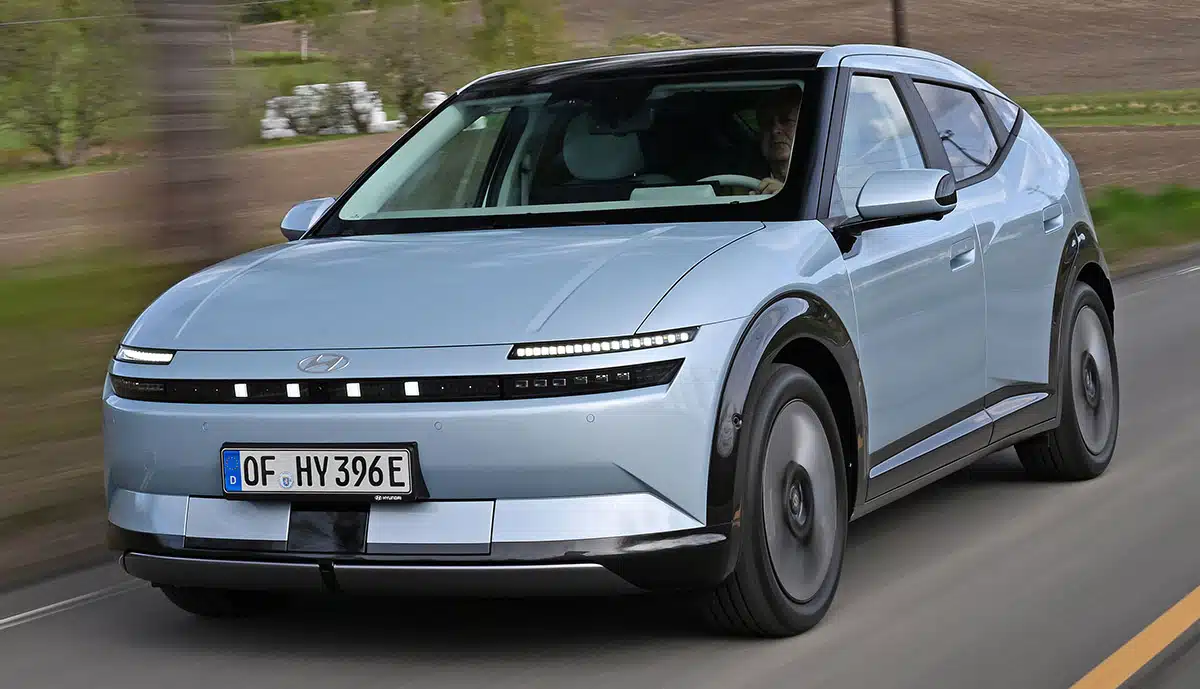
Hyundai is expanding the Ioniq family with the Ioniq 3, positioning it as a practical electric compact with a starting price of €28,950. The model is produced at the Izmit plant in Turkey and, according to the manufacturer, was developed specifically with European requirements in mind: compact exterior dimensions, effective use of interior space and low energy consumption.
Technically, the Ioniq 3 is based on the familiar E-GMP platform, which Hyundai also uses for larger models. Here, however, the focus is less on maximum performance and more on efficiency, aerodynamics and a practical body design that Hyundai calls “Aero Hatch.”
Two batteries, two characters: LFP for the entry-level model, NMC for greater range
Two battery sizes have been announced for the 4,155 mm-long Ioniq 3. The entry-level model uses an LFP battery, while a larger NMC version above it offers significantly more range. Both versions have a front-mounted motor.
| Version | Battery | Drive | WLTP range | DC charging | 0 to 100 km/h | Top speed |
|---|---|---|---|---|---|---|
| 42 kWh (Select, Trend) | 42 kWh LFP | Front-wheel drive, 108 kW | up to 344 km | up to 119 kW | 8.7 s | up to 171 km/h |
| 61 kWh (all trims) | 61 kWh NMC | Front-wheel drive, 99 kW | up to 497 km (estimated) | up to 119 kW | 8.7 s | up to 171 km/h |
Depending on the version, Hyundai quotes combined energy consumption of 13.7 to 14.1 kWh/100 km. That is a strong figure for this class, especially for commuters and anyone who does not drive at “full throttle” on the highway all the time.
Charging: up to 119 kW DC and optional 22 kW AC
DC fast charging is available at up to 119 kW. Under optimal conditions, the battery is expected to charge from 10% to 80% in around 29 minutes. That is not “ultra-high-power,” but in everyday use it is often exactly what matters for a compact EV: stop briefly, then continue driving.
AC charging will be particularly interesting to many people in the German-speaking DACH region—Germany, Austria and Switzerland. For the first time, Hyundai is offering an optional 22 kW onboard AC charger for the Ioniq 3. Anyone who frequently charges at AC stations, such as in city centers, parking garages or at work, can save time, provided the infrastructure supports 22 kW.
Interior and trunk: compact outside, spacious inside
Inside, Hyundai uses a long wheelbase, flat floor and its “Furnished Space” concept. The goal is clear: up to five people should be able to travel without feeling cramped in everyday use. Hyundai quotes 441 liters of luggage capacity, including storage beneath the trunk floor—a practical figure for families, sports gear and weekly grocery shopping.
Infotainment and features: Android Automotive, OTA and V2L
As the first European Hyundai model to receive the new Pleos Connect infotainment system, the Ioniq 3 uses Android Automotive OS. This is an important step because it integrates apps and services more deeply into the vehicle and typically allows updates to be rolled out more quickly and continuously.
Depending on the version, equipment includes Plug & Charge, over-the-air updates, Digital Key 2.0 and Vehicle-to-Load (V2L). In practice, V2L is particularly useful for camping, construction sites or emergency-power scenarios: charged car → external devices can be powered via an adapter or outlet.
If you are generally interested in everyday bidirectional functions, it is also worth looking at Hyundai’s strategic development in this field, such as the article on the new Hyundai-Kia brand for bidirectional charging.
Trim levels and packages: from Select to N Line Evo
The Ioniq 3 is available in five trims: Select, Trend, Prime, N Line and N Line Evo. According to Hyundai, even the Select trim includes full-LED headlights, front and rear parking sensors, a reversing camera, dual-zone automatic climate control and a 12.9-inch touchscreen with connected services.
Additional options and packages are also planned, including comfort, navigation, LED, technology and seat packages, as well as a panoramic glass roof. The Technology Package costs €1,650 and includes the 22 kW onboard charger, a Type 2 cable, a V2L adapter and a 230-volt outlet in the interior.
Market position: where the Ioniq 3 fits
With a starting price below €29,000, two battery sizes and modern software features, the Ioniq 3 is a fairly direct challenge to the mass-market segment. It will be interesting to see how the LFP and NMC versions are ultimately priced and which standard equipment Hyundai actually includes in its configurators for Germany, Austria and Switzerland.
Anyone comparing vehicles in this class should also consider other compact electric cars available in Germany in 2026. Our overview of electric compact SUVs for 2026 provides a useful guide, even though the Ioniq 3 is positioned more as a compact car with an “Aero Hatch” focus.
You can also find more about the model and the brand on our overview page for the Hyundai KONA, which is already regarded as a benchmark for practical Hyundai electric mobility in many DACH company fleets and private garages.