Hyundai Bets on Growth, Electrification and AI Through 2030
At its 2026 CEO Investor Day, Hyundai presented an ambitious roadmap through 2030. The group is targeting annual sales of 5.55 million vehicles, equivalent to around 6% of the global market. At the same time, the share of electrified vehicles in its sales mix is expected to rise to 60% by the end of the decade, up from 23% in 2025.
For those of us in the DACH region—Germany, Austria and Switzerland—the key question is how much emphasis Hyundai is placing on Europe. The company has announced a major product offensive, including numerous new model launches and facelifts, and explicitly says that a large share of the planned launches will be aimed at Europe.
Product Offensive: New Segments, More EVs and a Range Extender
According to Hyundai, more than 100 product launches and model updates are planned by the end of the decade. Several new vehicles are due to arrive in the next few months alone. Notably, Hyundai is also positioning new models as entries into segments where the brand has previously had less of a presence, including a midsize pickup and light commercial vehicles.
From a technology perspective, Hyundai’s announcement of its first electric car with a range extender is particularly interesting. The concept is planned for 2027, with a projected total range of more than 960 km and production in Alabama in the United States. This is not yet a firm commitment for Europe, but it clearly shows that Hyundai intends to pursue very different powertrain strategies in parallel depending on the market: fully electric, hybrid and EREV, or range-extended electric vehicle.
Performance models also remain part of the plan. The N range is set to expand further, and Hyundai is maintaining its target of selling 100,000 units annually in this segment by 2030.
Battery Strategy: Lower Costs While Charging Faster
Hyundai is linking its electrification target to a clear focus on costs: better EVs should become cheaper to manufacture. The automaker identifies several levers that point in two directions: high-end technology for selected models and cost-optimized cell chemistry for high-volume vehicles.
| Component | What Hyundai Is Announcing | Practical Effect |
|---|---|---|
| Proprietary high-performance cells | More than twice the power of previously used cells, with charging time reduced by 40% (not for all vehicles) | Potential for noticeably shorter charging stops, especially in premium models or technology flagships |
| Mid-nickel NMC cells | For new EV models starting next year, with battery costs around 30% lower | Greater price pressure in the mass market without necessarily making major compromises on range and performance |
| Cloud-based battery management system (BMS) | Further development is expected to extend average battery life by 20% by 2028 | Greater long-term stability, potentially better resale values and less range loss over the years |
The BMS approach is especially relevant in everyday use: when cell monitoring, temperature control and charging profiles work together effectively, battery degradation during daily operation typically decreases. That is not as flashy as “charge in X minutes,” but it determines how a battery feels after five to eight years.
Safety: Thermal Runaway Protection Designed to Stop Heat Transfer
Hyundai is also highlighting a new safety technology: an advanced Thermal Runaway Protection system designed to prevent heat from spreading to neighboring cells in the event of a battery fire. According to the manufacturer, the crucial point is that the concept is not merely intended to “buy time,” but to block the spread directly at the source, regardless of battery type.
The technology is set to debut in Genesis models, initially placing it in the premium segment. This is typical, as new cell and safety concepts often enter series production there first before later reaching high-volume models.
European Strategy: “Fully Electrified” and Higher Volumes
For Europe, Hyundai is promising a fully electrified model portfolio, specifically including five SUVs and light commercial vehicles. The sales target is ambitious: an increase from 116,000 EVs in 2025 to more than 420,000 units by 2030.
One element of this plan is the Hyundai Ioniq 3, which Hyundai says will be built in Turkey and is expected to offer just under 500 km of electric range at launch. For buyers in Germany, Austria and Switzerland, this is particularly interesting because local production and high volumes often improve vehicle availability.
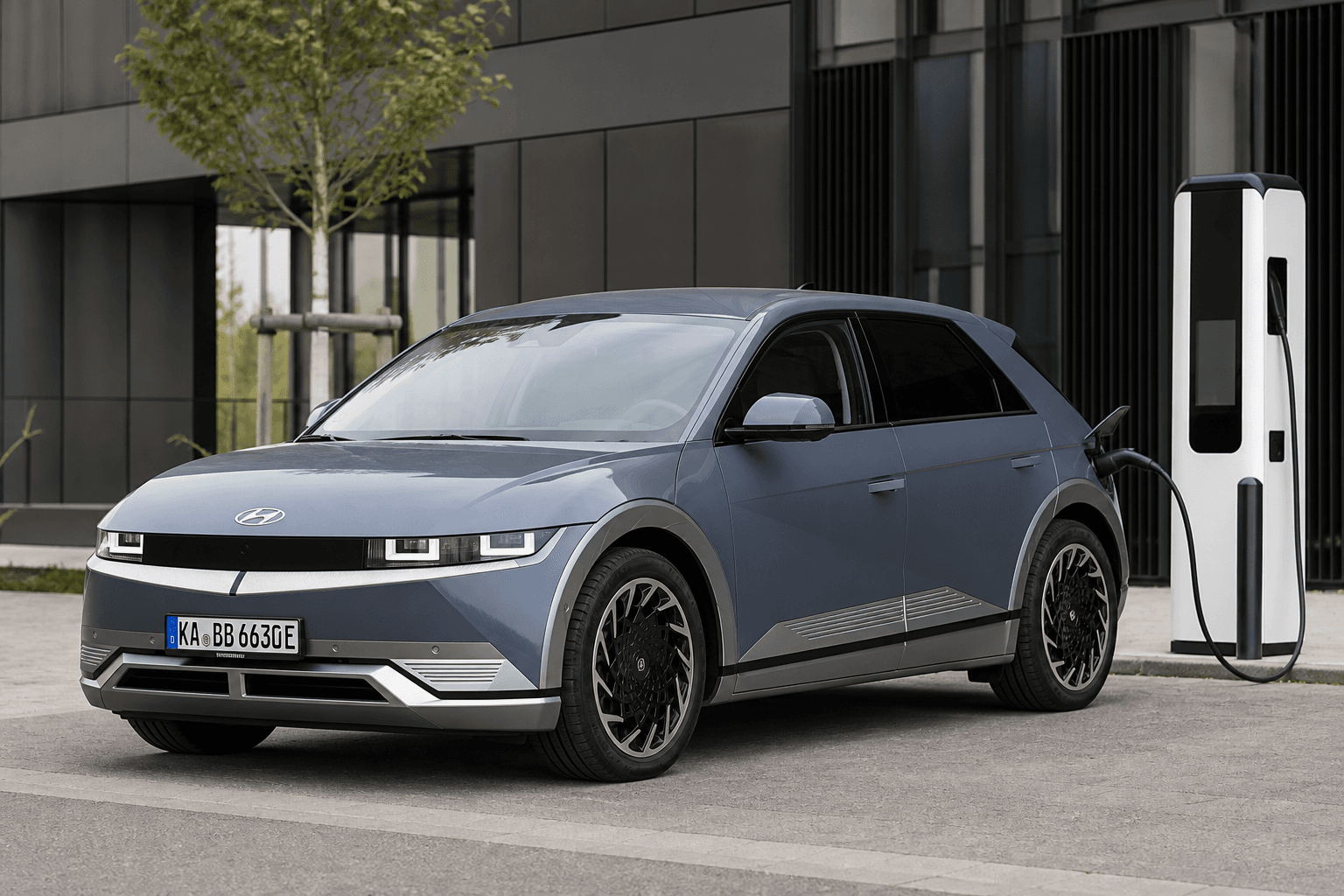
To put Hyundai’s current EVs into context, it is also worth looking at the Hyundai IONIQ5 as a reference for how Hyundai already combines range, charging performance and everyday usability.
North America and India: Localization to Reduce Costs and Tariff Exposure
In North America, Hyundai wants to increase local parts sourcing to 80% by 2030. This is not only a matter of industrial policy but also a major business lever, as it makes supply chains more stable and reduces the impact of potential trade barriers. In the United States, Hyundai also sees hybrid models as a key growth driver and highlights a target operating margin of more than 9% for 2030.
In India, Hyundai is placing even greater emphasis on localization: by 2030, 90% of components are expected to be sourced locally. With annual production capacity of 1.1 million units, India also remains an important export hub for Hyundai.
Robotaxis, Autonomous Driving and AI: Waymo, Nvidia and a Dedicated Data Center
Hyundai is closely linking its outlook to software, AI and robotaxis. In autonomous driving, the group is working with Waymo, among others, which plans to begin using robotaxi models based on the Ioniq 5 in 2027. At the same time, Hyundai’s mobility subsidiary Motional is also planning to use the model for driverless services.
On the technology side, Hyundai intends to standardize its sensor architecture around the Nvidia ecosystem so that data is collected consistently. A large, dedicated AI computing center—the “Saemangeum AI Data Center”—is then scheduled to begin operating in 2029. The goal is to enable autonomous driving functions from Level 2+ through Level 4, ranging from advanced driver assistance to highly automated operation in clearly defined environments. If you are interested in the topic more broadly, our overview of FSD, HW4 and Tesla’s AI approach offers a useful comparison, as the industry is currently pursuing the goal through very different strategies.
Genesis: Expansion, New Plants and Technology as a Testing Ground
Genesis is expected to continue growing as a luxury brand and operate in more than 40 markets by 2030. A new plant in Ulsan, South Korea, is intended for EVs and is set to take over production of the GV90. Hyundai says it will feature software-defined technology, AI-assisted quality control and an AI agent for manufacturing.
Further expansion has also been announced for Europe, including additional markets from 2026. For everyday ownership in the DACH region, this primarily means that a denser network of sales and service locations is essential if premium EVs are to be not only technologically impressive but also hassle-free to own.
Assessment: What Will Actually Affect EV Fans in the DACH Region?
Hyundai’s plan does not look like a single model announcement but rather a modular strategy: cost-reducing cell chemistry for high-volume models, high-end cells for flagships, plus cloud-based BMS technology to extend battery life and a cell-level safety upgrade. If Hyundai can truly scale the 30% reduction in battery costs to mass production, it is likely to put noticeable downward pressure on prices in Europe over the medium term.
When it comes to autonomous driving, one thing is clear: robotaxi projects often launch first in the United States because regulations and pilot zones can sometimes be established more quickly there. Nevertheless, European customers often benefit indirectly, as sensors, computing platforms and data pipelines later make their way into production vehicles.
And for anyone who immediately sees a “range extender” as a step backward: in practice, an EREV can serve as a bridge in regions with sparse charging infrastructure. In Central Europe, where the fast-charging network continues to grow, a good battery-electric vehicle with solid DC charging performance remains the more obvious choice for many people. Our guide to 800V vs. 400V can help you assess which charging architecture really makes a difference in everyday use.