BYD combines solar power and electric mobility, selling PV kits through 233 dealerships
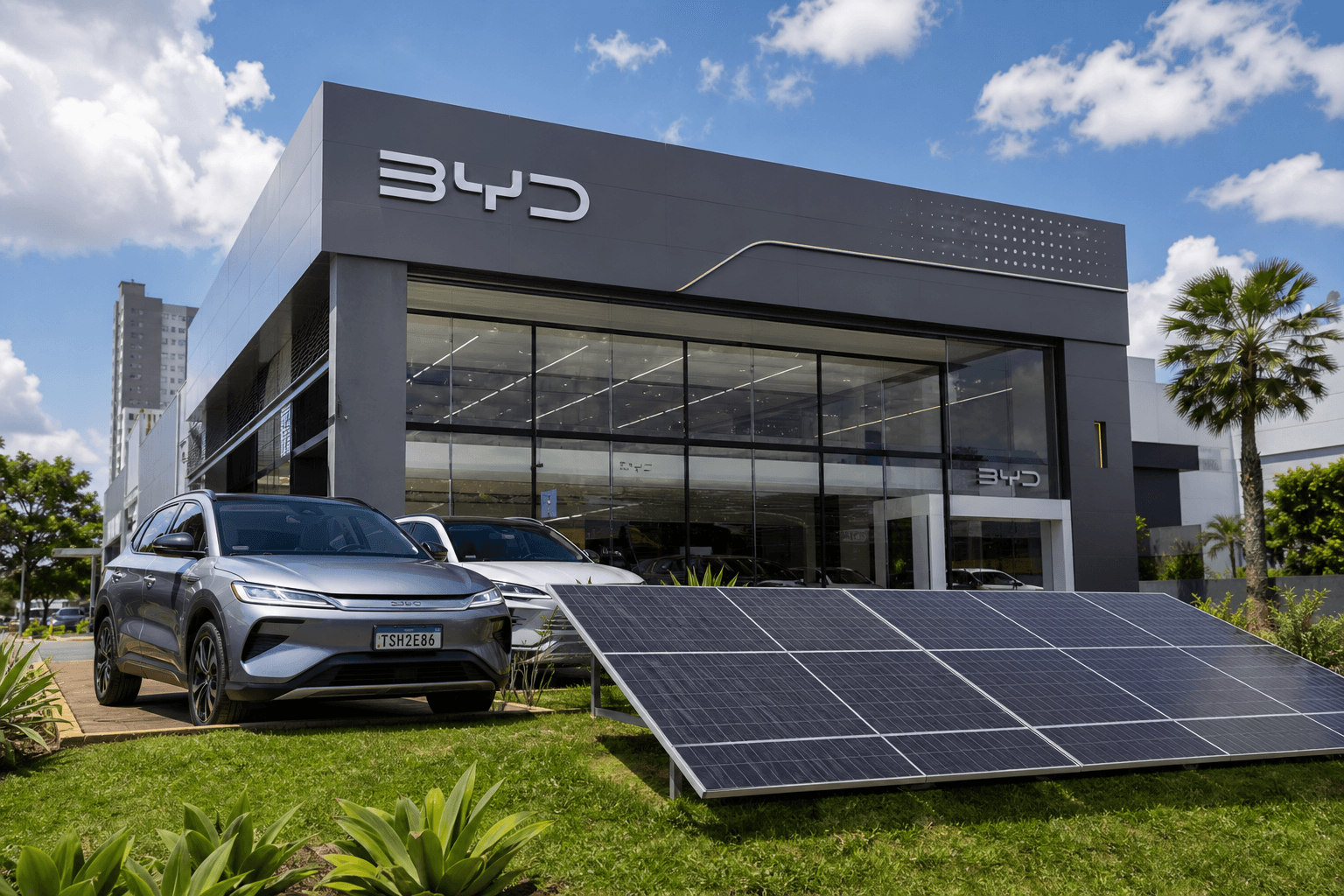
BYD is visibly expanding its energy business in Brazil and is now selling complete residential solar kits through 233 dealership locations. Notably, the offer is not limited to BYD customers but is explicitly available to all households, regardless of whether they own a vehicle.
For BYD, this is a logical step, as the company has long worked not only on cars but also on energy solutions. This is now becoming particularly tangible in Brazil, where sales, installation, and administrative formalities are handled through the existing dealership network.
How the solar kit is configured: 4.8 kWp as the standard package
The package has been deliberately standardized. It consists of eight PV modules rated at 600 W each, providing a total installed capacity of 4.8 kWp. It also includes an inverter, mounting structure, cables, and connectors.
BYD estimates average electricity generation of around 600 kWh per month, depending on location, roof orientation, shading, and weather. In practical terms, this output could cover a large share of a household’s electricity consumption and allow at least some home EV charging to be powered by its “own” generation, depending on driving patterns and charging times.
One contract instead of multiple contractors: installation, grid approval, and insurance
Unlike many conventional PV offers, BYD combines several steps in a single contract. It includes equipment, installation, certification or approval by the local grid operators, and one year of insurance.
This one-stop-shop approach is the real advantage: anyone who has compared PV offers knows that the modules are not the problem—it is the coordination, scheduling, and paperwork. BYD is using its dealership network as a process engine here, much as it does for vehicle sales.
Local production in Brazil: modules from Campinas
According to the company, the components are sourced from local production. BYD manufactures photovoltaic modules in Campinas, in the state of São Paulo. Its module production line is said to have a capacity of 0.5 GW, while cumulative production reportedly surpassed 2 million units as early as 2022.
This matters for the market because local manufacturing typically stabilizes delivery times and reduces currency-related pricing risks. It also fits BYD’s strategy of increasingly producing in Brazil rather than merely selling there.
Price and financing: Around BRL 19,000 for the kit
BYD puts the total cost of the solar kit at around BRL 19,000. Alongside the launch, financing is available through a bank for both new-car buyers and existing vehicle owners, regardless of brand.
The terms depend on the financing option selected. For prospective buyers, the key point is that BYD is selling the PV system like a consumer product at a car dealership: a monthly payment instead of a one-time investment. Whether it pays off in each individual case will depend primarily on electricity prices, solar yield, the share of electricity consumed on-site, and the applicable financing costs.
Why BYD is doing this and what it means for the DACH region
In the DACH region—Germany, Austria, and Switzerland—PV is already mainstream, but sales are usually handled by specialized solar companies, energy suppliers, or installation contractors. Nevertheless, the Brazilian model points to a trend that could become more relevant here as well: automakers acting as one-stop providers of EVs plus energy, backed by tightly coordinated processes.
It remains unclear whether BYD will bring a similar dealership model to Germany, Austria, or Switzerland in the medium term. What is clear, however, is that anyone seeking to scale electric mobility cannot ignore home energy, as charging at home is rarely beaten in terms of cost, convenience, and predictability.
BYD is using its car dealership network as a sales channel for solar power, turning PV into a product that can be purchased almost as conveniently as a new car.
Also of interest in the BYD ecosystem
At the same time, BYD is continuing to advance its charging and battery initiatives, including high-power charging. One recent example is the expansion of its own fast-charging network with extremely high charging rates: BYD is building a 1,500-kW charging network.
If you are more interested in BYD’s vehicles in Europe, it is also worth taking a look at the BYD Seal and the BYD Seal U. And in the compact segment: BYD Dolphin Surf.