What Model Y L Drivers in China Are Reporting
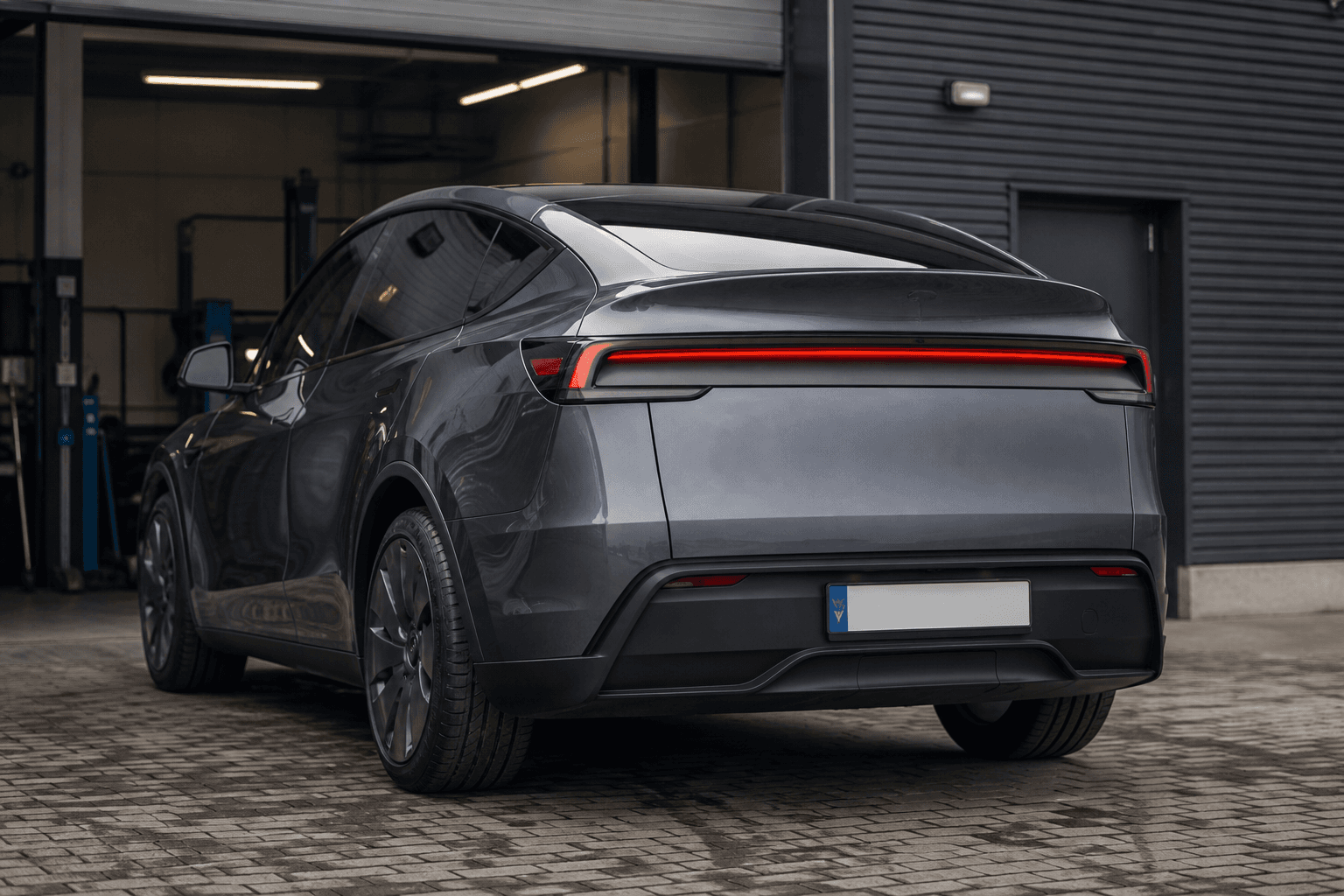
Reports are emerging on Chinese social media that the rear suspension on some Tesla Model Y L vehicles visibly sags over time. The gap between the rear tires and wheel arches is said to become significantly smaller, in some cases particularly after extended use or when the vehicle is heavily loaded.
In addition to reduced ground clearance, affected owners describe less stable handling. There are also reports of uneven tire wear, which would be consistent with altered rear-axle geometry if the vehicle’s ride height decreases permanently.
The Criteria Tesla Apparently Uses for Its Assessment
According to owners, Tesla is said to use a reference value of 784 mm for the rear wheel-arch height. A range of plus or minus 20 mm is reportedly still considered normal. In the cases described, the springs were replaced when the measurement fell below 764 mm.
Importantly, these figures currently come from owner reports and are not part of any publicly confirmed service guideline. Nevertheless, they provide an indication of how Tesla may be assessing the issue in practice: using a simple, reproducible height measurement rather than subjective impressions.
Why Replacing the Springs May Not Address the Root Cause
Several reports suggest that replacing the springs does not always resolve the problem permanently. In at least one case, the sagging is said to have returned after around 10 days. If this is confirmed on a larger scale, it is conceivable that not only the spring itself but also load scenarios, damper tuning, mounting points or the overall rear-axle design could play a role.
At present, however, there is no confirmed information about the underlying technical cause. It is also unclear how common these cases actually are. Individual social media reports may sound dramatic, but without reliable vehicle numbers, they reveal little about whether these are isolated cases or a systemic issue.
When Do Owners Say the Problem Occurs?
The reports describe the issue appearing both after relatively low mileage and at a later stage. One driver is said to have noticed severe sagging after around 9,000 km while traveling with the vehicle fully loaded. Another reported symptoms after nearly 30,000 km.
With the Model Y L in particular, it is reasonable to ask how additional seats, potentially higher payload expectations and weight distribution affect the rear axle. A longer wheelbase and a different mix of usage profiles involving families, luggage and longer trips may simply place different demands on components than the standard Model Y does.
What This Means for Germany, Austria and Switzerland
The Model Y L is a long-wheelbase, six-seat variant that was launched first in China and has since been introduced in additional markets. Model Y vehicles for Europe are currently supplied by Tesla’s factory in Grünheide, Germany, and the L variant is not yet part of regular production there.
For buyers in the DACH region—Germany, Austria and Switzerland—the issue is therefore primarily of interest as an early indicator. If Tesla later brings the Model Y L to Europe, reliable data from China could provide important evidence of whether changes to the springs, dampers or rear axle are needed.
What Drivers Can Check
Anyone who suspects that the rear end of a Model Y—whether the L or standard version—is sagging should take a pragmatic approach. A simple visual inspection is useful, but ultimately what matters is a measurement at defined points and a wheel-alignment check, because incorrect toe or camber can quickly lead to costly tire damage.
- Measure and document the rear wheel-arch height on the left and right while parked on level ground
- Check for uneven tire wear, with greater wear on either the inner or outer edges
- If anything appears unusual, request a wheel-alignment check from a service center before new tires are needed
If the ride height decreases permanently, the issue is not merely cosmetic—it also affects suspension geometry, stability and tire wear.
Why This Is Not Automatically a Widespread Tesla Problem
Suspension problems can occur with specific production runs or configurations from any manufacturer, especially when variants are new or user profiles differ significantly. Tesla is known for modifying hardware during production once patterns emerge. Whether this is genuinely a broader trend can only be assessed once more cases have been properly documented and Tesla has issued an official statement.
A comparison with other Model Y variants will also be interesting. Readers interested in real-world range and everyday testing can also find our article on the Tesla Model Y L range test, as well as a look at the 2026 highway efficiency test featuring the Tesla Model Y.