Volvo launches its biggest-ever model offensive
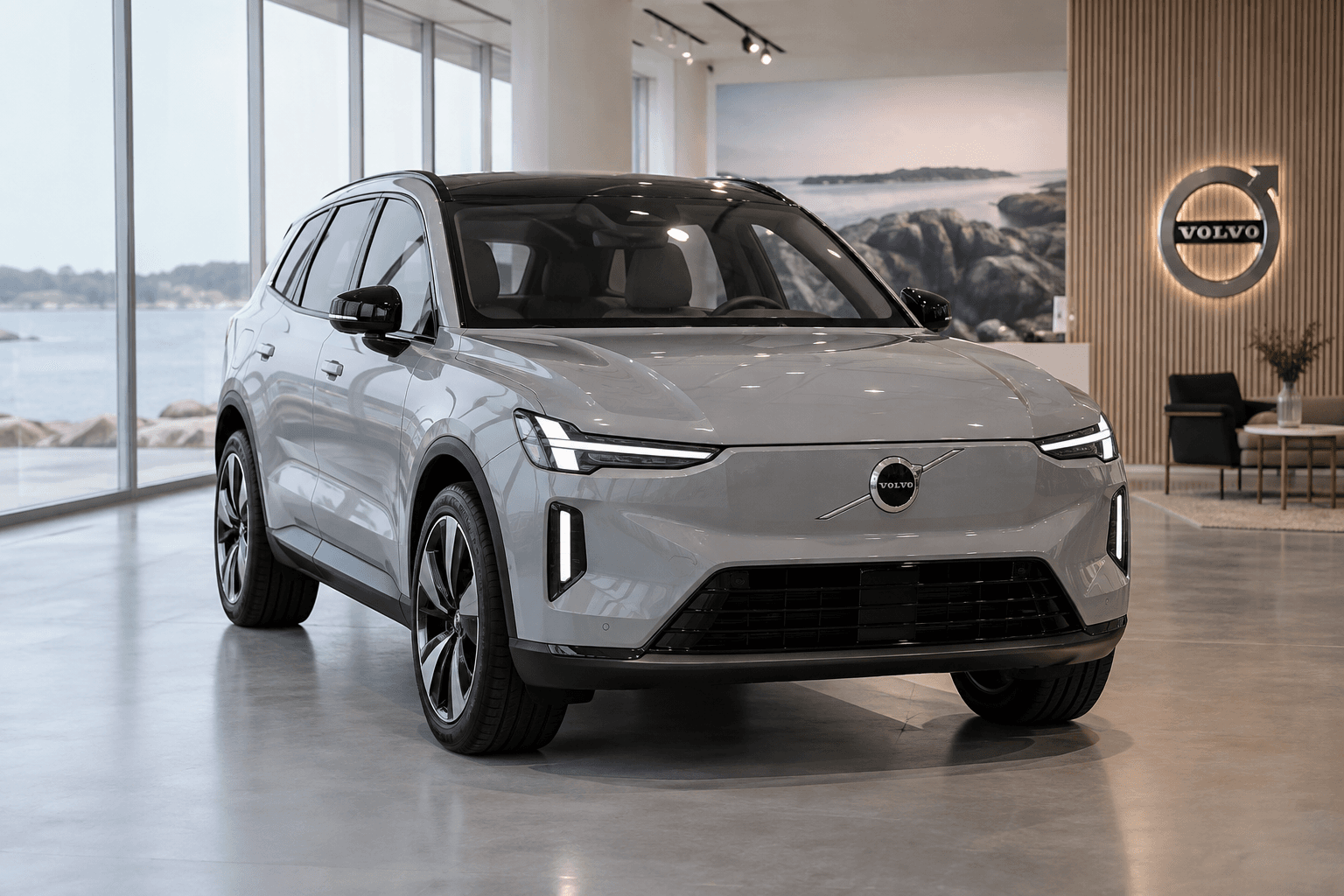
Volvo plans to launch a total of 13 new models by the end of 2030. According to the manufacturer, this is the largest product offensive in the company's nearly 100-year history.
The program includes new electric cars as well as third-generation hybrids. Volvo aims not only to renew its portfolio but also to double its global market share.
By 2030, Volvo showrooms are set to change fundamentally, with more region-specific models and a clear focus on electrified powertrains.
Europe, the US and China will get different cars
Volvo will pursue a more regional product strategy in the future. Europe and the US are set to receive new models based on the company's own architectures, while dedicated vehicles using technology from the Geely Group will be developed for China.
| Region | Planned number | Technical basis | Focus |
|---|---|---|---|
| Europe and the US | likely 6 to 7 models | SPA2, SPA3 and HuginCore | Electric cars and new hybrids |
| China | 6 models | Geely platforms and a dedicated China technology stack | Local requirements and cost advantages |
The exact breakdown remains unclear: Volvo has announced a total of 13 new models, while six models have so far been allocated to China and, depending on the account, six or seven vehicles to Europe and the US. The complete model plan has therefore not yet been made public.
In China, shared components, platforms and supply chains are intended to reduce costs. At the same time, Volvo can tailor infotainment and digital services more closely to local expectations.
SPA2 and SPA3 introduce 800-volt technology
The SPA2 and SPA3 platforms are particularly relevant to Western markets. SPA2 already provides the technical foundation for the EX90 and ES90, while SPA3 advances to the next stage of development with the EX60.
Both architectures support 800-volt battery systems and high charging rates. Our comparison of 800-volt and 400-volt architectures in electric cars explains why this technology offers particular benefits for larger batteries and long-distance driving.
In everyday use, the higher voltage can enable lower current at the same power level. This facilitates efficient fast charging and can allow for thinner cables and improved thermal management, although actual charging time still depends on the battery, charging curve and preconditioning.
New software platform for regular updates
Volvo is also introducing the centralized HuginCore computing platform. This will make its vehicles more software-defined, allowing them to receive features and optimizations via over-the-air updates.
For customers in Germany, Austria and Switzerland—the DACH region—the key question is how reliably Volvo will maintain this architecture over many years. A powerful hardware foundation is important, but it will deliver genuine value only through continuous, thoroughly tested software updates.
EX50, sedan and wagon under discussion
One potential new model is the compact Volvo EX50 with SPA3 technology. It could fill the gap between the Volvo EX30 and the larger EX60, although its final positioning has not yet been confirmed.
There are also indications that an electric sedan and an electric wagon could be offered from 2028. The long-established S60 and V70 names are being discussed, but have not yet been officially confirmed.
An electric wagon would be particularly interesting for Germany, Austria and Switzerland. The selection in this segment remains considerably smaller than for electric SUVs, even though company-car drivers and families are looking for traditional wagons.
Hybrids remain part of Volvo's strategy
Despite its strong focus on electric vehicles, Volvo is not abandoning hybrid powertrains in the near term. Third-generation hybrids are intended to serve customers and markets where charging infrastructure, prices or usage patterns still make a complete transition more difficult.
This is especially relevant to the US and certain other international markets. In Europe, by contrast, the focus is likely to shift increasingly toward fully electric cars based on SPA2 and SPA3.
Model offensive aims to increase sales and margins
The portfolio expansion follows a decline in sales. Volvo's global sales most recently fell by 11% in the first quarter and 5.6% in the second quarter compared with the respective prior-year periods.
Volvo aims to double its market share by 2030. At the same time, it is targeting an operating EBIT margin of more than 8%, up from 3.5% in 2025.
The company is also changing its sales model to achieve this. More transparent pricing, less complicated offer structures and preconfigured vehicles for rapid delivery are intended to simplify the purchasing process.
An ambitious plan with a strong technological foundation
Launching 13 models within a few years is an ambitious program. However, sharing technology and supply chains with Geely could help Volvo limit development costs and bring new models to market more quickly.
For Europe, the combination of 800-volt technology, a centralized software architecture and additional body styles is particularly promising. The key will be whether Volvo can turn these elements into competitive prices, short delivery times and a stable software experience.