Tesla Robotaxi: Why fewer Model Ys are currently joining the fleet
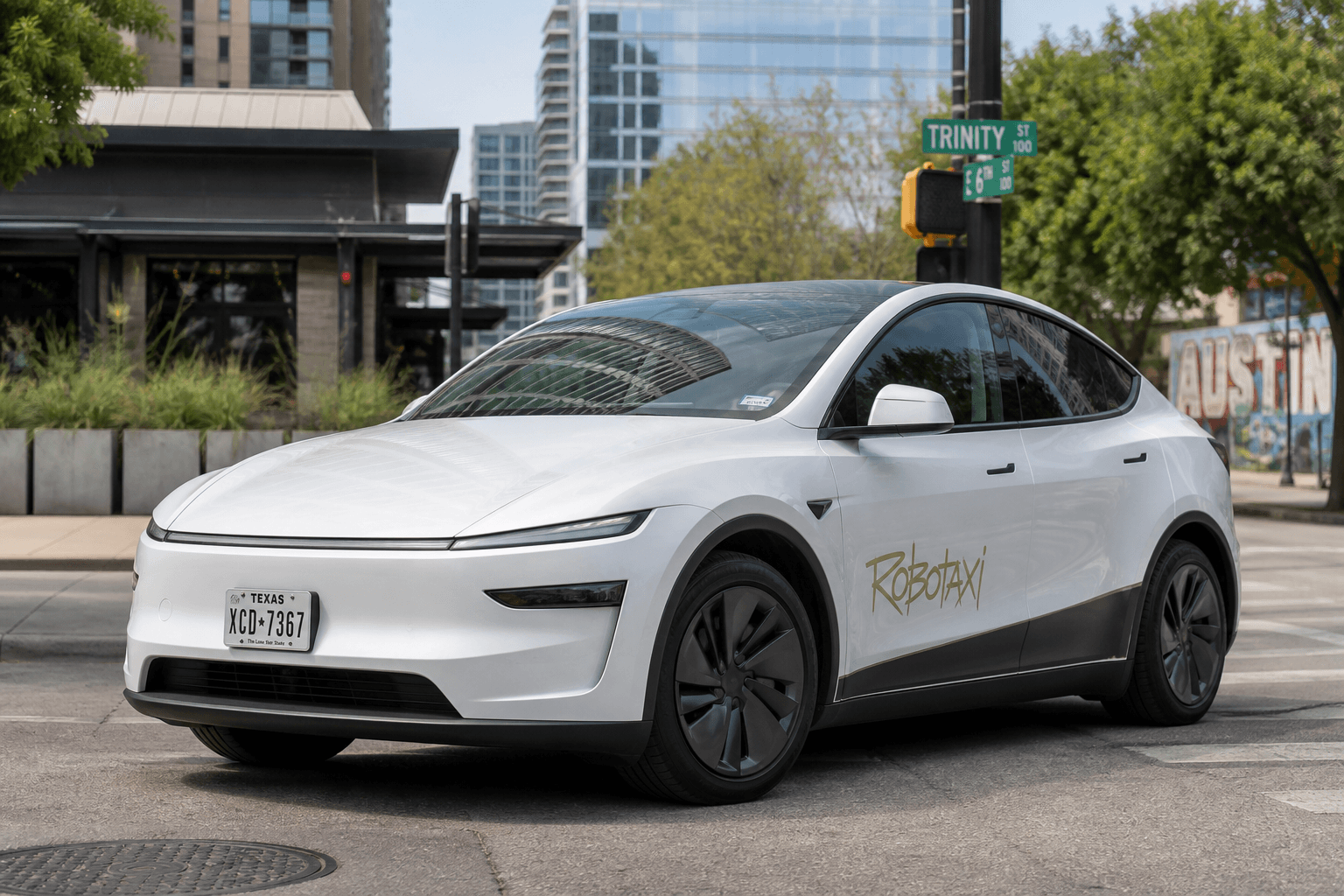
Tesla is currently making it clear to investors that it is deliberately not expanding the Robotaxi fleet with additional Model Ys. The reasoning appears strategic: Instead of adding more “conventional” vehicles, Tesla wants to bring the Cybercab into the mix soon. However, a new vehicle also means new sensor and driving-dynamics profiles, requiring training and validation from the ground up.
For drivers in the DACH region—Germany, Austria and Switzerland—this is particularly interesting as a signal: Tesla is not relying on software alone for its Robotaxi plans, but on a change in hardware and vehicle platform that could significantly accelerate scaling once it is ready. At the same time, this means the current Model Y-based Robotaxi rollout is more of an interim step than the endgame.
FSD v15 is already running in Robotaxis, apparently on HW4
FSD v15 is no longer just an item on the roadmap. According to newly disclosed information, Tesla is already testing the system in Robotaxis. Some of the changes are reportedly being trialed in real-world operation before v15 receives a broader rollout.
Importantly, Tesla assumes that Hardware 4 is the baseline required to run FSD v15, including “unsupervised” capabilities in the Robotaxi context. That does not automatically mean every customer vehicle with HW4 will immediately drive autonomously, but it underlines that Tesla considers the current platform powerful enough and that v15 does not necessarily require an entirely new hardware generation.
If you are interested in the current development of Robotaxi, we have already summarized the topic with specific figures and an assessment of what it means for Model Y drivers here: Tesla Robotaxi with FSD v15 and “unsupervised” miles.
What is expected to be technically new in FSD v15
Tesla says v15 includes several fundamental improvements and describes the leap as being on a scale comparable to previous major releases. Of particular interest, v15 is expected to include a model with around 10 billion parameters. It had previously been expected sooner, but is now explicitly scheduled to arrive with this version.
In practice, a step like this is primarily intended to improve generalization: fewer behavioral “special cases,” more stable decisions in complex situations and more robust handling of rare events. In short, fewer surprises at the limits of the system—something that is crucial for Robotaxi operations.
AI4+: 10% more computing power, but above all significantly more memory
Alongside the software, Tesla has also discussed the next tier of its FSD hardware: AI4+, often also referred to as HW4.5. The key figures are around 10% more computing power, measured in FLOPS, and approximately twice as much memory as AI4.
The memory is the real story here. More RAM enables longer “context windows” and larger networks without requiring aggressive compression. This could directly affect Robotaxi performance because the system can consider a longer sequence of events and more hypotheses in parallel instead of discarding them early.
If Tesla does indeed use AI4+ in the Cybercab, it would provide a clear explanation for its current fleet strategy: Do not keep expanding the Model Y fleet, but wait for the new vehicle and its matching hardware → then scale up.
Cybercab launch in Austin: Event announced, date still open
Tesla has also announced a Cybercab launch event in Austin, although it has not yet provided a public date. A contest is being held in connection with the event, with entry deadlines ending shortly after August 23 and winners expected to be selected soon afterward. This suggests that Tesla does not intend to delay the event indefinitely, even though no official calendar date has been announced.
The timing also fits with the information about v15: A new Robotaxi vehicle needs more than a design—it also requires a trained and stable version of the software stack. The fact that v15 is already being tested in the field looks like preparation for precisely this step.
Assessment: What does this mean for Tesla fans and the DACH market?
For Germany, Austria and Switzerland, Robotaxi will primarily remain a technology topic in the near term because regulatory approvals, liability issues and operating models work very differently there than in US cities. Nevertheless, Tesla’s direction is relevant: If the company first hardens v15 and AI4+ through its Robotaxi program, customer vehicles typically benefit later from improvements in stability and comfort, even if “unsupervised” operation is not enabled immediately.
Anyone already using Tesla’s technology stack can find the basics on the current models in our database, including the Tesla Model Y and the Tesla Model 3. And if you are generally interested in the underlying hardware, we discuss the debate surrounding “distilled” models on HW4 and the Cybercab’s role as a training platform here: Tesla HW4 and slimmed-down FSD models.
Ultimately, Tesla’s plan looks less like hesitation and more like a platform transition: harden v15, prepare AI4+, introduce the Cybercab and only then begin scaling in earnest.