New Tesla Charging Hub in Austin: V4 First, Wireless Later
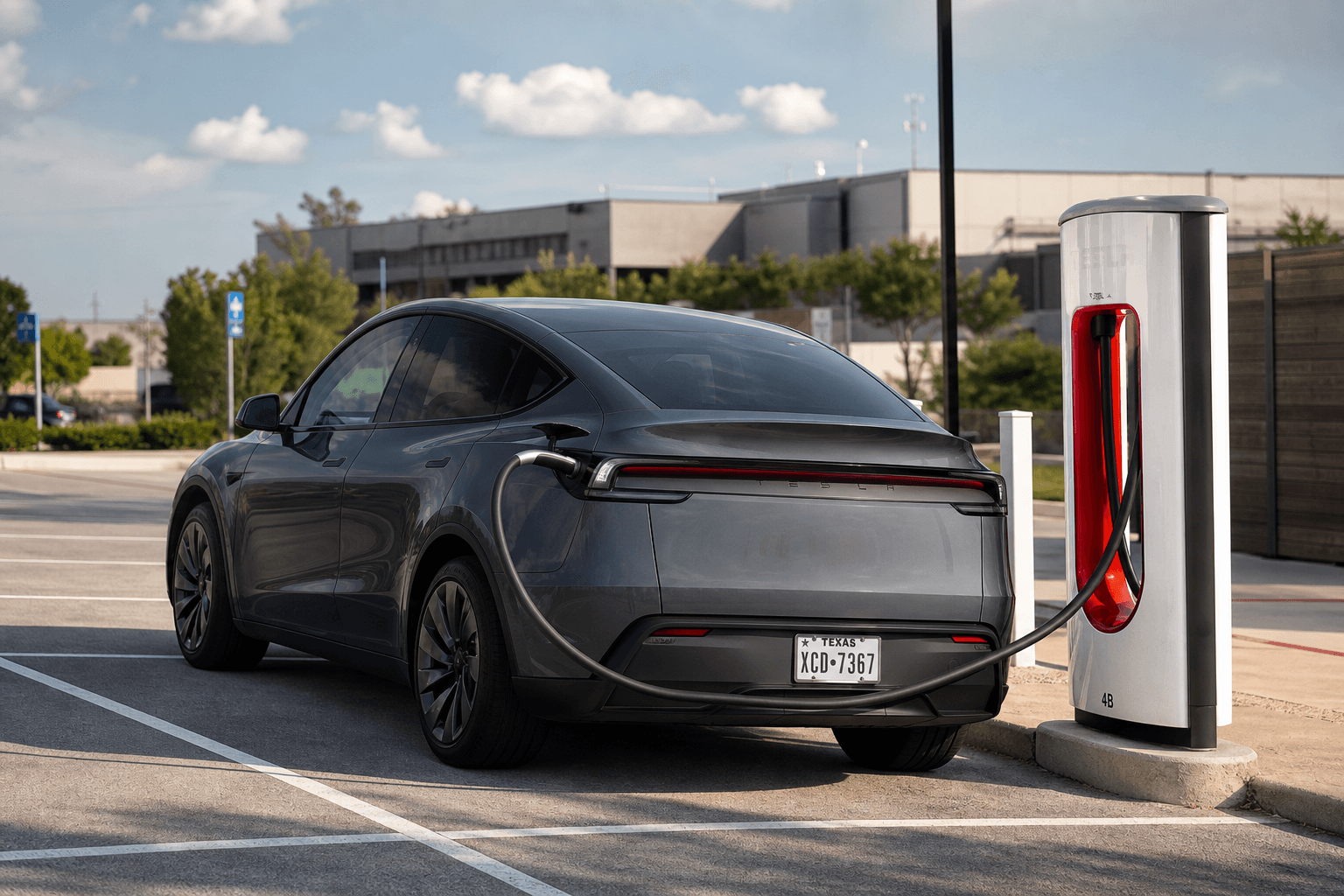
Tesla is preparing another large charging site in Austin, Texas. Construction documents for a new Supercharger at 405 E. St. Elmo Road describe a two-phase project: Phase 1 provides for 48 V4 Supercharger stalls. Phase 2 also lists equipment intended to support up to 80 wireless chargers.
For the DACH region—Germany, Austria and Switzerland—this is particularly interesting as a signal of Tesla’s technology and strategy. If Tesla really deploys wireless charging on a broad scale, it could become a key component for automated fleets in which no one has to connect or disconnect cables. The concept is still barely tangible in Europe, but sites like this show where things may be heading.
The Site Is Apparently Already Used by Tesla
According to the plans, the location is not an entirely new greenfield project. The site is said to be an area already used by Tesla for logistics, including indications of a vehicle transport pickup and drop-off point. The documents therefore describe the work as an upgrade to an existing Tesla parking lot.
Alongside the charging infrastructure itself, the plans include typical site components such as transformers, lighting, security cameras and Wi-Fi access points. Overall, it appears to be a charging hub designed for high throughput and highly streamlined operations.
Phase 1 in Detail: 48 V4 Stalls With V3.5 Cabinets
In the first expansion phase, 12 V3.5 Supercharger cabinets are expected to supply the 48 V4 charging points. Tesla is increasingly using V4 stalls as its standard because they are designed for future expansion stages, greater durability and often improved cable design and handling.
In practical terms, the site could meet conventional charging needs in the near term, for example for test fleets, internal logistics, service vehicles or robotaxis already operating on the Model Y platform. You can find more information about the model in our database entry for the Tesla Model Y.
Phase 2: Hardware for 80 Wireless Chargers and What It Could Mean
The most striking detail appears in the site plan notes: Tesla specifies a V4 charging unit explicitly intended to support 80 wireless charging points. Importantly, this is currently a planning detail from construction documents, not a guarantee that exactly this number of wireless charging pads will be installed and put into operation anytime soon.
From a technical perspective, wireless charging could be a game changer for a robotaxi fleet: a car drives itself onto a charging pad, charges automatically and then leaves. No staff, no repositioning vehicles and no “the cable isn’t connected properly.” This automation is precisely why wireless charging features so often in robotaxi concepts, even though it has remained a niche solution for private customers so far.
V4 stalls could serve as the interim solution, with wireless charging as the final expansion stage for automated fleets.
Why the Timing Stands Out: Cybercab and the Robotaxi Strategy
The plans have emerged just as Tesla is publicly preparing its next steps involving Cybercab and robotaxis. A large, pre-equipped charging hub in Austin fits this picture because Austin is a major Tesla location and is well suited to pilot programs, internal fleets and events.
Tesla’s decision to use conventional V4 charging points in Phase 1 is logical: they can immediately serve today’s vehicles. Phase 2, with wireless charging, would then provide infrastructure that only delivers its full benefits as the number of autonomous vehicles grows. We have also examined how Tesla is developing autonomous systems on its platform in the context of hardware and model sizes: Tesla HW4 and “stripped-down” FSD models.
What It Means for Germany, Austria and Switzerland
For the DACH region, this is still primarily a glimpse into the future. Large-scale wireless charging requires not only suitable technology and costs but also standardization, regulatory approvals and a clear use case. Its benefits for private drivers are limited as long as plugging in a charging cable takes only a few seconds. For fleets and robotaxis, however, the calculation changes because every minute of downtime and every manual task is multiplied across the entire operation.
Anyone wondering how much charging infrastructure and speed really matter in everyday use can find a useful comparison of architectures and charging performance in our article 800 volts vs. 400 volts: Which EV architecture you need in 2026.
What We Can Take Away From This
Tesla is planning a charging site in Austin that will initially provide conventional high-throughput charging with 48 V4 stalls while leaving the door open for 80 wireless charging points. If Tesla deploys wireless charging on this scale, it would be less of a convenience feature for private customers and more of an infrastructure solution for automated mobility. It would be a highly logical next step for Tesla’s robotaxi strategy.