Tesla App Offers Clues About Optimus Gen 3
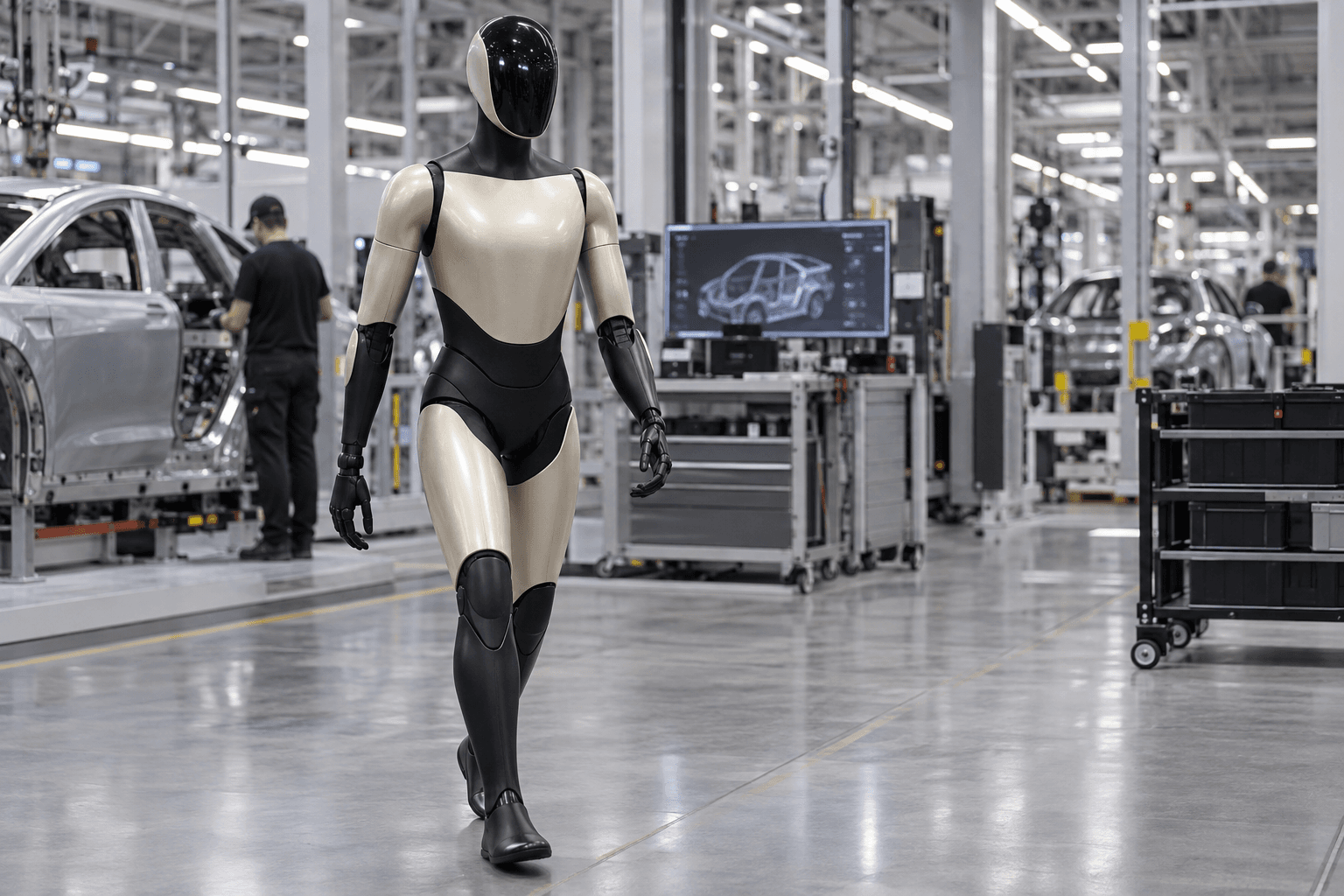
Digital models that apparently show the humanoid robot Optimus Gen 3 have appeared in a recent Android version of the Tesla app. The graphics were intended for the app’s user interface and look considerably more detailed than a simple concept drawing.
That makes them interesting, but it does not yet confirm the final production model. Such app assets can be created ahead of a presentation and modified several times before the market launch. Nevertheless, they provide the clearest indication yet of the direction in which Tesla is developing the design.
These Details Set Gen 3 Apart From Its Predecessor
Compared with Optimus Gen 2.5, the new version looks more enclosed and more like a finished industrial product. Exposed mechanical components are increasingly disappearing behind covers, while the color scheme is becoming more understated.
| Area | Optimus Gen 2.5 | Optimus Gen 3 According to App Files |
|---|---|---|
| Hips and pelvis | Mechanical components partially visible | Flexible covers over joints |
| Knees and lower legs | Gold-colored metal surfaces | Matte-black covers |
| Arms and hands | Prototype-style construction | More enclosed and integrated |
| Overall impression | Development platform | Design optimized for mass production |
The covers between the torso and thighs are particularly noticeable. They could better protect bearings and moving parts from dust while also shielding potential pinch points. Enclosed joints → less contact with dirt and a surface better suited to everyday work.
The black covers on the knees and lower legs are also likely to be more than a visual change. Standardized components and simpler surfaces could make manufacturing easier, provided Tesla uses them to replace different metal covers and assembly steps.
The Hands Remain Technically Crucial
Tesla says the hands of Optimus Gen 3 have a total of 22 degrees of freedom. This is intended to allow the robot to grip objects more precisely and operate tools. For real-world factory tasks, this fine motor control is at least as important as walking speed or load capacity.
The app graphics show significantly cleaner-looking hands and forearms. However, they do not reveal whether the final hardware will actually perform all the announced movements robustly and repeatedly. Durability, cycle time, and maintenance requirements will ultimately be decisive.
The files point to a major design leap, but they are not yet evidence that development is complete or that large-scale production is about to begin.
App Could Become a Control Center for Optimus
Tesla’s integration of corresponding 3D models into its app suggests that Optimus could eventually be incorporated into the existing ecosystem. Possible features could include status displays, task management, maintenance notifications, or the monitoring of multiple robots by fleet operators.
Which features will actually be introduced has not yet been confirmed. Tesla already uses its app as the central interface for vehicles and energy products. A similar structure for Optimus would therefore be technically and strategically plausible.
Mass Production Remains Tesla’s Biggest Challenge
Gen 3 is intended to be the Optimus generation that Tesla is specifically developing for high production volumes. The company is working on production facilities and has announced highly ambitious long-term capacity targets. However, these figures should be understood as expansion plans, not as production output that has already been achieved.
Production is expected to use areas in Fremont that were previously associated with the Tesla Model S and Model X, among other facilities. In the long term, the Texas factory could also play a central role.
Alongside autonomous driving and artificial intelligence, Optimus is one of Tesla’s most important future projects. Our article on Tesla FSD, HW4, and Optimus also provides an overview of its strategic positioning.
What the Discovery Really Reveals
The files that were discovered make an official unveiling in the near future more likely, but there is no confirmed date. Tesla had previously postponed the Gen 3 presentation and announced additional detailed work on the robot.
In any case, the design shown fits the planned evolution from a laboratory prototype to a scalable product. Covered joints, simplified surfaces, and more advanced hands are sensible steps toward that goal. Tesla still has to demonstrate in practice whether Optimus Gen 3 can also make the crucial leap in reliability and production costs.