Tesla FSD Fails to Reliably Obey Speed Limits in Belgian Test
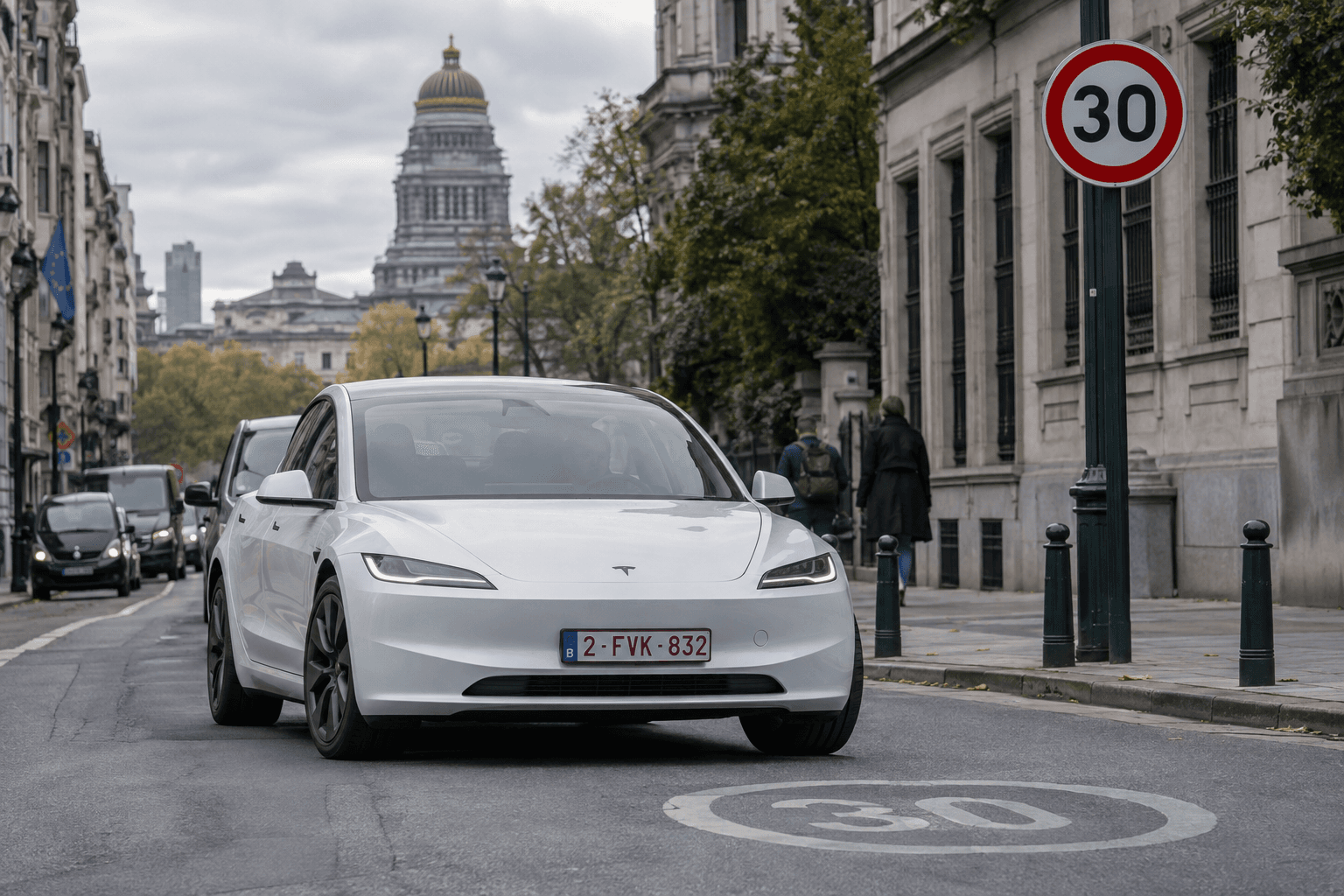
Tesla’s supervised Full Self-Driving (FSD) system repeatedly violated local traffic rules during a real-world test in Belgium. Its behavior in 30 km/h zones around Brussels was particularly striking: With the system active, the test vehicle traveled at an average of 44 km/h.
Over three days of testing, a Belgian road safety organization covered a total of around 400 km. FSD also reportedly failed to consistently comply with the limit in areas where the maximum speed was 20 km/h.
The test does not indicate a fundamentally reckless system, but it does reveal a significant gap in how local traffic rules are implemented.
Road Signs Recognized, but Speed Still Incorrect
The discrepancy between perception and driving decisions is concerning. According to the report, the vehicle recognized 30 km/h signs on the display but then often continued to show 50 km/h as the permitted maximum speed.
This suggests that the problem lies less with sign recognition itself and more with assigning and processing the detected information. Sign recognized → wrong speed limit applied. This software layer is crucial, especially in European cities with changing zones, supplementary signs and varying local rules.
The test also documented attempts to overtake on bicycle streets, even though overtaking cyclists was prohibited there. Situations like these show how difficult it is for an internationally developed driver-assistance system not only to recognize road markings and other road users, but also to correctly apply national and regional regulations.
FSD Also Demonstrated Clear Strengths
The report was not entirely negative. The Tesla system reportedly behaved cautiously and considerately toward pedestrians and cyclists in most cases. According to the findings, FSD often yielded early and responded defensively to vulnerable road users.
This is consistent with Tesla’s approach of continuously improving its driving software through comprehensive environmental perception and large amounts of data. The announced next generation, Tesla FSD v15 for HW4, is also intended to expand its capabilities further. However, the Belgian test makes clear that a good understanding of the driving environment is not enough if binding rules are implemented incorrectly.
How Conclusive Is the Test?
Around 400 km on public roads provides relevant evidence, but it is no substitute for comprehensive technical testing under all conditions. Among other things, it remains unclear how representative the selected routes were and whether the software version, map data or vehicle settings influenced the results.
Nevertheless, an average speed of 44 km/h in 30 km/h zones is not a minor anomaly. To gain approval in Europe, a driver-assistance system must reliably account for speed limits and overtaking restrictions, regardless of whether they are detected through signs, map data or a combination of both.
European Authorities Assess Tesla FSD Differently
The timing of the report is relevant for Tesla, as a vote on the broader approval of FSD in the EU is scheduled for October 6. The Dutch approval authority cleared the system for regular road use in April, with Belgium following shortly afterward.
Other European countries expressed reservations. Sweden cited potential speeding violations, while Finland pointed to challenging steep and winding roads. France did not want to approve FSD in the version tested.
These differing assessments highlight the core problem: Europe is far more fragmented than North America in terms of regulations and infrastructure. Software must be able to handle numerous traffic codes, sign variations and special local rules before it can be used reliably across borders.
The Driver Remains Fully Responsible
Despite its name, FSD is a supervised driving system. The person behind the wheel must monitor traffic and be ready to intervene at any time. This also applies when the system steers, accelerates or brakes on its own.
However, this responsibility does not eliminate the need for authorities to impose strict requirements on the software. A repeatedly incorrect speed limit increases the need for driver intervention and may lead drivers either to place too much trust in the system or to use it less often in everyday driving.
For Tesla, the report therefore represents a specific development task above all. The cautious interaction with pedestrians and cyclists demonstrates the system’s potential. Before a broad European rollout, however, local speed limits and overtaking rules must work just as reliably as the vehicle-control functions themselves.