Large battery study with 500,000 checks: What it reveals about Tesla
Fear of “sudden battery death” has long since diminished in the real world of electric cars. At the same time, real-world fleet data shows that degradation is not a myth, but it varies by model and usage. A recent analysis by an Austrian battery diagnostics company is based on 500,000 battery tests conducted worldwide since 2022 and compares 20 popular EV models at fixed mileage intervals.
This is particularly interesting for used-car buyers because it is not based on laboratory figures, but on a cross-section of “real-world” data. The metric assessed is State of Health (SoH), meaning the median percentage of the battery’s original usable capacity that remains.
Tesla Model Y vs. Model 3 after 150,000 km: The median figures
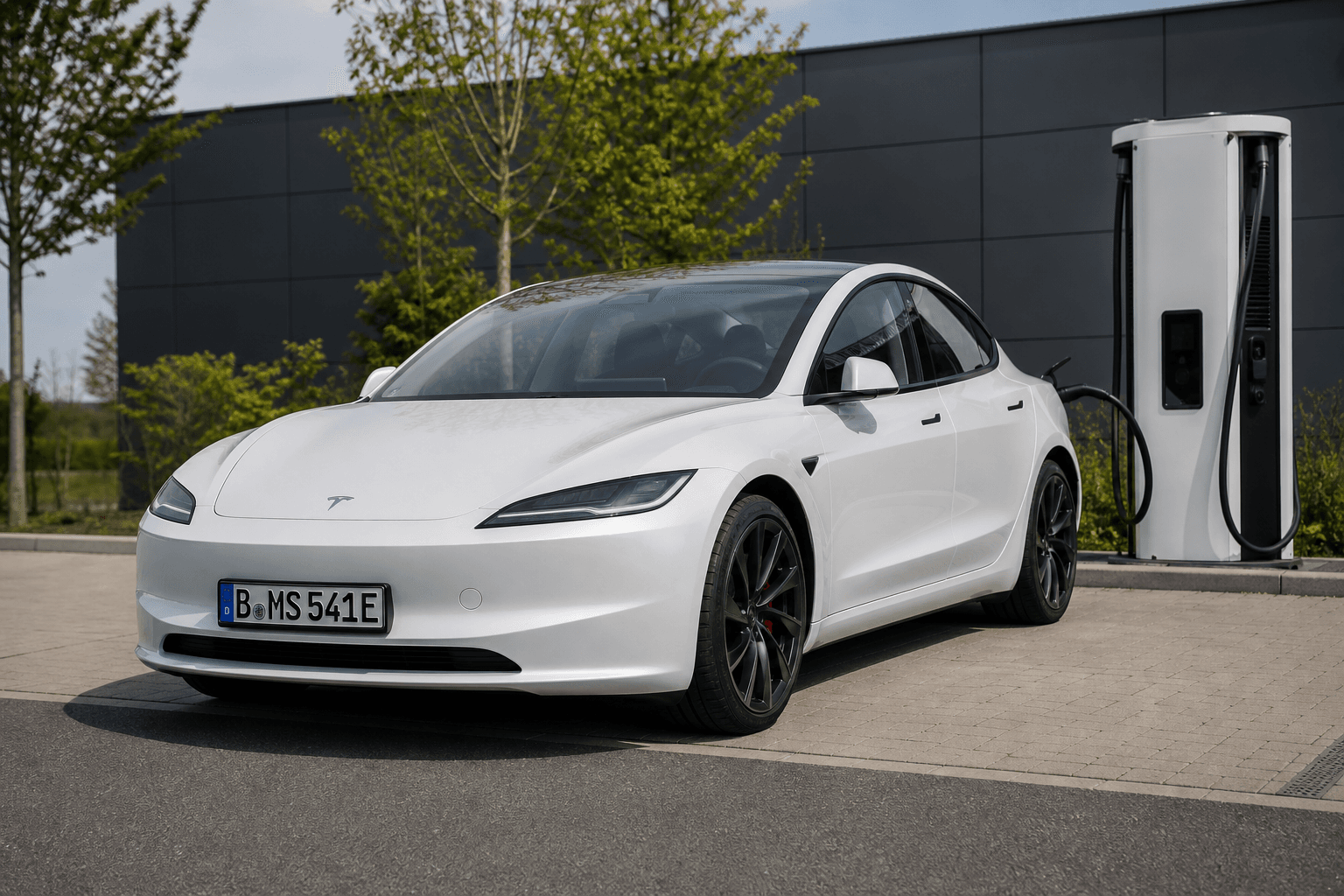
In the study, the Tesla Model Y performs better at the median than the Tesla Model 3. Both remain within a range that many drivers are likely to experience as “noticeable, but not dramatic” in everyday use: slightly less range and, depending on the driving profile, an additional short charging stop from time to time.
For comparison, the analysis also lists other models with higher median figures after 150,000 km, including the Hyundai IONIQ 5 and Ford Mustang Mach-E. At the lower end of this selection are models including the Nissan Leaf, Renault Zoe, and Mini Cooper SE, although even their figures after 150,000 km are not disastrous.
| Model | Median SoH at 150,000 km | Assessment |
|---|---|---|
| Tesla Model Y | 90.32% | Solid result, with roughly 10% less usable capacity |
| Tesla Model 3 | 88.94% | A slightly larger decline, but still clearly within the “normal” range |
| Hyundai IONIQ 5 | 93.79% | Above average at the median |
| Ford Mustang Mach-E | 92.53% | Also above the Tesla median |
Why the first 50,000 km often “cost the most”
One detail is consistent with what has appeared in many datasets for years: degradation is often greatest at the beginning and then levels off. For the Model 3, the analysis shows a typical pattern: a larger drop early on, followed by a significantly slower decline.
This is important for setting expectations: 10% less capacity after a certain mileage does not automatically mean the decline will continue at the same linear rate. Broadly speaking: early aging → often followed by a more stable “plateau” phase.
The median is not everything: Variation is crucial for used-car buyers
As useful as the median is, it smooths over real-world differences. The study therefore also shows a range that, according to its authors, is intended to cover 99% of vehicles for each model. At 150,000 km, this ranges from 80.28% to 94.53% for the Model 3 and from 82.90% to 94.94% for the Model Y.
In other words, you could find two visually identical used cars and discover that one drives almost “like new” in everyday use, while the other needs noticeably more frequent charging over the same route. This often has less to do with the manufacturer than with usage and operating conditions.
What really benefits battery health in everyday use
The analysis itself identifies familiar stress factors: lots of heat, consistently high charge levels, and “hard” use. This is not unique to Tesla; it applies to almost all lithium-ion batteries. In short: climate + charging habits + mileage profile → major impact.
- Heat: Frequently high battery temperatures can accelerate aging.
- Charging to 100% very often: A consistently high state of charge (SoC) can put greater strain on the cell chemistry.
- Frequent fast charging: It is not automatically “bad,” but relying on it all the time is often less ideal than combining it with AC charging.
Context for the DACH region: What to look for in a used Tesla
In the DACH region—Germany, Austria, and Switzerland—the climate is more moderate on average than in some hot parts of the United States, which generally helps. Even so, used-car buyers should take a clear-eyed look at the individual vehicle’s data: its charging history, whether it was typically left parked at a high SoC, and whether it spent extended periods doing a lot of highway driving and fast charging.
Overall, the study provides a useful guide: Around 10% less usable capacity after high mileage is a realistic benchmark for many vehicles. At the same time, the range is wide enough that a well-maintained individual vehicle can perform significantly better than the model average.
The most important message for used-car buyers is not “which model loses how much,” but rather that a well-treated battery can age significantly better than the median would suggest.