Volkswagen radically overhauls its China lineup
Volkswagen aims to regain ground in China with a broad-based model offensive. More than 20 New Energy Vehicles are set to be launched across the Group in 2026. By 2030, the company plans to offer around 50 electrified models, including approximately 30 all-electric vehicles.
The term NEV, commonly used in China, includes battery-electric vehicles as well as plug-in hybrids and range-extender models. Volkswagen is therefore not focusing exclusively on all-electric vehicles, but they will play a central role in its new product strategy.
Local development aims to make VW faster
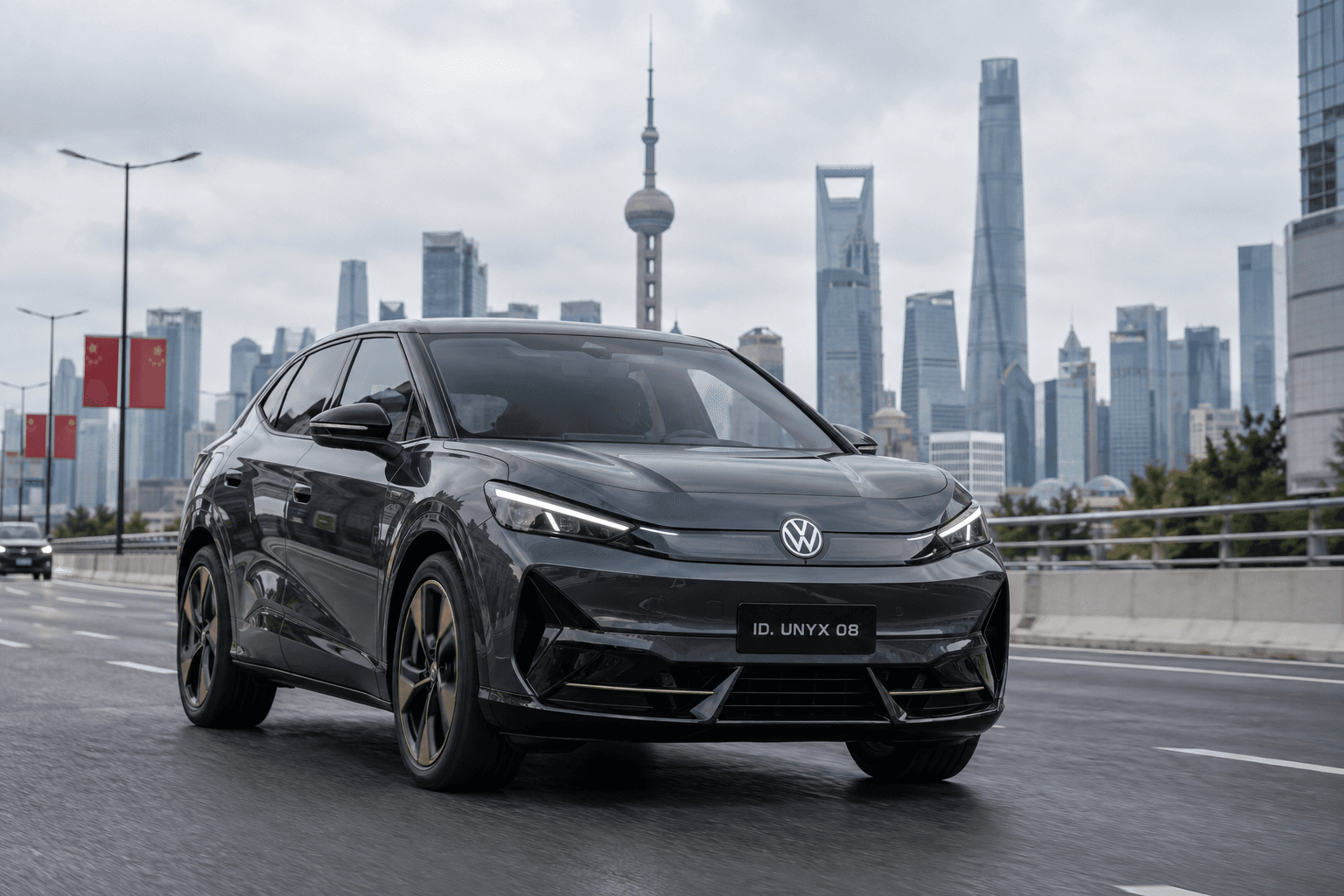
One key project is the VW ID. UNYX 08, developed jointly with Xpeng. The electric SUV, designed specifically for China, was developed in around 24 months. However, the model is already facing pricing pressure, as shown by the early price cut for the VW ID. UNYX 08.
New vehicles will be based in part on the locally developed China Electronic Architecture and the Compact Main Platform. This will allow Volkswagen to shift more development work to China and tailor software, interior concepts and digital features more closely to local customer expectations.
The crucial change is not just the number of new models, but the faster pace of development directly within the world’s most important automotive market.
For Volkswagen, this marks a significant strategic shift. Instead of merely adapting global models for China, vehicles are increasingly being developed locally and specifically for the Chinese market. The VW ID. UNYX 09 with a 92 kWh battery, also developed for China, illustrates how broad the future lineup is expected to become.
NEV share to rise from 5% to 70%
The internal targets are ambitious. In 2025, NEVs accounted for only around 5% of Volkswagen’s deliveries in China. This share is expected to rise to approximately 40% by 2027 and around 70% by 2030.
| Metric | Starting point | 2027 target | 2030 target |
|---|---|---|---|
| NEV share of deliveries | around 5% in 2025 | around 40% | around 70% |
| Deliveries in China | most recently around 2.7 million | around 3 million | around 3.2 million |
| Electrified model lineup | more than 20 new NEVs in 2026 | further expansion | around 50 models, including approximately 30 all-electric vehicles |
Volkswagen must therefore change its powertrain mix while also increasing overall sales. This will be challenging because the Group expects China’s passenger car market to shrink by around 20% in 2026.
Chinese brands set the pace
In the first five months of 2026, Chinese manufacturers had already captured around 71% of the market. German brands together accounted for just over 10%. EV makers such as BYD, Geely, Xpeng and Leapmotor are particularly successful thanks to short model cycles, aggressive pricing and highly integrated software.
The sales comparison between Leapmotor, VW and BMW also shows how quickly the balance of power is shifting. A large number of models alone will therefore not be enough. Volkswagen must remain competitive on price, efficiency, infotainment and digital driver-assistance features.
What the China offensive means for Europe
The announced vehicles are primarily intended for China and are not automatically planned for Germany, Austria or Switzerland. Nevertheless, local development could influence future European models. Shorter development times, more affordable electronic architectures and partnerships with Chinese technology companies could eventually carry over into other markets.
Volkswagen is starting from a difficult position, but its new structure puts it in a significantly stronger position. Whether this results in renewed market-share growth will depend less on major announcements than on competitive production vehicles. The next two years will show whether the “In China, for China” strategy takes effect quickly enough.