Tesla Apparently Ends Its Wrap Program in Its Own Shop
Anyone looking to have their Tesla Model 3 or Tesla Model Y wrapped directly through Tesla may currently find themselves at a dead end: The previous wrap offering has disappeared from the Tesla Shop, and some product pages now return unavailable content. There has been no official announcement so far, meaning Tesla has provided neither reasons nor a timeline.
An important distinction: This concerns Tesla’s first-party offering, with booking and fulfillment handled by Tesla itself. Vehicle wrapping is not disappearing from the market, of course; it is simply shifting back toward specialist installers.
How Tesla Originally Positioned Its Wrap Service
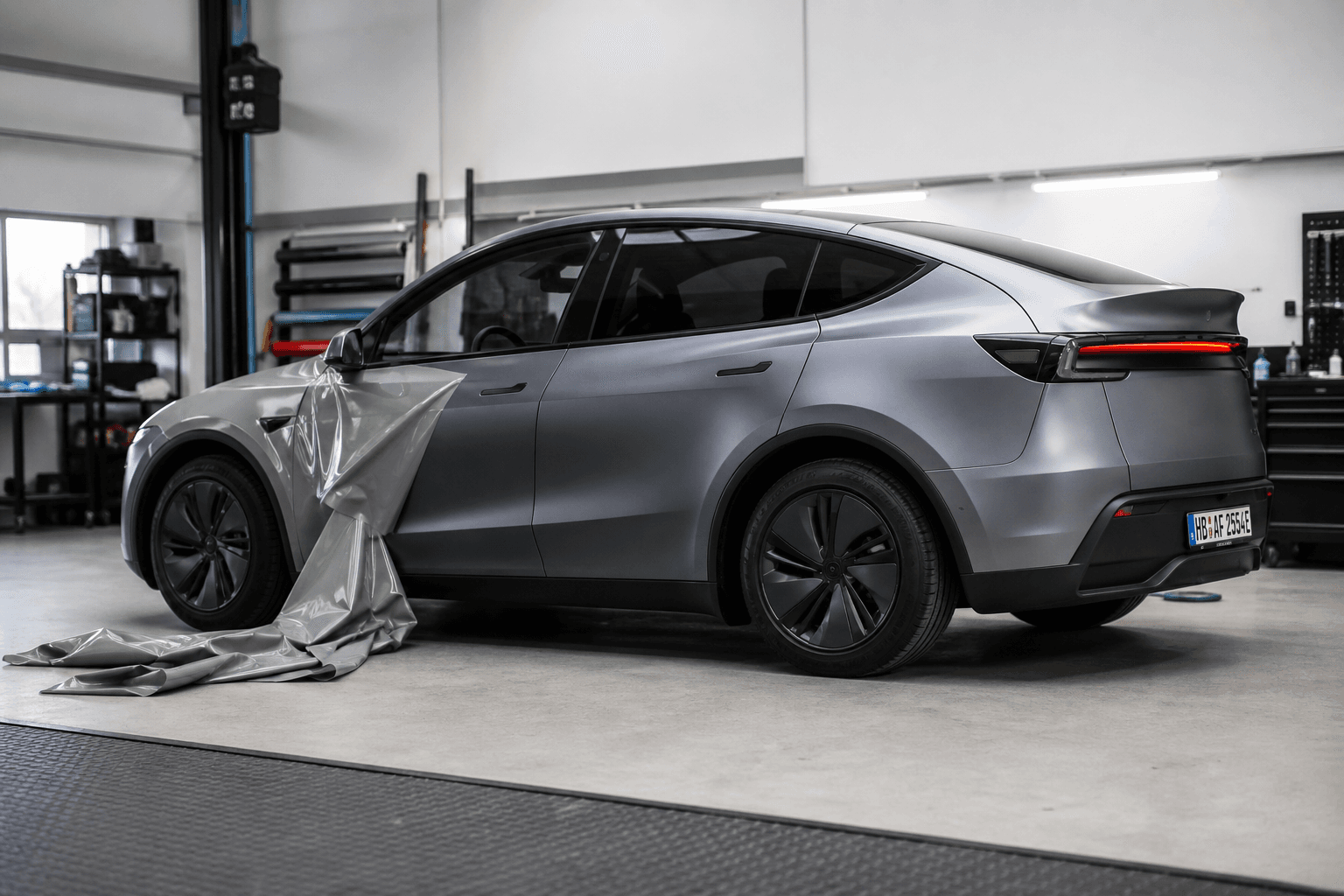
Tesla launched its official wrap program in October 2023, initially for the Model 3 and Model Y. Unlike many conventional color wraps, Tesla initially used urethane-based Paint Protection Film (PPF), a protective film that not only changes the vehicle’s appearance but also provides better protection for the paint against stone chips and scratches.
This had two consequences: First, the service was expensive; second, it was technically quite interesting because PPF is more durable in practice than conventional vinyl film. At launch, several color options were available at premium prices. A transparent protective film cost less than the colored versions but was still firmly in the premium category.
PPF vs. Vinyl: Why Tesla Initially Chose a “Thicker” Material
PPF is typically much thicker than conventional vinyl film. Tesla’s program specified a thickness of around 0.2 to 0.3 mm for its PPF products, while standard vinyl wraps are generally closer to around 0.08 to 0.10 mm. More material usually means greater protection, but also higher material and installation costs.
In everyday use, this means that drivers who spend a lot of time on highways or regularly park in cities are more likely to see tangible benefits from PPF. For a simple color change, however, vinyl is often more economical, especially when appearance rather than paint protection is the main priority.
Cybertruck Was Added Early, Followed Later by a Change in Material
After Cybertruck deliveries began, the wrap service was also rolled out for the pickup. Tesla offered various finishes for it as well, including satin options and, later, additional colors.
The bigger turning point came in late 2024, when Tesla revamped the program and switched from PPF to conventional vinyl wraps. This significantly reduced prices and made the service more suitable for the mass market. At the same time, installation availability was expanded, and customers could have vehicles wrapped even after delivery.
What Remains: PPF Through Partners, but No Tesla Wrap Service in the Shop
Although direct wrap bookings through Tesla apparently are ending, paint protection remains part of the Tesla ecosystem. Tesla continues to offer third-party PPF products installed by certified partners. Depending on how much of the vehicle is covered, options range from small partial-coverage packages to complete wraps.
Tesla pulling the plug on its wrap service is not necessarily a negative sign. It could also fit a strategy of outsourcing services with high operational complexity—appointments, quality control and rework—to partner networks, while Tesla itself focuses more heavily on production, software and core after-sales services.
What Does This Mean for Drivers in Germany, Austria and Switzerland?
The exact form of Tesla’s wrap program depended heavily on the individual market and was not equally available everywhere. For customers in the DACH region—Germany, Austria and Switzerland—the practical effect is therefore mainly that anyone wanting a high-quality wrap or PPF will once again need to use specialist providers and compare materials, warranties and edge sealing.
As a rule of thumb, vinyl is the less expensive route to a color change, while PPF is the more costly but more functional option for paint protection. Drivers who cover a lot of long-distance miles and are bothered by minor paint damage are more likely to view PPF as an investment. Those who simply want a new look will generally find vinyl faster and easier on the budget.
What You Should Pay Particular Attention to When Choosing a Wrap Installer
- Material type: Vinyl for appearance, PPF for protection, or a combination of both (PPF first, then the design).
- Coverage: A front-end package versus a full wrap has a major impact on both price and benefits.
- Edge quality: Cleanly wrapped edges and proper removal of vehicle parts prevent the film from peeling later.
- Warranty and care: Reputable providers give clear guidance on automatic car washes, hand washing and hot water.
Assessment: Tesla Is Still Involved in Protective Film, Just Differently
Overall, it appears that Tesla is ending its in-house wrap service in the shop while continuing to offer protective films through partners. For Tesla drivers, the change is less about whether they can get a wrap and more about how: less of a one-stop shop at Tesla itself and more reliance on the conventional market of wrap specialists and certified installers.
If you are also considering range and efficiency, a wrap can have a minimal impact on aerodynamics and therefore energy consumption, depending on its surface and quality, although the effect is usually very small. Tires, temperature and driving patterns are far more important, which ties in with our real-world look at EV range anxiety.