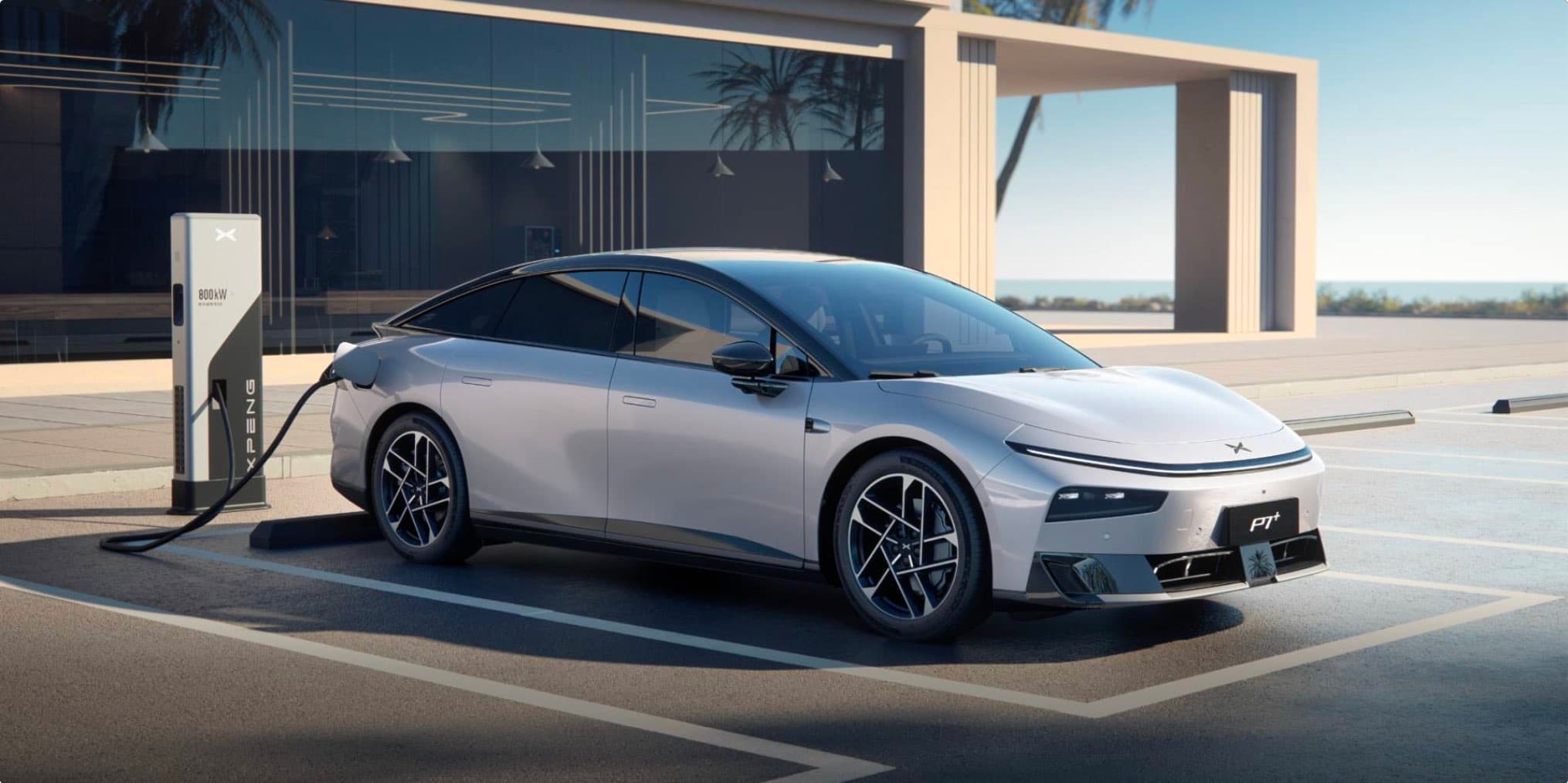
Xpeng P7+ in the Long-Distance Test: Fast at the Charger, Weaker on Efficiency
On long-distance journeys, it is not just WLTP range that matters in the end, but the total time spent driving and charging. In a recent 1,000-km test, the Xpeng P7+ in its Long Range version delivered mixed results: It was relatively power-hungry, but extremely fast when recharging.
Overall, the P7+ averaged 22.5 kWh/100 km. By comparison, a Tesla Model 3 in its Long Range configuration achieved 18.6 kWh/100 km in the same comparison. That is a difference of around 4 kWh per 100 km, which becomes clearly noticeable on long journeys.
Why the Overall Journey Time Can Still Favor the Xpeng
The key factor is charging speed, including the charging curve. The Xpeng P7+ reportedly completed the entire distance in 9 hours in the test, partly because its stops were shorter than those of more efficient rivals.
More specifically, the test reported a very fast charging session: 75% recharged in 11 minutes. In practice, this is exactly the kind of performance that turns “higher consumption” into “still reaching the destination quickly,” provided the infrastructure is available and the car can maintain that power across a broad state-of-charge range.
Efficiency Versus Charging Power: The Typical Trade-Off
Many manufacturers currently optimize heavily either for efficiency or for maximum charging performance. The P7+ is an example of how higher consumption can be partially offset by short charging windows. Conversely, Tesla has traditionally played more to its strengths in efficiency, thermal management, and a well-calibrated overall package.
Range at 120 km/h: Test Conditions Are Crucial
The range at a constant highway speed is also worth examining. The Tesla Model 3 was reported to achieve around 330 km at 120 km/h, although this was under winter conditions on wet roads. Under significantly more favorable conditions—20°C and dry roads—the Xpeng P7+ achieved 388 km.
This is not a direct like-for-like comparison, but it clearly demonstrates how strongly tests are affected by temperature, precipitation, wind, and tires. Particularly when comparing efficiency, it is worth ensuring that conditions are identical; otherwise, a comparison of technology can quickly turn into a comparison of weather.
Context: What the Test Means for Everyday Driving in the DACH Region
For drivers in Germany, Austria, and Switzerland—the DACH region—the conclusion is fairly straightforward: Anyone who frequently drives long distances should consider not only energy consumption but also the combined travel speed, meaning driving speed plus charging time. A car that recharges very quickly can make up time on routes with good high-power charging (HPC) locations, even if it consumes a few more kWh per 100 km.
Conversely, efficiency remains a major advantage because it lowers costs and reduces reliance on charging stops. Tesla’s continued strength in this area is evident not only from comparisons like these, but also from how consistently details such as tires, software, and powertrain calibration are optimized for low energy consumption.
On long-distance journeys, the most efficient EV does not automatically win; it is often the one with the best combination of efficiency and a stable charging curve.
Key Lessons From the P7+ Comparison
- Xpeng P7+: Higher consumption, but potentially extremely short charging stops.
- Tesla Model 3: Very efficient, but can still lose time depending on the charging setup and conditions.
- Comparisons are only fair when the weather, route, and speed are similar.
If you are interested in long-distance driving and range concerns in general, our guide to EV range anxiety explains which factors really matter and how to make your routes more predictable.