Tesla speeds up construction of new Superchargers
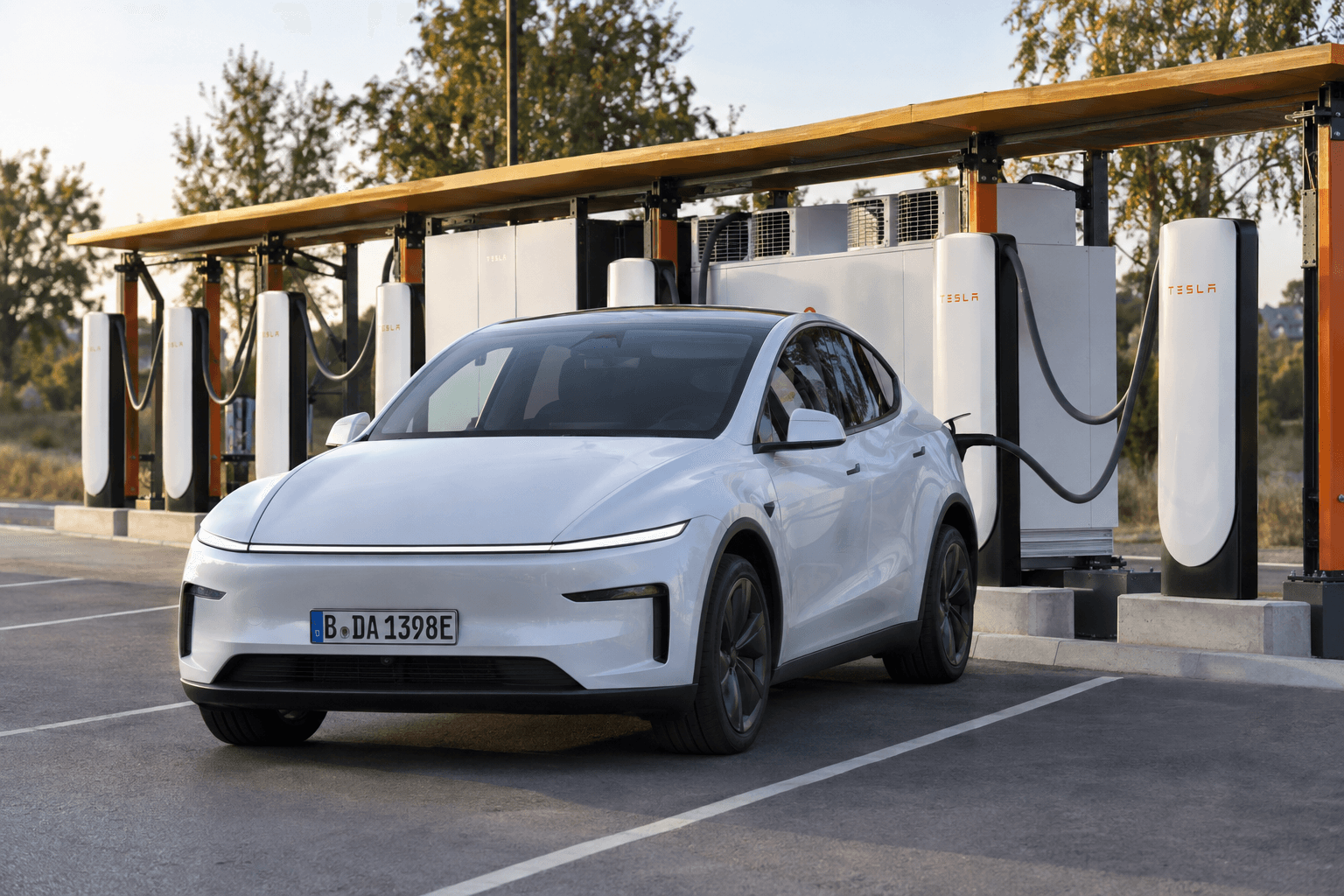
Tesla has unveiled a new method for installing Superchargers in parking lots more quickly and at lower cost. The so-called Accordion Supercharger arrives at the construction site largely preassembled and is extended on site like an accordion.
The design is intended for locations where charging stations cannot simply be installed behind a curb. Instead, the V4 charging points can be positioned between opposing rows of parking spaces.
Factory preassembly is intended to reduce on-site work and costs while providing additional options when selecting locations.
How the Accordion Supercharger works
The system consists of a central V4 switch cabinet, several prewired charging stations and prefabricated foundation elements. Flexible, high-capacity cables connect the switch cabinet to the individual charging islands.
After delivery, a construction vehicle lifts the folded module into a prepared trench. The charging points are then extended into their designated positions, the trench is backfilled and the surface is closed with paving stones.
The wiring, cooling lines and bases are already assembled under controlled factory conditions. This reduces potential sources of error and on-site diagnostic work, although excavation, the grid connection and final approval are still required.
| Metric | Figure | Practical significance |
|---|---|---|
| Charging points per shipment | Up to 16 | Fewer delivery trips and more compact logistics |
| Installation costs | Around 20% lower, according to Tesla | New locations could become more economically viable |
| Preassembly | Factory-installed wiring, cooling and bases | Less electrical work at the construction site |
| Placement | Between rows of parking spaces | More suitable sites for fast-charging hubs |
How it differs from Tesla’s fold-out charging stations
Tesla already uses preassembled Supercharger units that unfold along one edge of a parking lot. This concept works particularly well when sufficient open space is available behind the parking spaces.
The Accordion version solves a different problem. It can distribute multiple charging islands across a parking lot, opening up locations that were unsuitable for the previous modular system.
Deliver preassembled module → extend charging points → establish high-voltage connection. This process can significantly shorten the actual construction phase, but it eliminates neither the need for permits nor the requirement to provide sufficient grid capacity.
What the technology means for Germany, Austria and Switzerland
In the DACH region—Germany, Austria and Switzerland—the construction of a fast-charging hub often takes a long time for reasons other than installing the charging stations themselves. Grid connections, civil engineering plans, land use and regulatory approvals remain crucial factors.
Nevertheless, Tesla’s approach could provide a tangible advantage. Once the site and grid connection have been approved, less work is required at the construction site, while closures and noise-intensive work can be reduced.
This is particularly interesting for supermarket parking lots, shopping centers and existing parking facilities. Operators there need to keep construction work as brief as possible while accounting for complex traffic routes and rows of parking spaces.
Tesla focuses on industrial scaling
With more than 80,000 Supercharger charging points worldwide, Tesla operates one of the largest DC fast-charging networks. Its expansion therefore requires not only more powerful hardware, but also more efficient construction methods.
Other manufacturers are also investing heavily in their own infrastructure, as shown by the planned expansion of BYD’s fast-charging network with power of up to 1,500 kW. With the Accordion system, Tesla is initially focusing less on setting a new power record than on faster scaling and lower site costs.
For drivers, the most relevant outcome is more charging points in locations that were previously difficult to develop. A denser network could also help further reduce the persistent issue of EV range anxiety.
A clever modular system with real benefits
At first glance, the Accordion Supercharger may seem less spectacular than a new charging-power record. However, its modular design could prove more important for expanding the network because it addresses costs, transportation requirements and installation time simultaneously.
The promised 20% cost reduction must now prove itself across different locations. The basic principle is compelling, however: shift as much work as possible to the factory and perform only the necessary steps at the construction site.