Smart charging eases the strain on Europe’s power grids
The growth of electric mobility requires not only more charging points, but also more capable distribution grids. A modeling study conducted by Siemens puts the investment needed by 2030 without smart load management at €24.7 billion.
If charging sessions are managed strategically, the modeled requirement falls to around €14.1 billion. This represents potential savings of €10.6 billion. The study examined battery-electric passenger cars and light commercial vehicles in 27 EU member states and three countries in the European Economic Area.
Smart charging does not eliminate the need for grid expansion, but it can make it significantly more efficient and cost-effective.
What smart EV charging means in practice
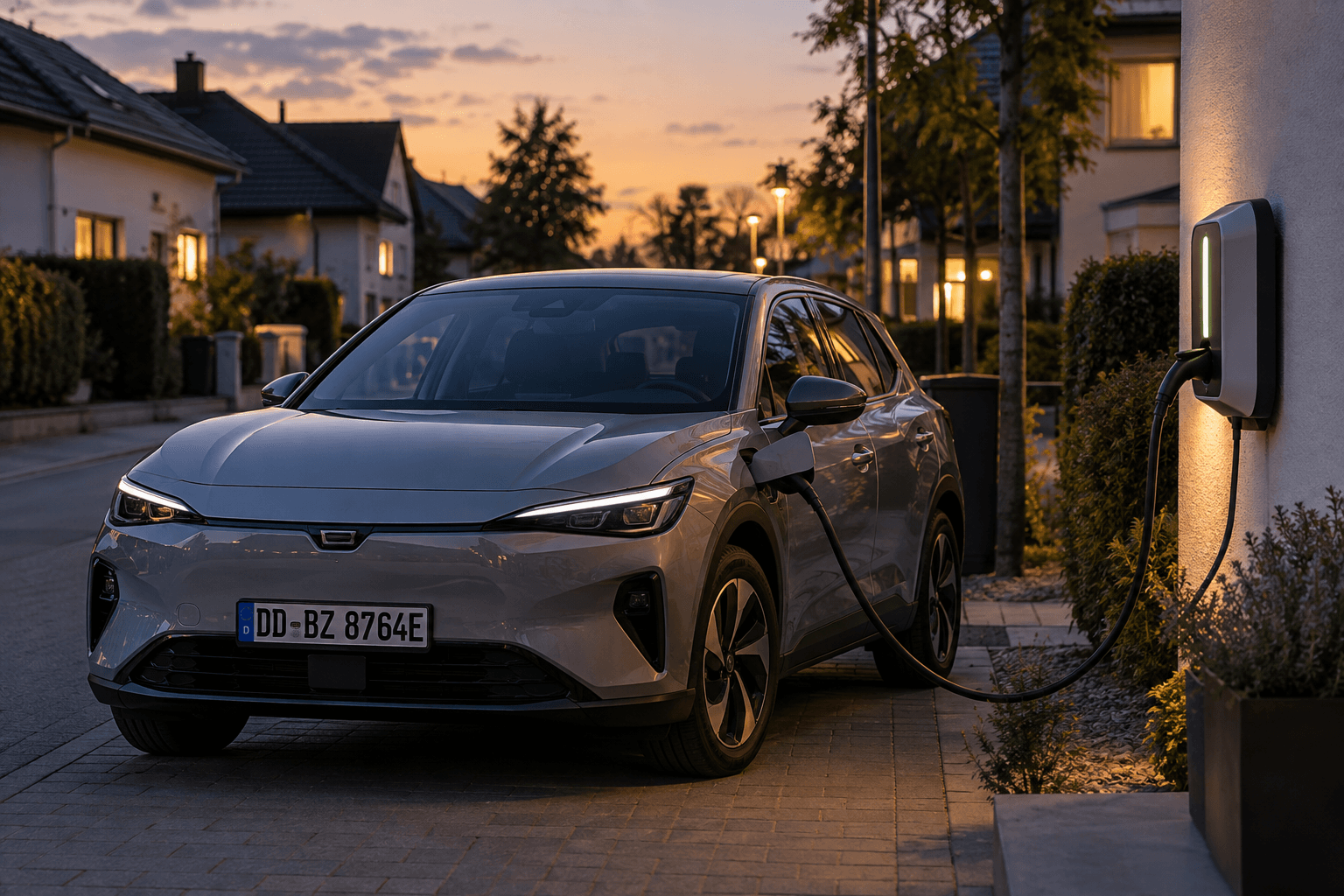
EV load management adjusts charging power almost in real time to the current level of grid utilization. If many households need electricity at the same time, a home charging station can temporarily charge more slowly. When demand subsequently falls, charging power increases again.
Drivers do not necessarily experience any disadvantages in everyday use. Someone who plugs in their car in the evening and does not need it until the next morning primarily sets a desired departure time and minimum state of charge. The system shifts electricity consumption within this time window → the vehicle is charged on time without creating unnecessarily high load peaks.
Smart charging should not be confused with particularly high DC charging power. Whether an electric car uses a 400-volt or 800-volt architecture primarily affects rapid charging on the road. Grid-responsive charging, by contrast, often plays a central role at private and commercial AC charging points.
Germany ranks in the middle for expected growth
For the study, six basic urban types were applied to 64 European centers. By 2030, the number of battery-electric vehicles operating there could increase to 3.8 times its current level. However, the expected shares differ significantly between countries.
| Country | BEV share of passenger cars in 2030 | BEV share of light commercial vehicles in 2030 |
|---|---|---|
| Sweden | 27.3% | 22.7% |
| Germany | 15.7% | 9.1% |
| Italy | 4.6% | Not specified |
| Spain | 4.5% | Not specified |
| Poland | 2.5% | 5.9% |
Compared with 2024, the number of vehicles would increase by a factor of between 3.4 and 5.3, depending on the market. According to the model, Poland’s van market is developing particularly dynamically, with its electric fleet potentially growing almost tenfold.
Home charging puts pressure on low-voltage grids
The number of electric cars on the road is not the only decisive factor. Where and when they are charged is equally important. For the cities studied, it is assumed that around 55% to 62% of EV owners will be able to charge at home by 2030.
Although convenient, this concentrates the burden on local low-voltage grids. In the model, 77.7% of the necessary investment in physical upgrades is allocated to this grid level. Residential areas where many vehicles are plugged in simultaneously after work are particularly relevant.
Cities with few private parking spaces, by contrast, need more public charging infrastructure. In these locations, loads can often be consolidated more strategically through charging hubs, neighborhood solutions and commercial sites. According to the model, investment requirements are highest in Central Europe, followed by Northern Europe, Eastern Europe and Southern Europe.
Why grid expansion remains essential
Even with smart load management, every region studied requires physical upgrades. New power lines, higher-capacity transformers and digitally monitored local grids therefore remain necessary. Smart charging primarily ensures that existing capacity is used more effectively and that expansion measures can be planned more strategically.
For this to work, vehicles, home charging stations, energy suppliers and grid operators must communicate reliably with one another. Dynamic electricity tariffs alone are not always sufficient, because an hour with low wholesale electricity prices is not necessarily beneficial to the local grid. Transparent grid signals and market-based incentives for flexible charging are therefore needed.
Bidirectional charging expands the potential
The load management examined can already work without feeding electricity back from the vehicle. Bidirectional charging adds another option: the electric car can temporarily supply energy to a building or the grid. The role manufacturers intend to play is illustrated, among other examples, by the Hyundai and Kia initiative for bidirectional charging.
For Europe, however, the greatest short-term opportunity initially lies in controlled charging. Millions of vehicles do not all need to draw electricity at full power simultaneously. If their idle periods are used intelligently, electric mobility can be transformed from an additional consumer of grid electricity into a controllable and predictable load.