New Facility Aims to Recycle Almost All Solar Panel Materials
End-of-life solar panels are not ordinary electronic waste. In addition to glass and aluminum, they contain smaller quantities of valuable raw materials such as silver, copper, and silicon, which are considerably more difficult to recover cleanly.
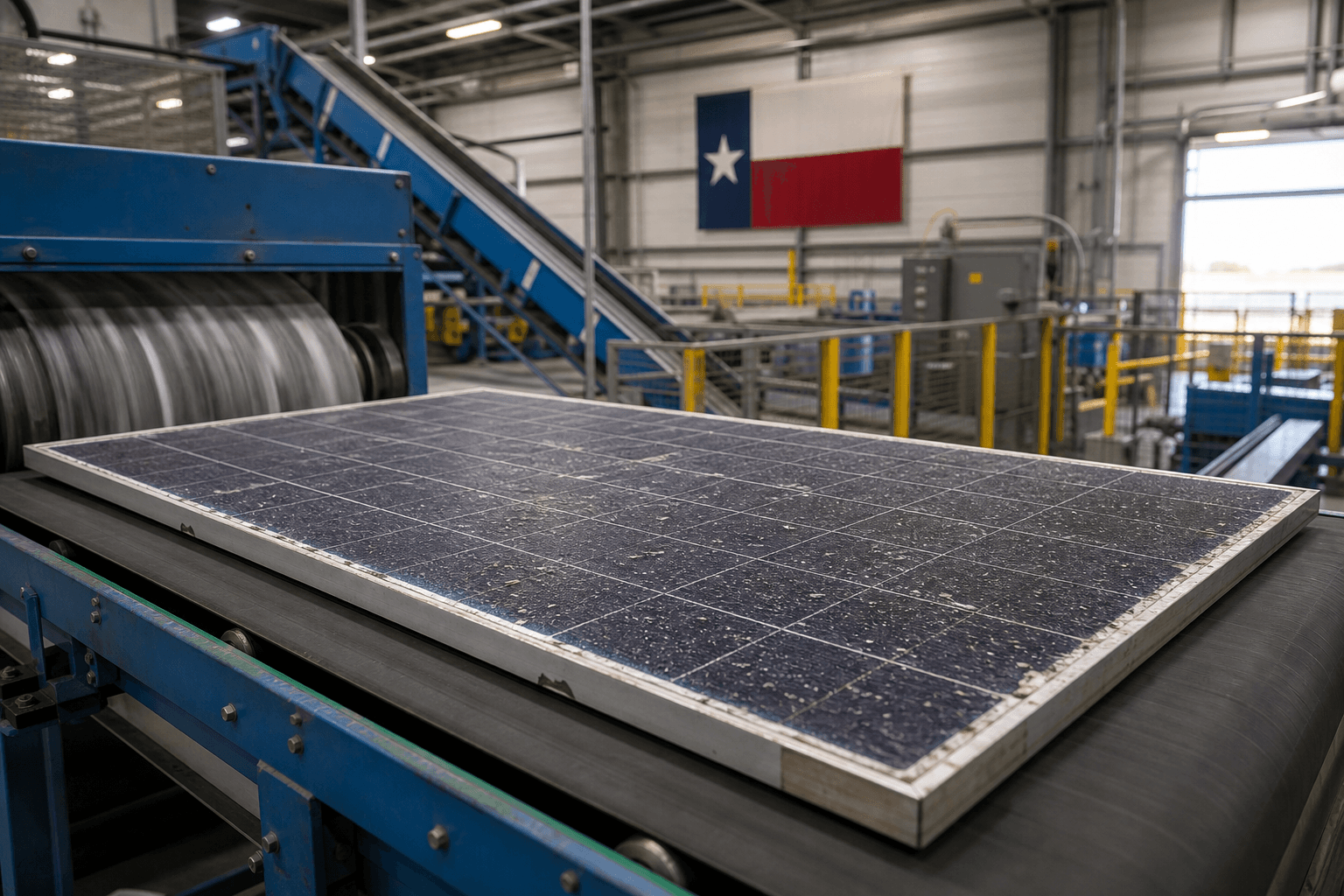
This is precisely where a new recycling facility in the U.S. state of Texas comes in. The plant is scheduled to open outside Dallas in the third quarter of 2027 and, according to the operator, will recover up to 96% of the materials in a solar panel.
| Metric | Planned figure |
|---|---|
| Start of production | Third quarter of 2027 |
| Location | Dallas region, Texas |
| Site area | Around 4 hectares |
| Processing rate | One solar panel per minute |
| Material recovery | Up to 96% |
| Key raw materials | Silver, copper, silicon, aluminum, and glass |
The Crucial Step Comes After Dismantling
Many established recycling methods focus primarily on aluminum frames and glass. These materials account for a large share of a panel’s weight, but they are less valuable than its thin silver conductors or the silicon used in its solar cells.
The planned facility is therefore intended to do more than simply separate components. The recovered materials will be cleaned and processed so that they can be sold directly to companies in the solar, electronics manufacturing, or energy technology industries.
The key factor is not the recycling rate alone, but whether the recovered materials can once again reach a quality suitable for industrial use.
According to the operator, this will not require downstream smelting overseas. Both the raw materials and a larger share of the value created from them would therefore remain in the United States. However, because the process is proprietary, its actual energy requirements, costs, and achievable material quality will still have to prove themselves during continuous commercial operation.
Why High-Quality Solar Recycling Has Been Expensive Until Now
A photovoltaic module consists of layers that are firmly bonded together. Glass, plastic films, solar cells, conductors, and backing materials must be separated without heavily contaminating the valuable components.
Silver and copper, in particular, are present only in small quantities. Recovering them requires additional mechanical, thermal, or chemical processing steps. This drives up costs and can mean that, in some parts of the United States, sending panels to landfill remains cheaper than comprehensive recycling.
A high recovery rate at industrial throughput could change that calculation: more saleable raw materials → lower net costs per panel processed. At the same time, demand for newly mined materials would decline, potentially improving the environmental footprint of future solar installations.
The Major Wave of Old Solar Panels Is Still to Come
Most of the solar technology installed worldwide is still at the beginning of its service life. Around 70% of global solar projects have been installed since 2019. Modern panels typically remain in operation for 25 to 35 years.
Nevertheless, the number of discarded panels is already growing. Storm damage, installation errors, and the early replacement of older systems with more powerful technology mean that not every panel reaches the end of its theoretical service life.
The operator of the planned facility says its existing dismantling, resale, and recycling activities have already kept more than one million solar panels out of landfills. The Texas plant is now intended to mark the beginning of a larger network. Four additional U.S. locations and investments of around US$100 million are planned within four years, although specific locations have not yet been announced.
What the Project Means for Germany, Austria, and Switzerland
The regulatory situation in the DACH region—the German-speaking markets of Germany, Austria, and Switzerland—differs significantly from that in Texas. Germany and Austria have incorporated photovoltaic modules into their national rules for waste electrical and electronic equipment. Switzerland has its own collection and disposal systems.
This means that organized collection is more firmly established in these countries. However, the technical challenge remains the same: in the long term, recovering glass and aluminum alone will not be enough. As volumes increase, processes that can also economically recover silver, copper, and silicon at high levels of purity will become more important.
The Texas project is therefore also relevant to Europe. If the facility achieves its stated throughput and recovery rate in everyday operation, it could demonstrate how solar recycling can evolve from a waste disposal business into a significant source of raw materials.