LG Energy Solution turns to Arkansas for lithium with long-term contract starting in 2029
LG Energy Solution (LGES) has signed a long-term supply agreement with Smackover Lithium. Starting in 2029, LGES is expected to purchase 8,000 metric tons of battery-grade lithium carbonate annually from Arkansas. The term is ten years, for a total of 80,000 metric tons.
An important point for context: This is a binding take-or-pay agreement. That means LGES must either take the agreed volumes or pay for them anyway, even if demand changes. Prices and other details remain confidential.
Who is behind Smackover Lithium and how large the project is expected to become
Smackover Lithium is a joint venture established in 2024 by Standard Lithium (55%, operator) and Equinor (45%). It focuses on projects for the direct extraction of lithium from brine in Arkansas and Texas. The initial source for the contract is the South West Arkansas Project, which is currently scheduled to begin commercial production in 2029.
In its first development phase, the project is expected to reach 22,500 metric tons of lithium carbonate per year. At 8,000 metric tons annually, LGES would secure more than one-third of that capacity. This illustrates how crucial such offtake agreements are for new raw-material projects: Without reliable customers, it is difficult to secure billions in financing.
Financing: Offtake agreements are key to starting construction
Smackover Lithium has already secured another major customer: Trafigura has also signed a ten-year agreement for 8,000 metric tons per year. Overall, the joint venture aims to find long-term buyers for around 80% of its planned production capacity. The existing agreements are expected to cover about 90% of that target volume, with another smaller contract still to be announced.
Project financing is progressing in parallel: Several export credit agencies are said to have expressed interest in providing more than US$1 billion in debt financing. However, a final investment decision has not yet been made and is expected later this year. Construction can only begin after that decision if the project is to remain on schedule for 2029.
Why “Direct Lithium Extraction” (DLE) is attractive for the supply chain
The lithium is to be recovered from brine using Direct Lithium Extraction (DLE) and then processed into battery-grade lithium carbonate. DLE separates lithium directly from the brine instead of using large evaporation ponds. LGES highlights sustainability benefits, although the company has not provided specific figures for the expected savings.
For the battery industry, DLE is particularly appealing for one reason: If the process can be scaled reliably, projects could potentially ramp up faster while requiring less land. Whether and how well that works here will only become clear during commercial operations.
US lithium for US batteries: The strategy behind the deal
For LGES, the deal is a clear step toward localizing its North American supply chain. The lithium from Arkansas is also expected to meet requirements stipulating that raw materials must not come from a “Prohibited Foreign Entity.” In the US, such criteria are crucial for eligibility for incentives and market opportunities, particularly when automakers and cell manufacturers are planning for the long term.
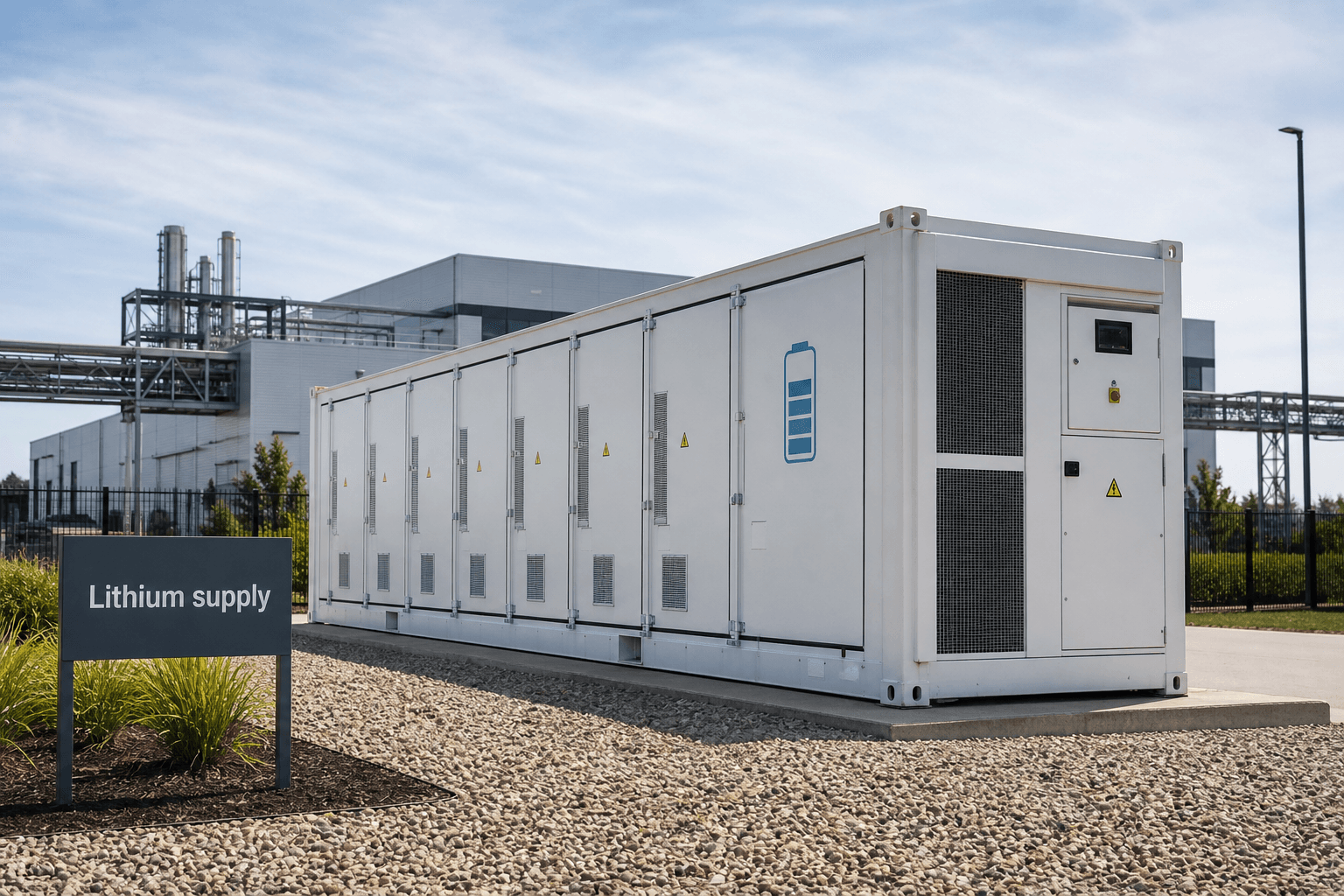
LGES is expanding its US production in parallel, not only for EVs but increasingly for the rapidly growing stationary energy storage market. By the end of 2026, three company-owned sites and two partner sites in North America are expected to provide a combined production capacity of more than 50 GWh for LFP cells used in stationary storage systems.
And what does this have to do with Tesla?
Production has already begun at LGES’s plant in Lansing, Michigan. The facility manufactures LFP cells for stationary storage systems, including for Tesla. In the future, Lansing is also expected to produce NMC cells for another manufacturer’s EVs.
For Tesla, LGES’s move is primarily relevant indirectly: More locally secured raw materials and cell production capacity in the US generally mean more resilient supply chains for energy storage products. At the same time, lithium remains a global market, so a single agreement does not eliminate volatility from the system, but it does reduce it significantly for the buyer.
Key figures at a glance
| Metric | Value |
|---|---|
| Start of deliveries | From 2029 (planned) |
| LGES delivery volume | 8,000 metric tons of lithium carbonate per year |
| Contract term | 10 years |
| Total volume | 80,000 metric tons of lithium carbonate |
| Project capacity (development phase 1) | 22,500 metric tons per year |
| Contract type | Take-or-pay |
If you want to explore battery chemistry and market trends in greater depth, the shift toward LFP is evident not only in stationary storage but is also shaping the cell market as a whole. Our analysis of the LFP share of China’s battery market provides further insight.
And because fast charging and cell architecture are currently gaining momentum in parallel, the comparison of 800V vs. 400V architectures in EVs is a useful complement to the raw-material discussion. For more context on Tesla’s energy storage systems and hardware, it is also worth looking at Tesla’s FSD v15, HW4 and Optimus, as this shows how strongly Tesla is focusing on scalable energy products alongside cars.