Xpeng Commissions Its First Megawatt Charger
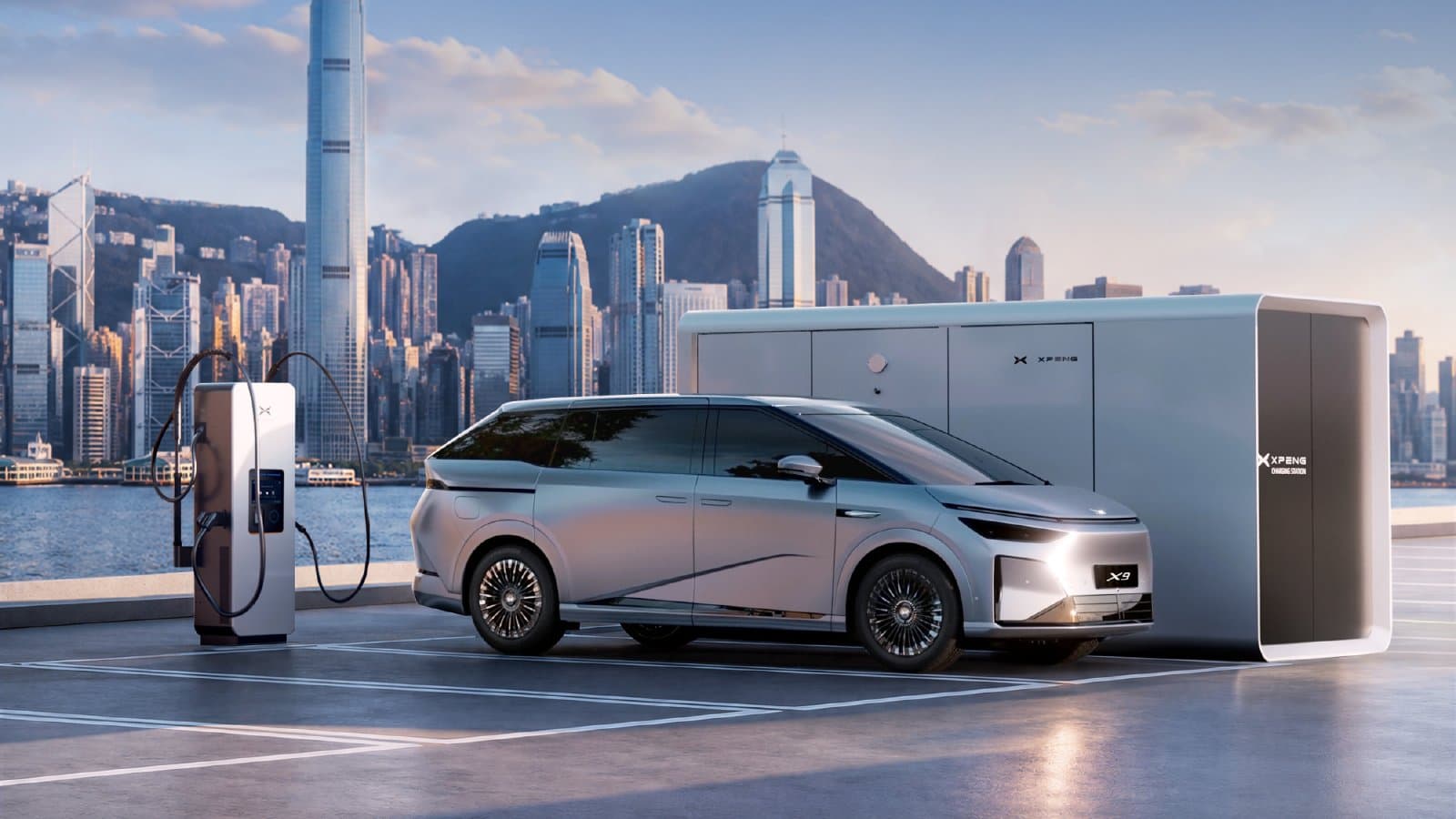
Xpeng has opened the world’s first charging station based on its new X-Energy platform in Hong Kong. Built together with local operator Halo, the facility delivers a peak output of 1 MW and is open to electric cars of all brands.
However, this does not mean that 1 MW is actually delivered to the vehicle. The figure describes the station’s maximum output, while the connected electric car determines how much power reaches the battery. There is currently no Xpeng model capable of charging at 1 MW.
400 kWh Battery Storage Eases the Strain on the Grid
The most technically interesting element is not in the charging cable, but in the integrated energy storage system. Its capacity of 400 kWh enables high power peaks even though the station draws no more than 240 kW from the grid.
In simplified terms, the principle is: grid power charges the battery → the battery and grid supply the vehicle together. This makes it possible to provide significantly higher charging power for short periods without having to upgrade the local grid connection to 1 MW.
| Metric | X-Energy Megawatt Station |
|---|---|
| Maximum output | 1,040 kW, marketed as 1 MW |
| Maximum current | 1,000 A |
| Integrated energy storage | 400 kWh |
| Grid connection capacity | 120 to 240 kW |
| Storage efficiency | 91.5% over the charging and discharging cycle |
| Access | Public and open to all brands |
This concept is particularly attractive for densely built-up cities such as Hong Kong. New high-capacity grid connections there often require considerable space, lengthy approval processes and costly work on the distribution grid. A buffer battery can reduce such obstacles, though it cannot eliminate them entirely.
The Battery Does Not Replace a High-Capacity Grid
When several charging sessions occur in quick succession, the buffer battery drains faster than the grid connection can recharge it. The continuously available output therefore depends on utilization, the battery’s state of charge and load management.
The stated efficiency of 91.5% also applies to the battery cycle, not to the entire charging process from the grid to the vehicle battery. The additional conversion and temporary storage cause losses, but the system may still be economically attractive compared with an expensive grid upgrade.
Europe Is Also Set to Receive X-Energy Technology
Xpeng had already presented the platform at a vehicle launch event in Munich. The company plans to build a total of more than 1,000 company-operated fast-charging stations across 13 European countries and bring X-Energy technology to Europe as well.
It remains unclear which countries will come first, how many sites will actually receive megawatt technology and when the rollout will begin. It has therefore not yet been confirmed whether Germany, Austria or Switzerland will be among the first markets.
In addition to the energy storage system, the plans include support for 10C charging technology and AI-based diagnostic functions. Under idealized conditions, a 10C-capable battery could accept energy at ten times its capacity. In practice, output is limited by factors including temperature, state of charge, cell chemistry and battery management.
Vehicles Need to Catch Up Technically
A megawatt station alone does not shorten a charging stop. The decisive factor is the weakest link among the charger, cable, voltage level, battery and thermal management system. Even modern electric cars with an 800-volt architecture currently remain well below the megawatt threshold.
Models such as the Xpeng G9 already demonstrate how high system voltage and suitable battery conditioning can enable short charging stops. Beyond that, the new station provides headroom for future generations of vehicles and could dynamically supply multiple charging points with high power.
The real advance lies not only in the 1 MW peak output, but in combining local battery storage with a comparatively modest grid connection.
Why Xpeng Is Building Its Own Charging Network
The expansion of charging infrastructure supports Xpeng’s international vehicle strategy. In August 2026, the manufacturer delivered 39,107 vehicles, the second-highest monthly figure of the year after 40,126 vehicles in June.
Deliveries from January through August totaled 243,111, around 10.5% fewer than in the same period of the previous year. Xpeng is targeting more than 60,000 vehicles in a single month during the fourth quarter. A visible, high-performance charging network could help establish the brand in new markets, even if the stations remain open to vehicles from other manufacturers.
Assessment for Germany, Austria and Switzerland
For the DACH region—Germany, Austria and Switzerland—the X-Energy platform is particularly attractive in locations where high-capacity grid connections are unavailable or can only be installed with considerable effort. These include urban charging hubs, highway service centers and existing sites where connection capacity cannot easily be increased.
Whether the concept gains traction will depend on site costs, battery degradation, utilization and electricity rates. Technically, however, Xpeng offers a compelling approach: instead of immediately upgrading the grid everywhere to megawatt capacity, energy is stored and then delivered at high power precisely when a vehicle needs it.