Europe’s hydrogen trucks are set to move beyond the niche
Several major players from the vehicle manufacturing, supplier, and energy industries are pooling their plans for hydrogen-powered heavy-duty transport. Participants include Daimler Truck, Volvo Group, Toyota, Bosch, Air Liquide, and TotalEnergies. Germany is intended to serve as the first major market for implementation.
The goal is a robust ecosystem by 2030. This includes readily available trucks, renewably produced hydrogen, high-capacity refueling stations, and business models that work for freight operators in everyday use. However, the companies believe rapid scaling is hardly realistic without coordinated support at national and European level.
A hydrogen truck alone does not create a market. The vehicle, fuel supply, refueling station, and operating costs must all work at the same time.
Daimler Truck plans 100 fuel-cell trucks
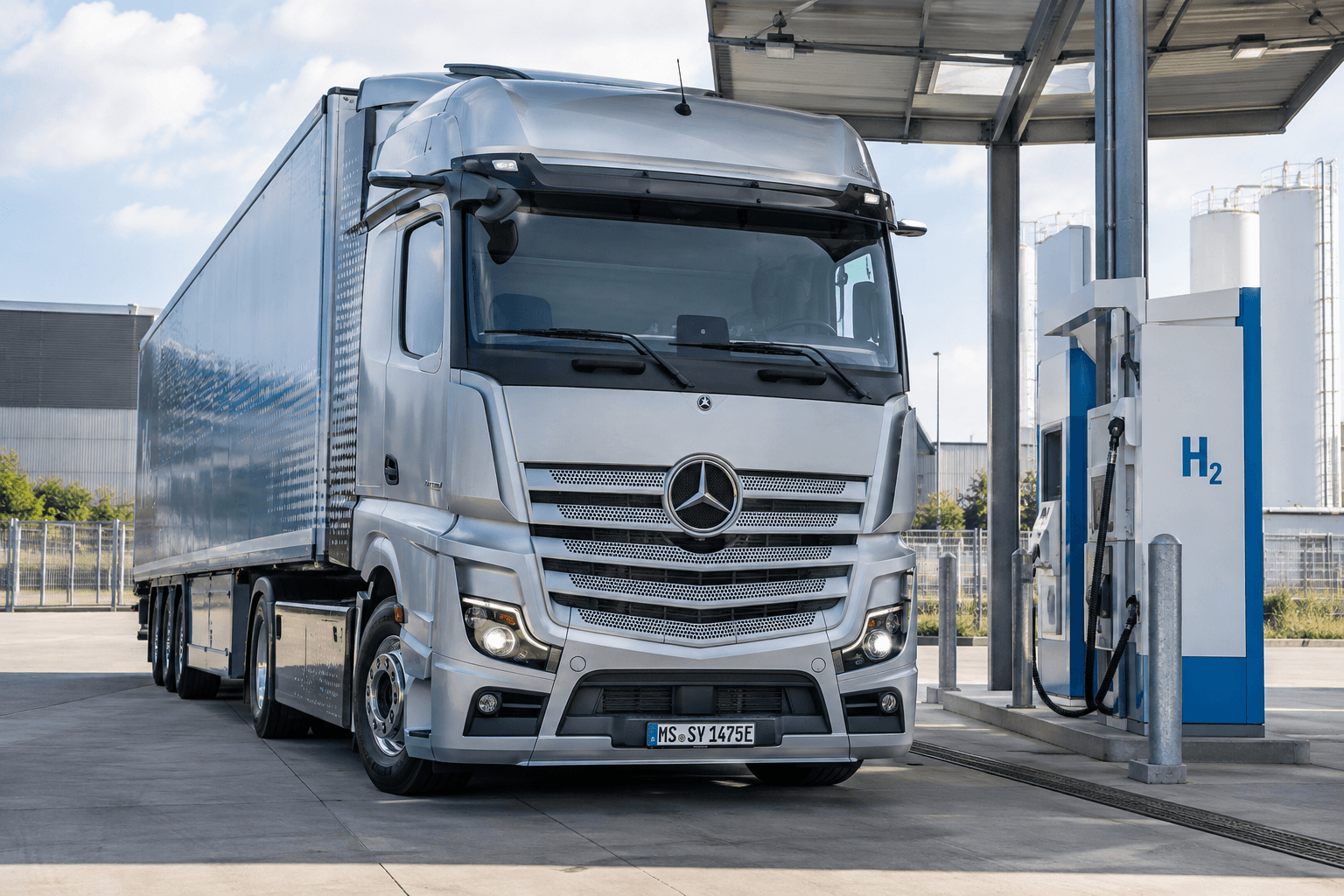
Daimler Truck points to almost 600,000 km already covered by customers using fuel-cell trucks in real-world operations. Starting in late 2026, a small series of 100 next-generation vehicles is set to enter customer fleets. By the end of the decade, the manufacturer intends to invest several hundred million euros in hydrogen trucks.
At the same time, Daimler Truck is preparing heavy-duty commercial vehicles with hydrogen combustion engines for market launch. Volvo is also working on both fuel cells and hydrogen engines and is targeting corresponding vehicles by 2030. Toyota is contributing fuel-cell expertise, while Bosch is supplying components for vehicles and refueling.
Two technological pathways for hydrogen
| Approach | Operating principle | Strength | Challenge |
|---|---|---|---|
| Fuel cell | Generates electricity for an electric drivetrain | No CO2 from the drivetrain and quieter local operation | High system costs and demanding hydrogen supply requirements |
| Hydrogen engine | Burns hydrogen in a modified engine | Uses familiar engine technology and existing manufacturing expertise | Lower efficiency and continued need for exhaust aftertreatment |
For fleet operators, the drivetrain technology is ultimately not the only deciding factor. Availability, payload, refueling time, maintenance, and the price of hydrogen determine whether a vehicle can compete economically with diesel and battery-electric trucks.
Refueling stations to serve up to 100 trucks per day
On the infrastructure side, supply chains for gaseous and liquid hydrogen are to be expanded. Liquid hydrogen offers a higher energy density by volume, but requires complex cooling and specialized facilities. Both forms of storage therefore require their own logistics and suitable refueling technology.
Plans call for stations capable of refueling up to 100 heavy-duty trucks per day. This scale is important because a conventional passenger-car hydrogen station is not sufficient for heavily utilized logistics fleets. High throughput → better utilization of expensive infrastructure and potentially lower costs per kilogram of hydrogen.
The hydrogen should be produced from renewable sources wherever possible. The European RED III regulation—the EU’s revised Renewable Energy Directive—could create additional demand, provided that national rules for crediting renewable fuels are implemented clearly and consistently.
Three cost levers will determine success
To make hydrogen trucks economically competitive with diesel, the alliance is focusing on three key levers:
- Lower vehicle prices through higher production volumes and temporary subsidies
- Cheaper hydrogen through larger production volumes, more efficient supply chains, and reliable quotas
- Operational advantages through road-toll incentives and greater recognition of avoided CO2 emissions
According to industry representatives, a previous German subsidy program was significantly oversubscribed. Applications were submitted for more than 70 high-capacity refueling stations and 800 heavy-duty commercial vehicles. This does not yet prove that a functioning mass market exists, but it does demonstrate concrete interest from logistics companies if investment risks are mitigated.
Germany is the starting point, but Europe must follow
Heavy-duty transport rarely stops at national borders. Individual clusters of refueling stations in Germany will therefore not be enough if trucks regularly travel through Austria, Switzerland, France, or the Benelux countries. Continuous corridors with compatible technology, reliable supply, and transparent prices will be crucial.
The European AFIR regulation—the EU’s Alternative Fuels Infrastructure Regulation—provides the policy framework for alternative-fuel infrastructure. In addition, the industry is calling for coordinated support programs for vehicles and refueling stations, as well as shared risk across hydrogen production, liquefaction, transport, and operation.
Hydrogen complements battery-electric trucks but does not replace them
The initiative is not proof that hydrogen will automatically prevail throughout road freight transport. Direct charging is more energy-efficient, which means battery-electric trucks may have an advantage on predictable routes and where sufficient charging time is available.
Hydrogen remains particularly attractive where high daily mileages, short downtimes, or specific payload requirements make other solutions more difficult. Whether this develops into a significant market by 2030 will depend less on further prototypes than on the cost of renewable hydrogen and the actual expansion of the refueling network.