Yadea and Spiro join forces
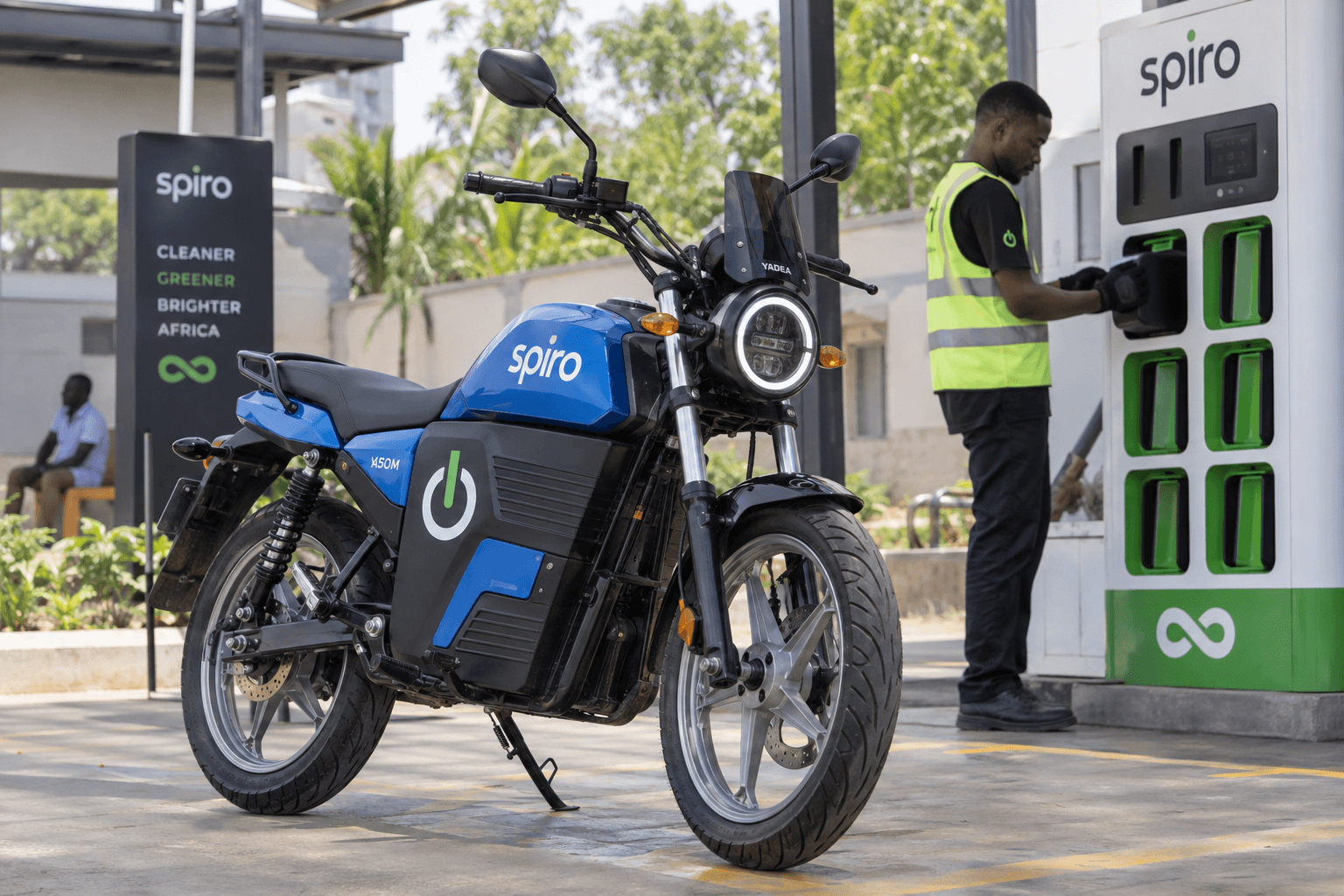
Chinese two-wheeler manufacturer Yadea is entering into a strategic partnership with African electric mobility provider Spiro. Together, the companies aim to develop electric motorcycles and scooters tailored to road conditions and commercial use in African markets.
Yadea will primarily contribute its experience in large-scale industrial production. Spiro, meanwhile, brings an established network of vehicles and swapping stations, as well as regional operating structures, to the partnership.
The crucial combination is high production capacity paired with locally developed infrastructure for rapid battery swapping.
Spiro’s existing network is already substantial
According to Spiro, more than 130,000 electric motorcycles are currently on the road in seven African countries. They are supported by over 2,500 battery-swapping stations.
Riders have reportedly completed more than 50 million battery swaps to date and traveled a combined total of over two billion kilometers. Spiro is also expanding assembly and production in countries including Uganda, Kenya, Nigeria, and Rwanda.
| Partner | Contribution to the partnership |
|---|---|
| Yadea | Large-scale production, vehicle development, electric two-wheeler technology, and international supply chains |
| Spiro | Battery-swapping network, energy infrastructure, regional assembly, and experience with local operating conditions |
Why battery swapping makes sense for motorcycles
In many African cities, electric two-wheelers are not used solely for private transportation. They are essential tools for motorcycle taxis, delivery services, and other riders who cover long distances each day. In these sectors, lengthy charging stops would directly reduce income.
With battery swapping, a depleted battery is exchanged for a charged pack within a few minutes. Empty battery → brief station stop → back on the road immediately. This makes the process more like refueling than conventionally charging an electric car.
Reducing the load on the power grid where the vehicle is parked can also be an advantage. Batteries can be charged under controlled conditions at centralized stations, allowing charging power, temperature, and timing to be managed more effectively.
The vehicles need to offer more than a low price
The partners do not simply intend to export existing Chinese models. They plan to develop specially adapted two-wheelers capable of handling poor roads, high temperatures, dust, and intensive commercial use.
Robust suspension systems, easily replaceable components, and batteries able to withstand numerous charging cycles will be important. A reliable spare-parts supply is equally crucial, because an inexpensive motorcycle is of little use to a commercial rider if a minor fault leaves it out of service for days.
What supports the case for the partnership
- Yadea can manufacture electric two-wheelers in very large volumes.
- Spiro already has vehicles, stations, and operational experience.
- High daily mileage increases the potential savings compared with gasoline motorcycles.
Questions that remain unanswered
- Prices, technical specifications, and specific market launch dates have not yet been announced.
- Battery formats and stations must remain compatible over the long term.
- Maintenance, financing, and electricity supplies vary considerably between individual countries.
Putting Yadea’s scale into perspective
Yadea describes itself as the world’s largest electric vehicle company by unit sales. However, this classification is based on electric two-wheelers and therefore cannot be compared directly with electric car manufacturers.
The company was founded in 2001 and says it is now active in more than 100 countries. According to Yadea, its network includes ten production sites, over 40,000 retail outlets, and more than 2,000 patents related to electric vehicle technology.
Spiro, meanwhile, says it has raised a further US$270 million in funding. The money is intended to accelerate the expansion of its electric fleet, swapping stations, and regional operations.
What the partnership means for the market
No market launch has initially been announced for the DACH region—the German-speaking markets of Germany, Austria, and Switzerland. Nevertheless, the project is relevant because it demonstrates how electric mobility can be scaled beyond conventional electric cars. While Europe is primarily expanding public fast-charging points and private wall chargers, standardized swappable batteries may be the more economical solution for intensively used two-wheelers.
Whether the partnership realizes its potential will depend less on spectacular performance figures than on availability and operating costs. If it succeeds in combining robust vehicles, a dense station network, and affordable rates, it could develop into one of Africa’s largest electric two-wheeler systems.