Tesla Oasis Passes the Holiday Stress Test
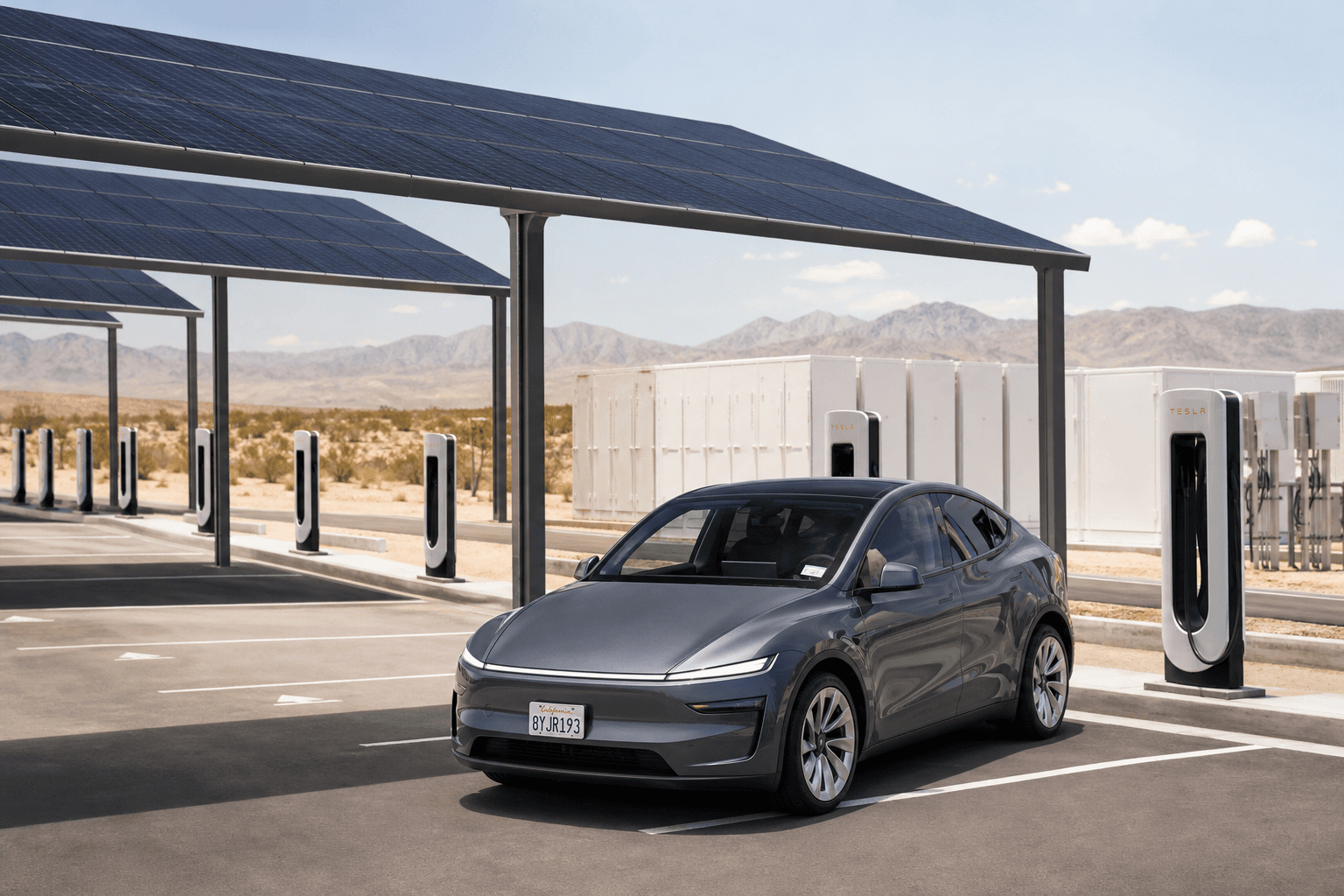
The Tesla Oasis Supercharger in Lost Hills, California, has completed one of its biggest stress tests to date. Over the four-day Labor Day weekend, Tesla recorded 6,038 charging sessions at 164 charging points, without reporting a queue.
That amounts to more than 1,500 charging sessions per day and an average of 9.2 sessions per charging point per day. On Labor Day itself, that figure rose to 11.2 sessions. On the heavily traveled Interstate 5 in particular, this represents an important real-world test of charging infrastructure during peak travel periods.
164 charging points, 6,038 charging sessions and no reported queue demonstrate the throughput that consistently large-scale charging hubs can achieve.
11.4 MW of Power With 116 Vehicles Charging Simultaneously
At the busiest point, 116 electric cars were charging simultaneously. According to Tesla, total power draw reached 11.4 MW. Mathematically, this equated to an average of around 98 kW for each connected vehicle at that moment, although the actual output per car depended on its state of charge, battery and vehicle model.
This figure highlights why the number of chargers alone is not enough. A large charging hub also needs a high-capacity grid connection, intelligent load management and on-site storage so that many vehicles can reliably receive power at the same time.
| Metric | Tesla Oasis |
|---|---|
| Charging points | 164 |
| Charging sessions over four days | 6,038 |
| Vehicles charging simultaneously | Up to 116 |
| Measured total power | 11.4 MW |
| Solar farm | 11 MW |
| Battery storage | 10 Megapacks with a combined capacity of 39 MWh |
Solar Power and Megapacks Reduce Strain on the Grid
Oasis is designed as a largely grid-independent charging hub. The site includes an 11 MW solar farm and ten Tesla Megapacks capable of storing a combined 39 MWh of energy. Tesla also reported 7 MW of available solar power for the holiday weekend.
This approach is particularly useful when demand fluctuates sharply: solar power is generated and stored during the day → the Megapacks supply it again in the evening or during periods of peak demand. However, the site is not completely disconnected from the public power grid and instead combines multiple energy sources.
Oasis Is More Than a Collection of Chargers
Tesla initially opened the site with 84 charging points in July 2025 and later expanded it to 164. Twelve are designed as pull-through bays, allowing vehicles with trailers to charge without first unhitching them.
Restrooms, a driver lounge and outdoor seating are intended to make longer charging stops more comfortable. This suits vehicles such as the Tesla Model Y, which is also frequently used for towing and long-distance travel in North America.
What the Charging Hub Demonstrates for Germany, Austria and Switzerland
A site of this size cannot simply be replicated at every highway rest area in the DACH region—Germany, Austria and Switzerland. Land availability, grid connections, permits and local electricity prices create different conditions from those in rural California.
Nevertheless, Oasis makes a strong case for larger charging hubs with buffer storage. Numerous charging points at one location can accommodate peaks in arrivals more effectively, while battery storage can reduce costly demand spikes and make locally generated solar power usable.
Ultimately, what matters to drivers is not the theoretical maximum output of an individual charger, but whether a charging point is reliably available. High-capacity sites like this can help further reduce the still widespread range anxiety associated with electric cars.