BYD ETT 44 brings flash charging to long-haul transport
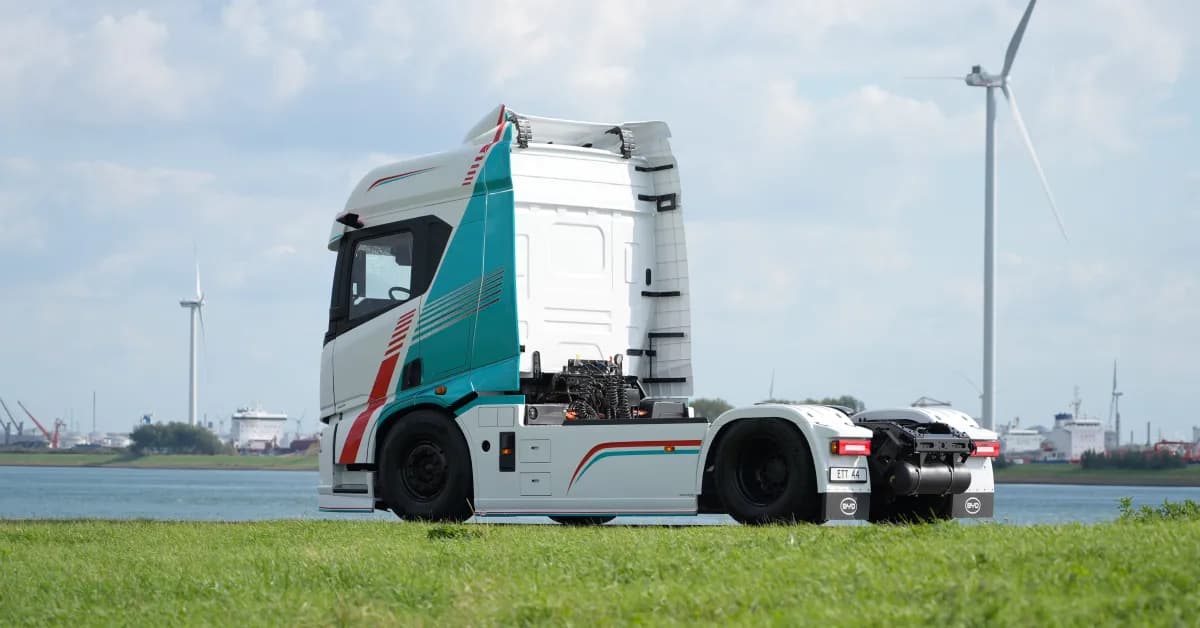
BYD is expanding its European commercial vehicle lineup with the ETT 44. The electric tractor unit is designed for combinations weighing up to 44 tonnes and is expected to travel up to 600 km on a single battery charge.
The real highlight, however, is its charging power. Using BYD’s Megawatt Charging System, the ETT 44 can charge at more than 1.5 MW. Charging from 20% to 80% is expected to take around 20 minutes and provide enough energy for up to another 400 km.
BYD ETT 44 technical specifications
| Specification | BYD ETT 44 |
|---|---|
| Vehicle type | Electric 4×2 tractor unit |
| Permissible gross combination weight | Up to 44 tonnes |
| Battery | 651 kWh Blade Battery |
| System voltage | 851 volts |
| Rated power | Approximately 546 kW |
| Peak power | Up to 735 kW |
| Range | Up to 600 km |
| CCS2 charging power | Up to 420 kW |
| Megawatt charging power | More than 1.5 MW |
| Charging time from 20% to 80% | Approximately 20 minutes at a megawatt charger |
| Battery warranty | 10 years or 1.2 million km |
The 651 kWh battery operates at 851 volts. Our comparison of 800-volt and 400-volt architectures explains why a high system voltage is particularly important for large batteries and very high charging power.
At a conventional CCS2 fast charger, the truck can reach a maximum of 420 kW. BYD estimates that charging from 20% to 80% will take about an hour in that case. Megawatt charging shortens the same stop by around 40 minutes, which could significantly improve vehicle utilization when charging several times a day.
Why a 20-minute charging time matters for hauliers
In heavy-duty transport, maximum range is not the only factor that matters. Downtime, route planning and the availability of high-power charging points determine whether an electric truck can be operated economically. Shorter charging stop → more productive time on the road.
The ETT 44 shows that megawatt charging is moving from a technical promise to a practical component of electric long-haul fleets.
The stated 600 km range remains a manufacturer figure for now. In everyday use, payload, speed, outside temperature, topography and auxiliary systems all affect the actual range. Achieving the 20-minute charging time also requires a preconditioned battery and a suitable megawatt charging station.
BYD supplies more than just the tractor unit
The ETT 44 is part of a commercial vehicle lineup covering weight classes from 3.5 to 44 tonnes. It includes rigid 4×2 and 6×2 trucks, 26-tonne chassis for swap bodies and roll-off tippers, the E-Vali light commercial vehicle and the EYT 2.0 electric terminal tractor.
According to BYD, the ETT 44’s standard equipment includes adaptive cruise control, emergency braking assistance, lane-keeping functions and blind-spot monitoring. In urban distribution operations and busy depots in particular, such systems are at least as important as high motor power.
BYD plans to offer the vehicle, Blade Battery, megawatt charger, stationary storage, energy management and financing as an integrated package. This vertical integration could make planning easier for fleet operators, provided that local service, spare-parts availability and charging infrastructure can keep pace.
1.5 MW is impressive, but the charging network remains the bottleneck
BYD is already building an extensive network of high-power charging points in China. The company recently announced plans to install 10,000 charging points offering up to 1,500 kW within a matter of months. For Europe, however, the key issue is how quickly suitable sites can be developed at logistics hubs and along major transport corridors.
A single megawatt charger places considerable demands on the grid connection, load management and local buffer storage. Several trucks charging simultaneously multiply those requirements. BYD’s approach of directly incorporating charging hardware and stationary storage therefore addresses a major bottleneck for the industry.
Strong competition from Europe and the US
With the ETT 44, BYD faces established manufacturers such as Daimler Truck, Volvo, Scania and MAN. Models such as the Mercedes eActros 600 show that European manufacturers are also well advanced in electric long-haul transport and are working with partners on megawatt charging.
Tesla is also pursuing an integrated approach for the Semi, combining the vehicle with high-power charging infrastructure. However, comprehensive data for a European production version is not yet available, making a robust comparison difficult. For now, BYD’s advantage lies in its combination of a large battery, a specific 1.5 MW charging system and a broad commercial vehicle portfolio.
The policy situation requires a nuanced assessment. The European countervailing duties on battery-electric vehicles from China do not automatically apply to all heavy commercial vehicles. BYD’s success will therefore depend primarily on type approval, price, service coverage, residual values and the actual rollout of the megawatt charging network.