Smart #2 drives through Chinese cities in camouflage
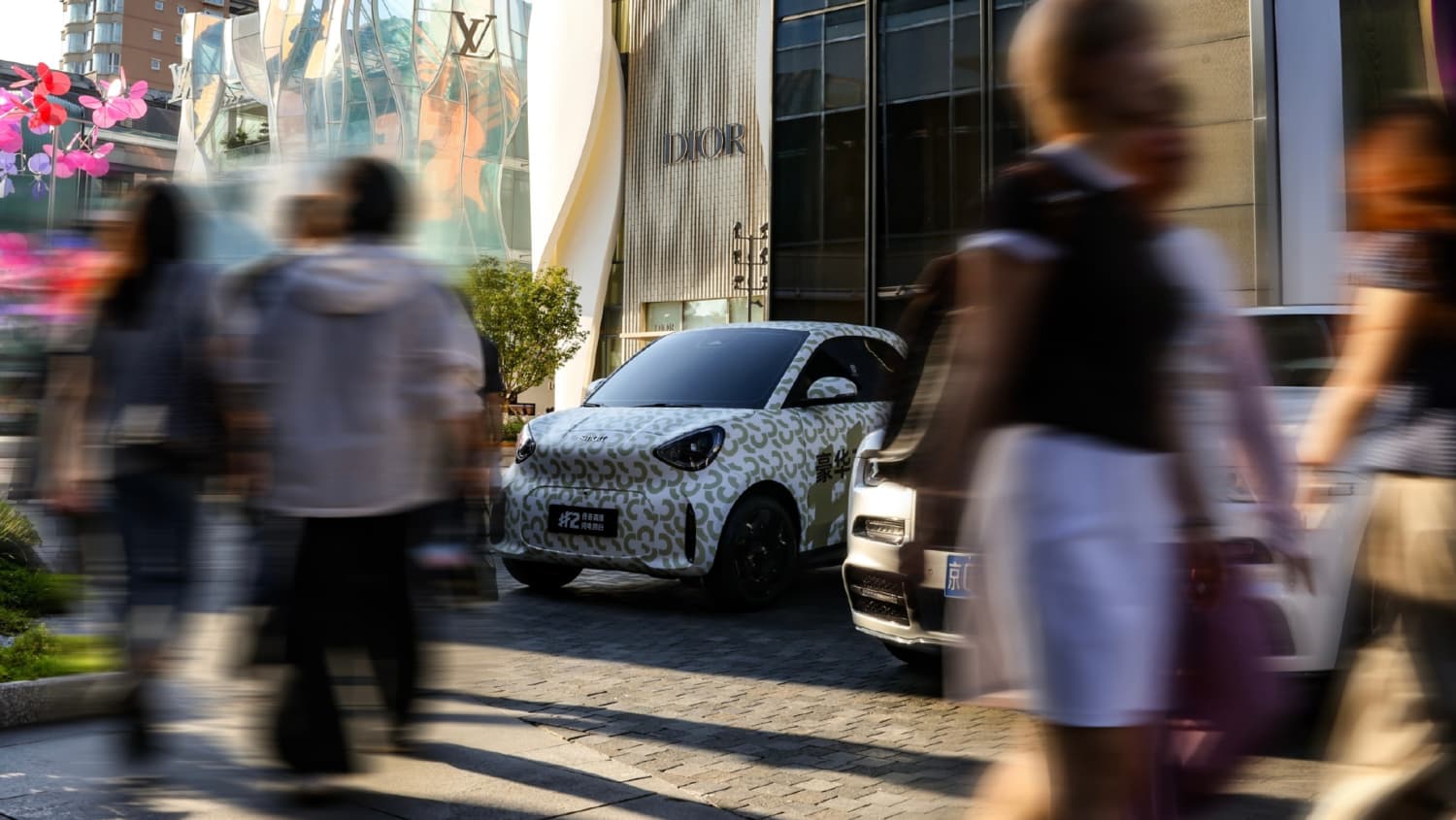
The new Smart #2 has been spotted testing in Beijing, Shanghai and Shenzhen. Despite the camouflage wrap, the basic concept is clearly visible: Smart is bringing back an extremely compact, two-door electric two-seater.
The world premiere is scheduled to take place at the Paris Motor Show in October 2026. This also confirms the model for Europe and the DACH region—Germany, Austria and Switzerland. Initial key specifications for the Smart #2 as an electric two-seater were already known, and Chinese registration documents have now provided further details.
The Smart #2 adopts the basic idea of the former Fortwo but uses a new electric platform.
Two seats and less than 2.80 metres long
The Smart #2 was designed by the Mercedes-Benz design team. Its proportions remain close to the familiar city-car concept, complemented by a closed-off front, distinctive headlights, round taillights and a contrasting roof.
Depending on the version, it measures around 2.75 or 2.76 metres long. Both variants are approximately 1.67 metres wide and 1.56 metres high. The wheelbase is a compact 1.88 metres.
| Specification | Smart #2 |
|---|---|
| Body | Two-door electric two-seater |
| Length | around 2.75 to 2.76 m |
| Width | around 1.67 m |
| Height | around 1.56 m |
| Wheelbase | around 1.88 m |
| Kerb weight | 1,130 kg |
| Motor output | 60 kW |
| Top speed | 140 km/h |
| Battery | 35.7 kWh, LFP cells from CATL |
| Range | around 300 km WLTP |
| DC charging | 10% to 80% in 20 minutes |
New ECA platform enables an extremely tight turning circle
The new ECA architecture, developed by Smart specifically for small electric cars, provides the technical foundation. Particularly striking is the stated turning circle of just 6.95 metres. Tight parking garages, narrow driveways and quick U-turns are therefore likely to be among the #2’s major strengths.
The electric motor produces 60 kW and enables a top speed of 140 km/h. That is sufficient for a vehicle designed squarely for urban driving while also allowing short motorway journeys.
LFP battery provides around 300 km of WLTP range
A 35.7 kWh battery with lithium iron phosphate cells from CATL is installed in the underbody. This cell chemistry is considered robust, relatively inexpensive and well suited to frequent charging to high states of charge. Developments in China in particular demonstrate how widely LFP batteries are being adopted in the electric car market.
Smart states a WLTP range of around 300 km. In everyday urban use, that could be enough for several days without a charging stop, while significantly less range should be expected on the motorway.
When DC charging, the battery is expected to go from 10% to 80% in 20 minutes. This is a practical figure for a small battery: a short break → enough energy again for most of the day’s driving.
A true city Smart rather than another SUV
With the #2, Smart is returning to a vehicle class closely associated with the brand’s history. While the #1, #3 and #5 are considerably larger, the new model once again targets limited parking space and short everyday journeys.
The European price, standard equipment and actual charging performance will be crucial. The final specifications for Germany, Austria and Switzerland may also differ from the Chinese registration data. Nevertheless, the basic concept appears coherent: very compact, fully electric and with enough range for more than just inner-city driving.