Estonia plans 5 MW chargers for a new electric ferry
Electric mobility does not stop at the dockside. Estonia plans to build high-power charging infrastructure for future electric ferry operations on the important route between Virtsu on the mainland and Kuivastu on the island of Muhu. The connection is also the main corridor to Saaremaa, making it important for commuters, tourism, and logistics.
The project will use a Megawatt Charging System capable of delivering up to 5 MW of charging power at each location. According to current plans, the new battery-electric ferry is to be completed by late 2028 and then enter service on the route.
How the charging infrastructure is planned
Two charging points are to be installed on each side of the crossing. This means the system is not designed solely for a single charging session during each port call, but could also provide redundancy in the future or support multiple suitably equipped vessels.
Technically, the system is based on a 1,500-volt architecture. At megawatt power levels, high voltages offer a practical advantage because they enable lower currents for the same power output. This reduces losses and simplifies the thermal management of cables, connectors, and power electronics—particularly important in everyday maritime operations involving wind, salt, and tight turnaround times.
Why 5 MW matters so much in practice
On short ferry routes with frequent crossings, the basic principle is clear: the battery is not “fully charged” once a day, but topped up during numerous short stops. Above all, high charging power means less downtime for the same amount of energy, enabling a more reliable schedule even when weather or demand causes disruptions.
If a ferry can recharge quickly while in port, the battery can remain smaller, the vessel lighter, and the overall system more efficient. This is precisely why megawatt charging is often the key to integrating electric propulsion into ferry schedules economically.
The new ferry: 3 MWh battery and a focus on the main route
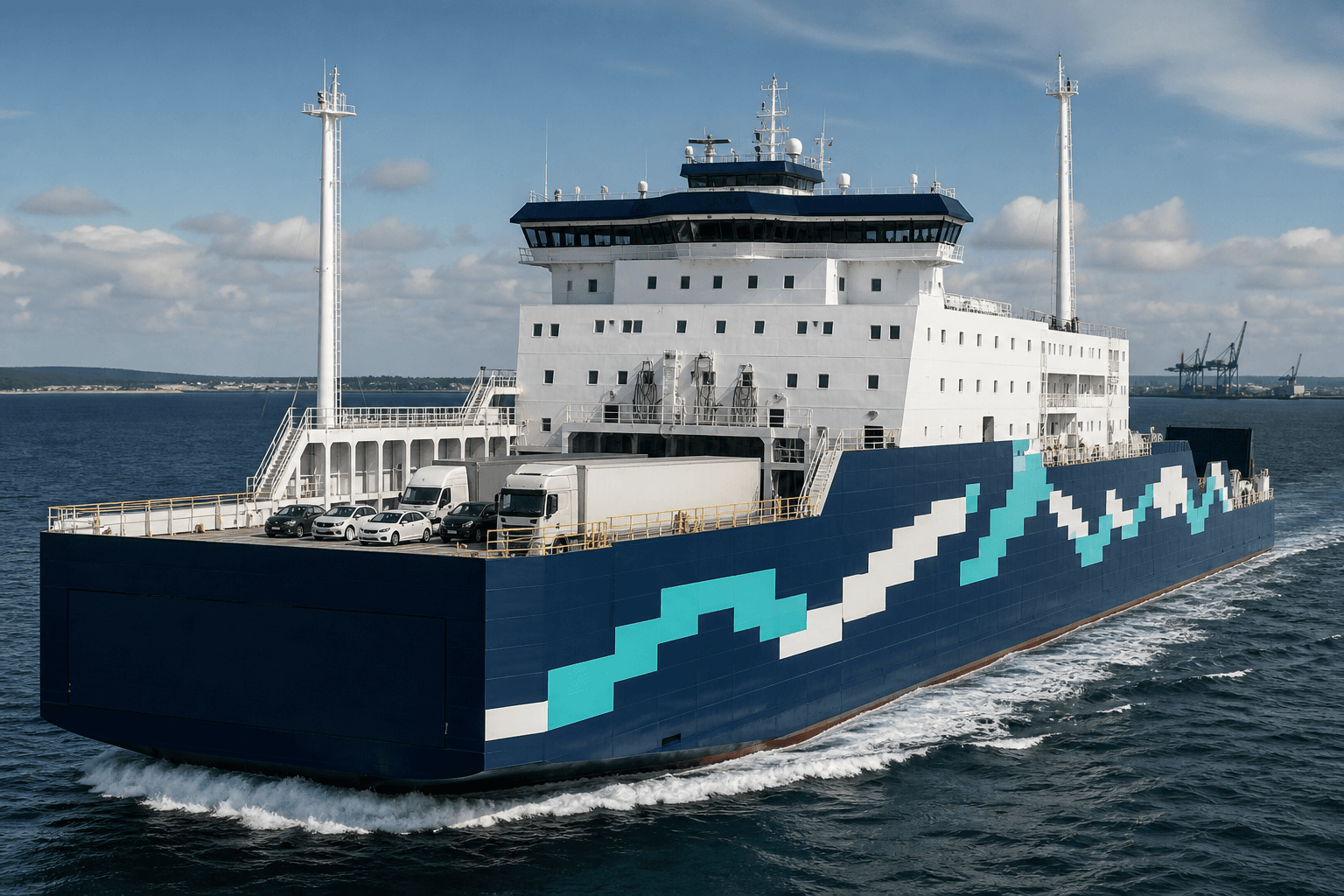
The Estonian government is commissioning a new ferry for the route. It is planned to carry up to 380 passengers and 110 cars or eight trucks. Although the vessel will be smaller than the ferries currently in service, it is intended to provide electric service on the route from late 2028.
The planned energy storage system is a battery with around 3 MWh of capacity. Combined with megawatt charging, this is a typical approach for shuttle routes: enough reserve capacity for operation, but sized so that rapid top-ups throughout the day can keep the battery within its optimal operating range.
| Component | Planned specifications | Real-world impact |
|---|---|---|
| Charging infrastructure | Megawatt Charging System, up to 5 MW per side, two charging points each | Short charging windows are sufficient, keeping the schedule stable |
| Voltage level | 1,500 V | Lower losses and more manageable currents at high power |
| New ferry | Up to 380 passengers, 110 cars, or 8 trucks | Electric operation on a key island route |
| Battery | Around 3 MWh | Designed for frequent top-ups rather than a large overnight charge |
Costs and scalability: infrastructure for more than one vessel
The construction contract for the ferry is worth €50 million, exceeding the amount originally budgeted. This is not unusual for specialized projects involving new technology, particularly when supply chains, safety requirements, and integration work all come into play.
Notably, the charging infrastructure is not being planned exclusively for this particular vessel. If the megawatt system can eventually serve other suitably equipped ships, a standalone project becomes a scalable port solution. This is a sensible approach for island routes in particular, as fleets and service frequencies change over time.
Assessment: Megawatt charging on the water is the next logical step
While high-power charging for road vehicles is generally discussed in the range of 250 to 400 kW, the scale is significantly greater in the maritime sector. Ships move more mass, require more energy per round trip, and still face strict time windows while docked. Megawatt charging is therefore less of a “nice-to-have” and more of a prerequisite for battery-powered vessels to operate in regular service.
Battery technology for electric vessels is also continuing to evolve, including new pack architectures and higher continuous-power requirements. This is exactly where the Estonian concept fits in: high-power charging points at the dock combined with a battery designed for frequent, rapid charging cycles.
Why this is also relevant to everyday EV use
Technology sectors are converging. Many principles familiar from electric cars reappear on a larger scale: high system voltage, charging power as the factor that determines timing, and the challenge of transferring energy into storage quickly and efficiently. Readers interested in charging infrastructure can also find practical analysis in our comparison of 800V vs. 400V in electric cars.
And because range and charging planning are not only issues on land, it is also worth examining the psychology behind them: EV range anxiety explains why large numbers matter less than reliable charging points and predictable operations.