Leapmotor B03: New Electric Hatchback Targets Europe’s Compact Car Segment
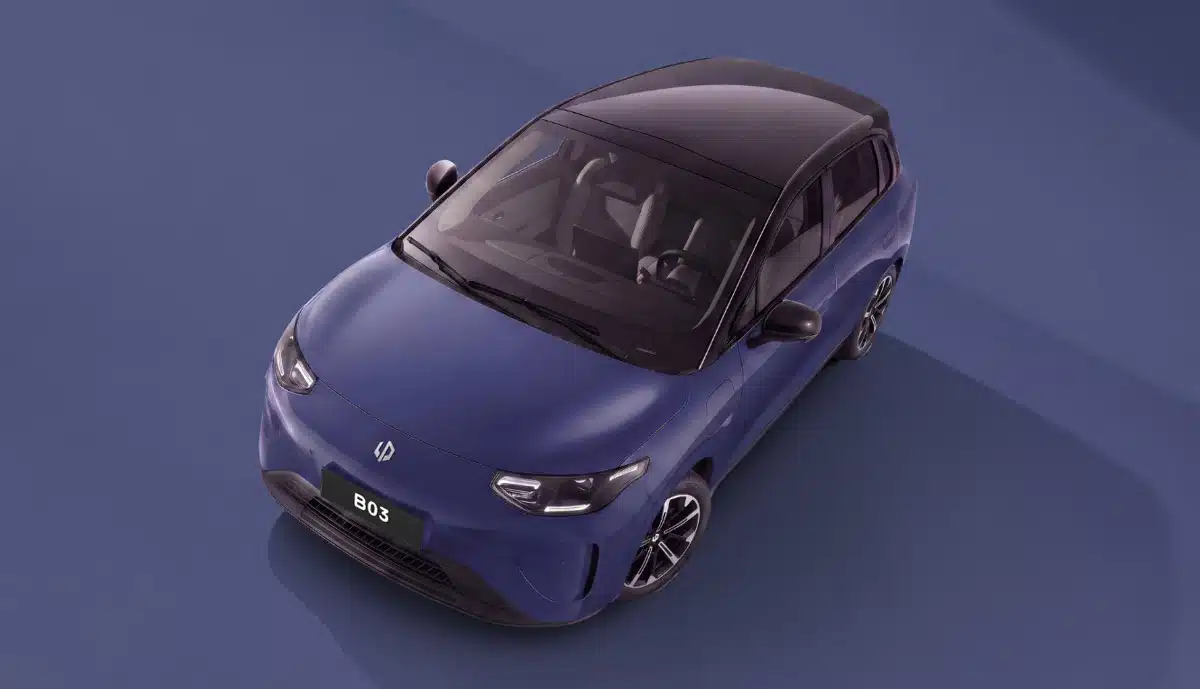
Leapmotor has unveiled the new A05 in China, which is set to be marketed globally as the B03. The concept is clear: a compact, agile electric hatchback for everyday urban use, focusing on the digital user experience, practical versatility, and modern driver-assistance systems.
Of particular interest to the DACH market—the German-speaking region comprising Germany, Austria, and Switzerland—is that Leapmotor is explicitly positioning the B03 as a global model. Although a specific European timeline or final market launch has yet to be confirmed, the direction is clear. As a Stellantis partner, Leapmotor also has a direct route into European sales and service networks.
Dimensions and Spaciousness: 4.18 m Long, but Optimized for Space
At 4,175 mm long, 1,790 mm wide, and 1,560 mm tall, the B03 falls into a typical European compact-car size category. Its wheelbase is 2,605 mm, often a good indicator of how much interior space has been extracted from compact exterior dimensions.
Leapmotor promises a versatile interior with flexible seating configurations, multiple storage compartments, and a large, two-level trunk. In everyday use, this can be more important than a few extra centimeters of length, particularly when strollers, crates of drinks, or sports bags need to be carried regularly.
Range and Charging: Up to 510 km Under WLTC, Pending Homologation
Leapmotor quotes an electric range of up to 510 km under WLTC, subject to final homologation. For European context, WLTC is generally more optimistic than WLTP, so a potential EU model should be expected to have a noticeably lower WLTP figure once the European specifications become official.
Fast-charging capability is also mentioned, although no specific charging rates or charging curves have been provided for the B03. Realistically, the key question will be whether Leapmotor equips the B03 with practical DC charging performance and whether charging remains stable at higher states of charge. In real-world use, that is precisely what separates “capable of fast charging” from “genuinely charges quickly on long journeys.”
Software and Driver Assistance: AI-Powered Experience as a Differentiator
Leapmotor emphasizes an AI-powered digital user experience and “intelligent driving features.” What that means in practice will become clear with a European version: functions relating to assisted driving and automated lane changes are more tightly regulated in the EU than in China, and features are often adapted for individual markets.
For buyers, what ultimately matters is how reliably the driver-assistance systems perform in everyday use: lane guidance on country roads, behavior in construction zones, phantom braking, traffic-sign recognition, and the quality of navigation with charging-route planning. This is precisely where manufacturers such as Tesla have scored highly for years with their strong focus on software, while new entrants often require several updates to reach the standard drivers expect on their daily commutes.
B03X Offers a Technology Preview: The SUV Counterpart Is Already Available to Order in Germany
The sibling B03X, an electric SUV already available to order in Germany, provides a tangible preview. It starts at €24,900 and comes in two versions: the B03X Pro and B03X ProMax. Both feature rear-wheel drive and a permanent-magnet synchronous motor, with top speed limited to 160 km/h in each case.
Leapmotor B03X (Germany): Specifications at a Glance
| Version | Power | Battery (LFP) | Range (WLTP) | Consumption (WLTP) | DC Charging (Max.) | 10 to 80% (DC) |
|---|---|---|---|---|---|---|
| B03X Pro | 130 kW | 39.8 kWh | 292 km | 15.5 kWh/100 km | 100 kW | 21 min |
| B03X ProMax | 145 kW | 53.0 kWh | 382 km | 15.7 kWh/100 km | 133 kW | 21 min |
The B03X supports 11 kW AC charging as standard. For charging from 30 to 80% at an 11 kW wallbox, the manufacturer quotes 2 hours and 30 minutes for the Pro and 3 hours and 10 minutes for the ProMax. With DC charging, 30 to 80% is said to take 16 to 17 minutes. This points to a charging strategy optimized more for short stops than solely for achieving the highest possible peak-kW figure on the specification sheet.
What Does This Mean for Prospective Buyers in Germany, Austria, and Switzerland?
If Leapmotor does bring the B03 to Europe, it would be another contender in the highly competitive compact EV segment, where price, efficiency, and software quality matter more than extreme performance. Particularly interesting is the expected combination of LFP batteries—cost-stable and robust in everyday use—and charging performance that already appears solid in the B03X.
For context and alternatives, it is also worth looking at our overview of compact electric SUVs in Germany. And because real-world charging times always depend on the underlying platform, our comparison of 800 volts vs. 400 volts is useful for putting specification-sheet figures into perspective.
How successful Leapmotor ultimately becomes in Europe will depend not only on price and equipment, but above all on the overall package: reliable software, a robust service network, and effective charging-route planning. That is what determines whether a compact EV merely looks good on paper or genuinely impresses in everyday use.
You can also find more details about the European launch and the compact model’s specific technical configuration in our overview of the Leapmotor B03 for Europe.