The market for new cars under €20,000 is tight, but EV options are growing
Anyone looking for a new car in Germany for less than €20,000 in 2026 now has only a limited selection. According to the latest market overview, just a few models are still available in this price range, and most of them continue to use combustion engines, including mild hybrids and liquefied petroleum gas (LPG) models.
What is interesting, however, is that the budget segment for all-electric cars is no longer a one-model show. Three different EVs currently have base versions that officially start below €20,000. That is not yet a mass market, but it is a clear step toward affordable electric mobility.
Comparing the three new electric cars under €20,000
| Model (base version) | List price | Power | Battery (net/usable) | WLTP range | AC charging | DC charging |
|---|---|---|---|---|---|---|
| Dacia Spring (Electric 70 Essential) | €16,900 | 52 kW | 24.3 kWh | 221 km | 3.7 kW | depending on trim/option |
| Leapmotor T03 | €18,900 | 70 kW | 36 kWh | 265 km | 6.6 kW | up to 45 kW |
| Renault Twingo E-Tech Electric (Evolution) | €19,990 | 60 kW | 27.5 kWh | 263 km | up to 11 kW | up to 50 kW |
Important: These are list prices as of August 2026, excluding discounts or limited-time offers. In practice, special deals can narrow the gap to larger models, particularly when manufacturers offer aggressive financing or additional incentives.
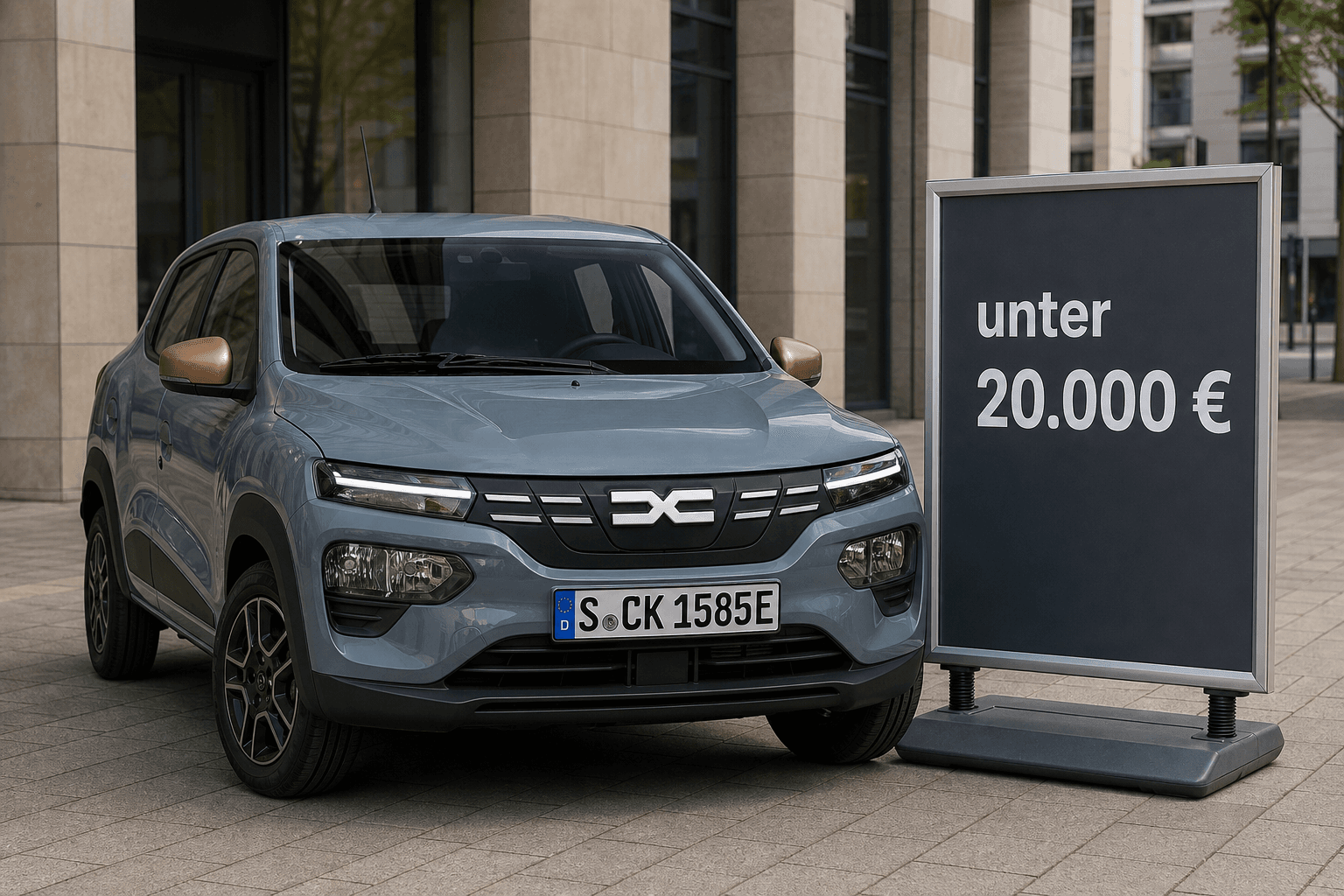
Dacia Spring: Minimalist but unbeatable on price
The Dacia Spring remains the entry-level choice for anyone who simply needs an inexpensive electric car. The base version costs €16,900 and comes with 52 kW of power and a 24.3 kWh battery. Its WLTP range is 221 km, while official energy consumption is correspondingly low at 12.7 kWh per 100 km.
The downside is charging: The base version’s 3.7 kW AC charging is a clear limitation if you frequently use public chargers or do not want the car to sit for long periods overnight. It can still work well for city driving, suburban trips and short commutes, provided the charging profile suits your routine.
On the plus side, even the better-equipped versions remain below €20,000. This makes the Spring particularly attractive if you deliberately want something small and view the car primarily as a practical tool.
Leapmotor T03: A larger battery and a surprising amount of equipment
The Leapmotor T03 starts at €18,900, offers 70 kW of power and has the largest battery in this trio, with 36 kWh of usable capacity. That gives it a WLTP range of 265 km, providing noticeably more of a buffer than the cheapest Spring.
Charging performance reaches up to 6.6 kW AC and up to 45 kW DC. It is no long-distance champion, but for a typical mix of city driving and occasional fast-charging stops, it is considerably less stressful than very slow AC charging.
The T03 also demonstrates how important equipment has become in the entry-level segment. Features such as air conditioning, a reversing camera, navigation and driver-assistance systems are no longer automatically paid extras in this class.
Renault Twingo E-Tech Electric: Just under €20,000 and the most well-rounded for charging
Renault has priced the base Twingo E-Tech Electric at €19,990, right on the threshold. You get 60 kW of power, a 27.5 kWh battery and 263 km of WLTP range. That is a solid figure for a city car capable of more than just short errands.
Its everyday advantage lies in the charging package: up to 11 kW AC and up to 50 kW DC are impressive in this price class because they provide greater charging flexibility. Renault quotes around 30 minutes for a fast charge from 10% to 80% at a suitable charging station.
Another interesting feature is standard Vehicle-to-Load (V2L). This means the car can serve as a power source for external devices → useful for camping, tools or limited emergency power. If this interests you, it is also worth looking at V2L in the Tesla Model Y and its adapter-based approach, as it shows how differently manufacturers implement V2L.
Why there are so few new cars under €20,000
There are several reasons why the overall selection is shrinking: stricter safety and driver-assistance requirements, higher material and energy costs, and generally more expensive vehicle platforms. Even in the small-car segment, a price below €20,000 is no longer the norm.
Notably, no model from a German manufacturer appears on this list below €20,000. The cheapest new German car sits just above that threshold. This also explains why new platforms and economies of scale are so crucial if genuinely affordable, mass-market electric cars are to be built in Europe again.
Which electric car under €20,000 is right for whom?
A good fit if you want to drive electric as cheaply as possible
- Dacia Spring, if you cover short distances and can live with slower AC charging.
A good fit if you want more range and equipment
- Leapmotor T03, if you want strong range for the money and a more modern overall package.
A good fit if charging and everyday usability are priorities
- Renault Twingo E-Tech Electric, if you want the most well-rounded charging setup of the three and find V2L appealing.
Perspective: Under €20,000 is the new starting point, not the ceiling
These three models show that the entry-level EV segment is moving again. Even so, buyers with a slightly larger budget can often get considerably more car for their money, particularly in terms of charging performance, space and long-distance comfort. Our overview of electric compact SUVs in Germany in 2026 offers a useful guide to alternatives, although they naturally fall into a higher price bracket.
And if range is your main concern, a fact check may help. Our guide to EV range anxiety explains where these concerns come from and what really matters in everyday use.