New Yangwang sedan spotted under heavy camouflage
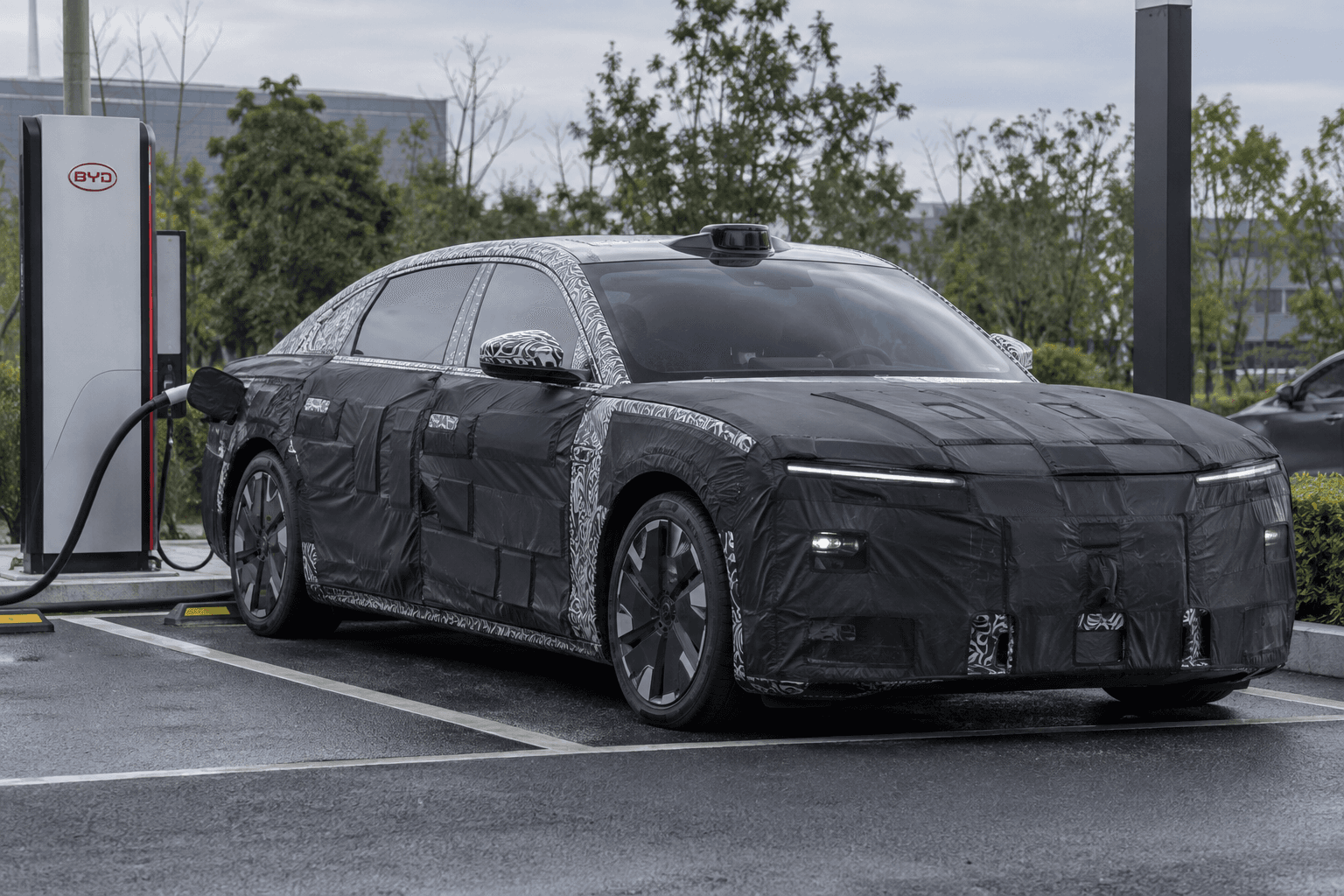
BYD appears to be aiming even higher with its Yangwang luxury brand. A heavily camouflaged flagship sedan has been spotted in China. With an estimated length of around 5.5 m, it could compete in the segment for particularly large chauffeur-driven cars.
The prototype has an angular silhouette, a long bonnet and a notably generous wheelbase. Large rear doors emphasise its prestigious ambitions. The camouflage makes it impossible to determine reliably whether they will eventually be rear-hinged.
Yangwang has yet to officially confirm the model name, dimensions, price or launch date.
Price could be significantly higher than the Yangwang U7
A Chinese price of more than 2 million yuan has been suggested, equivalent to roughly €250,000. That would be more than three times the starting price of the Yangwang U7, which is offered in China from 658,000 yuan, equivalent to around €83,000.
However, such conversions are only a rough guide. Chinese prices cannot be transferred directly to Germany, Austria or Switzerland because of taxes, equipment, distribution costs and potential import surcharges.
| Feature | Current information |
|---|---|
| Length | Around 5.5 m, not yet confirmed |
| Price in China | Expected to exceed 2 million yuan |
| Powertrain | Electric powertrain likely, not yet confirmed |
| Sensors | Roof-mounted LiDAR module visible |
| Charging technology | Flash Charging suspected |
| Market launch | Not yet officially announced |
Flash Charging is likely, but not confirmed
The location where the photos were taken is particularly interesting: the prototype was photographed at one of BYD’s Flash Charging stations. This suggests that Yangwang is testing the new sedan with the latest generation of the Blade Battery and very high charging power.
However, a photo at this charging station does not constitute technical confirmation. Only official data will reveal whether the sedan can actually achieve the short charging times that BYD has already indicated for models such as the BYD Seal 06 with Flash Charging. At the same time, the group is building its own charging network with up to 1,500 kW in China.
For a heavy luxury sedan, the combination of a large battery and high charging power would be particularly relevant. Greater battery capacity may provide a long range, but without suitable infrastructure it also extends charging stops. High voltage and effective battery-cell cooling could significantly reduce this disadvantage.
LiDAR and plenty of rear-seat space
A LiDAR sensor is visible on the roof. The system uses laser pulses to scan the vehicle’s surroundings and can complement cameras and radar for driver-assistance functions. For a flagship sedan in particular, BYD is likely to be targeting an extensive suite of assistance systems and a high level of comfort for rear-seat passengers.
The proportions also point to a vehicle intended more as a chauffeur-driven sedan than as a sporty alternative to the U7. The large distance between the front and rear axles creates room for spacious seats, generous legroom and comfort features in the rear.
Yangwang expands its luxury line-up
Yangwang already offers the U7 as both a battery-electric model and a plug-in hybrid. The electric car is rated for up to 1,006 km under China’s CLTC test cycle. This figure is not directly comparable with a European WLTP range and is usually lower in everyday driving.
A long-term 30,000 km test of the Yangwang U7 demonstrates how seriously BYD takes its battery technology in the luxury segment. The potential new sedan would not simply replace the existing range but would open up an additional price category above the U7.
For now, this remains a small market segment. Yangwang sold 442 vehicles in August, comprising 233 examples from the U8 series, 205 U7s and four U9s. A total of 2,899 vehicles were sold during the first eight months of the year.
European launch remains uncertain
It is not yet clear whether the new Yangwang sedan will be offered outside China. A European launch would be challenging because of homologation, servicing, brand development and the high price category. Nevertheless, the model could become an important technology showcase for BYD, even if sales volumes remain modest.
Official details on the battery, charging power, range and start of production will now be crucial. Until then, the prototype sends a clear signal: BYD sees Yangwang not merely as a manufacturer of eye-catching prestige cars, but as a serious challenger in the automotive luxury segment.