BYD presents the Ti 9 live for the first time, and the PHEV feels like an EV with backup
At the 2026 Chengdu Auto Show, BYD publicly presented the Ti 9 for the first time through its Fang Cheng Bao (FCB) brand. The model is positioned as a plug-in hybrid (PHEV), but its battery and charging specifications are more commonly associated with battery-electric vehicles. At its core is a 66.5 kWh LFP “Blade 2.0” battery with what the company calls Flash Charging.
One aspect is particularly relevant to the DACH region—Germany, Austria and Switzerland: Fang Cheng Bao is a separate BYD sub-brand in China, but many of its technologies and platform modules later appear in BYD or Denza products. In other words, even though the Ti 9 itself has not yet been confirmed for Europe, its specifications indicate where the technology is heading.
Dimensions and technology: large and angular, but not a traditional off-roader
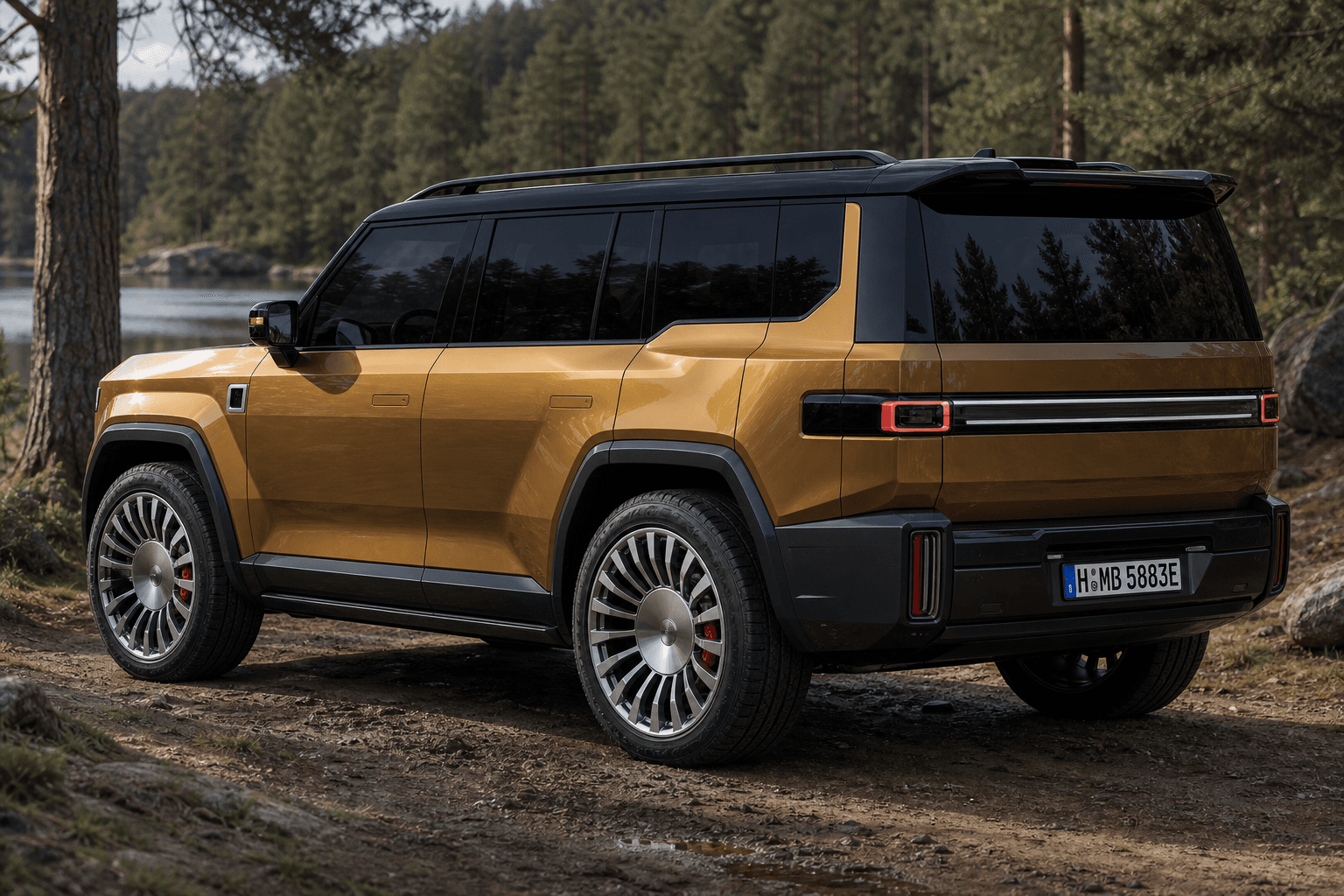
Visually, the Ti 9 presents itself as a “hardcore” SUV with an angular silhouette, wide fenders and a tall front end. Technically, however, it is not a body-on-frame off-roader but a unibody crossover. A DiSus-P Ultra hydraulic suspension control system is intended to provide comfort and driving dynamics, while rear-wheel steering should offer tangible benefits in everyday use—around town, in parking garages and when maneuvering—given the vehicle’s length of more than five meters.
| Specification | BYD Fang Cheng Bao Ti 9 (PHEV) |
|---|---|
| Length, width, height | 5,270 mm, 1,999 mm, 1,850 mm |
| Wheelbase | 3,130 mm |
| Battery | 66.5 kWh LFP (Blade 2.0) |
| Electric range (Chinese figure) | up to 310 km |
| Powertrain | 1.5-liter turbo engine + 2 electric motors |
| Peak system output | 400 kW |
| Flash Charging | 10% to 97% in 9 minutes |
| Total range (Chinese figure) | up to 2,300 km |
310 km of electric range in a PHEV: why that stands out in Europe
An electric range of 310 km is exceptionally high for a plug-in hybrid. For context, such figures generally come from Chinese test cycles and cannot be compared directly with WLTP. Nevertheless, the Ti 9 shows where the market is heading: large PHEVs in China are increasingly being designed as “EVs with range-extender characteristics,” featuring a genuinely useful battery for everyday driving and a combustion engine as backup for long journeys.
In theory, that means commuting and urban driving could be completed entirely on electric power, even without a perfectly consistent daily charging routine. On the highway, the combustion engine retains its flexibility, including a very long combined range—although European results would depend heavily on the driving profile and the test cycle ultimately used.
Nine-minute Flash Charging: what is behind it, and what it is not—yet
BYD claims that the Ti 9 can charge from 10% to 97% in nine minutes. More than anything, this demonstrates how aggressively BYD is advancing its LFP systems, including thermal management and usable charging windows. Since LFP is considered both robust and cost-effective, this development is technically and strategically significant.
For Europe, however, it is crucial to remember that such charging times always depend on specific conditions: a compatible high-power charging station, battery temperature, the charging curve and whether the feature is approved for the respective market. Those interested in exploring the architectural differences in greater depth can find a useful comparison of 800V versus 400V in everyday EV use.
Seating: five, six or seven seats, in keeping with the XXL format
Complete details of the interior were not yet provided on stage. Chinese homologation documents do, however, indicate that the Ti 9 will be available in three layouts: with five, six or seven seats. That makes sense given its dimensions, while the 3,130 mm wheelbase points to generous space in the second and third rows.
Market context: Fang Cheng Bao remains focused on China, but its technology often spreads further
Fang Cheng Bao is currently primarily a China-focused brand under the BYD umbrella. At the same time, Europe is increasingly seeing models or platforms appear under other BYD labels, such as Denza. Those interested in this aspect of BYD’s European strategy can also take a look at the Denza N8 with a Blade battery and Flash Charging.
For a broader look at how strongly LFP currently dominates in China, figures and background information are available in our overview of the Chinese battery market and LFP’s share.
Assessment from a DACH perspective: competitive pressure is also increasing for Tesla and others
For Tesla, a vehicle such as the Ti 9 is less a direct rival than a signal: BYD is scaling its battery and charging expertise across multiple brands and segments, including PHEVs with very large batteries. Tesla remains firmly committed to battery-electric vehicles and a tightly integrated overall package combining efficiency, software and its charging network, but the pressure to innovate in batteries, charging times and cost curves is clearly increasing.
Ultimately, the Ti 9 demonstrates one thing above all: BYD no longer treats LFP as “budget chemistry,” but as a platform for extremely fast charging and substantial, practical electric driving—even in vehicle classes traditionally associated with high consumption and little enthusiasm for plugging in.