BYD launches Canadian website as market entry takes shape
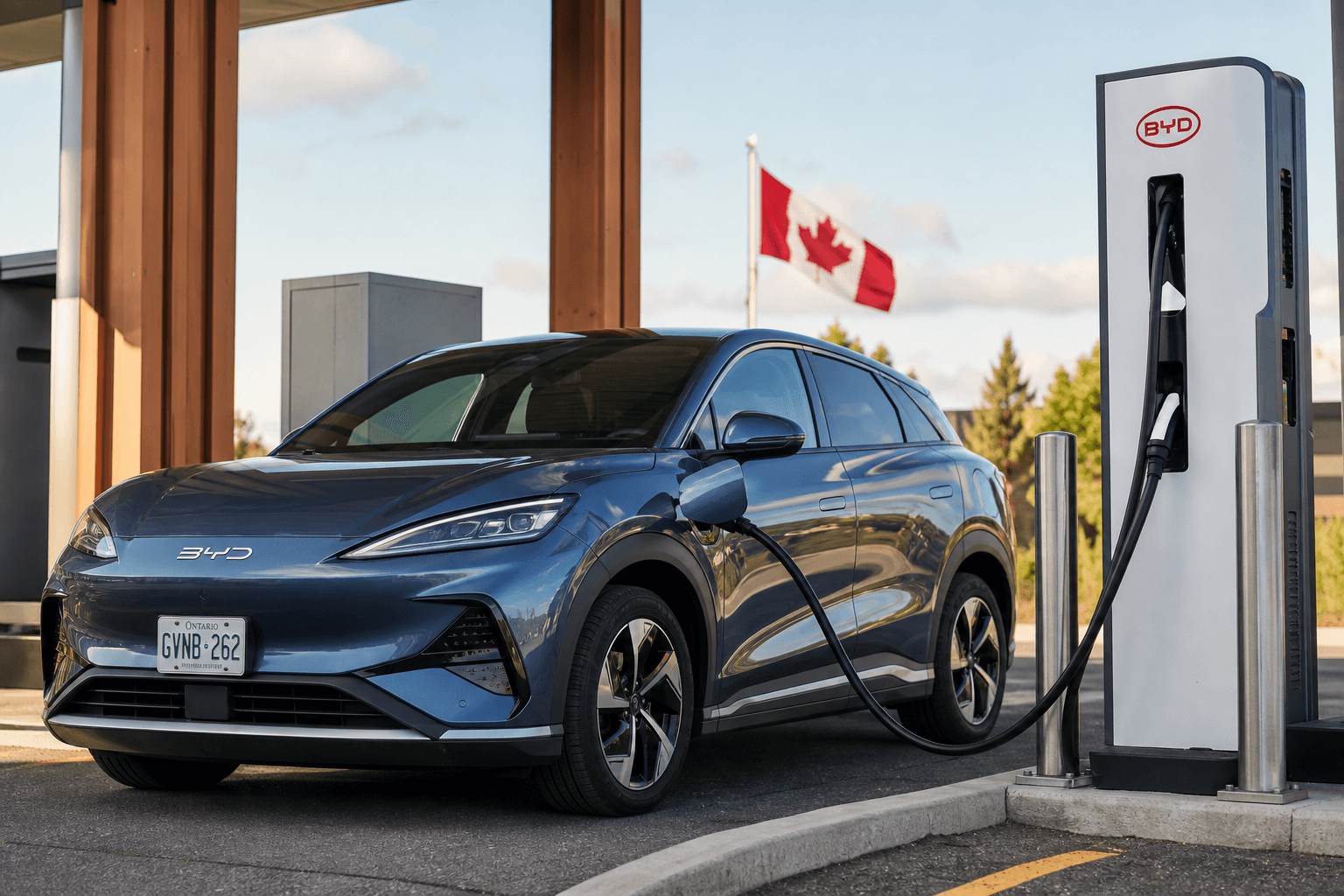
BYD has quietly launched a dedicated website for Canada. The site is still light on content: Instead of a configurator, prices or a dealer locator, it primarily features a "Coming soon" message along with basic information about the brand, safety and its global presence.
Nevertheless, a dedicated country website like this is more than cosmetic. In practice, it is often one of the building blocks that only goes live once legal structures, communication plans and initial processes for a market launch are being prepared.
No sales or reservations, but a clear statement in the terms of use
Anyone already hoping to place a preorder will have to wait: According to the terms of use, the Canadian BYD website currently does not allow purchases, lease agreements, financing applications, reservations, preorders or deposits. That is consistent with an early launch phase in which the brand initially builds awareness and prepares its operations.
The formal setup is also notable: The documents name "BYD Canada Company Limited", based in Markham, Ontario, as the operator. The content is available in English and French, clearly tailored to Canada’s bilingual market.
Megawatt FLASH Charging as showcase technology
On the technology side, BYD is using the website to highlight an area that is also of interest to Europe: Megawatt FLASH Charging. This refers to a fast-charging system that, according to BYD, is designed to enable extremely short charging sessions when combined with 1,500 kW charging technology and the second-generation Blade Battery.
What BYD is specifically promising
| BYD claim | Figure | Real-world relevance |
|---|---|---|
| Charging from 10% to 70% | 5 minutes | A brief stop—more grab-and-go than a proper break |
| Charging to 97% | 9 minutes | Unusually high for such a short charging time, but it requires suitable infrastructure |
| 20% to 97% at -30 °C | only 3 minutes slower than normal | Cold-weather performance is crucial for Canada, but would also be relevant to winters in the DACH region—Germany, Austria and Switzerland |
An important caveat: Figures like these depend on the vehicle, battery temperature, state of charge, charging hardware and grid connection. The real game changer would be for BYD to deliver this performance reliably in everyday use at a large number of locations, not just in the laboratory.
20,000 FLASH Charging stations in China, then an international rollout
BYD plans to have around 20,000 FLASH Charging stations operating in China by the end of 2026. A larger international rollout is then expected to follow. The fact that this technology is featured so prominently on the Canadian website suggests how BYD intends to stand out in the new market: by making charging time a key selling point.
For the DACH region, this is primarily of interest as a broader trend. High-power charging and 800-volt architectures are also receiving considerable attention there because they can deliver noticeable time savings on long journeys. If you are interested in the topic more generally, our comparison of 800V vs. 400V architectures in EVs is also worth reading.
More pieces of the puzzle: BYD builds its market-entry organization
Alongside the new website, other signals suggest that BYD is serious about Canada: The manufacturer has recently advertised several management and key positions there, covering areas such as sales, marketing, dealer network development, finance, after-sales, legal affairs and operations. This is typical of a phase in which import operations, service capabilities and retail structures are being prepared.
What this means for Tesla and the market
More competition in the EV market is rarely bad for customers. BYD traditionally brings a high degree of vertical integration and extensive battery expertise, while Tesla counters with its Supercharger ecosystem, efficiency and an extremely mature software platform. If BYD does scale megawatt charging with a network of its own, it will create additional pressure to keep improving the charging experience, regardless of whether someone drives a Tesla.
It is also interesting to see how quickly new energy-management features are becoming part of everyday life. Tesla itself is currently demonstrating how bidirectional technologies are becoming more tangible, for example with the Tesla Model Y and its V2L adapter, which allows the vehicle to power external devices.
Which BYD models will arrive remains unclear
The Canadian website does not yet answer the most important question: Which vehicles BYD will offer there first. Manufacturers generally begin with high-volume models that are competitively priced and positioned in key segments. BYD has long been present in Europe, including with the BYD Seal, making many of its technical claims easier to assess than those of an entirely new market entrant.
Ultimately, the new Canadian website is not a major breakthrough, but it is a clear milestone: BYD is building the public-facing platform for its market entry, and FLASH Charging is apparently intended to play a key role.