Xiaomi is bringing its EVs to Germany in 2027
Xiaomi is getting serious about Europe: The technology group plans to officially launch its electric cars in Germany and other European markets from 2027. This will turn its previously heavily China-focused automotive business into a genuine international rollout, including local sales and service infrastructure.
For buyers in the DACH region—Germany, Austria, and Switzerland—this is relevant for one key reason: An official market launch means reliable service planning, parts availability, and clearly defined specifications for Europe. For young brands, these points are often the biggest hurdle, rather than the technology in the car itself.
Eight dealer groups to provide the foundation for sales and service
In Berlin, Xiaomi signed letters of intent with eight major German automotive retail groups. The companies named were Dello, Dinnebier, Emil Frey, Fett & Wirtz, Hahn Automobile, LUEG Mobility, Penske-Jacobs Innovation, and SPT Avior.
The strategy is therefore clear: At launch, Xiaomi will not rely exclusively on its own stores but will initially use established dealer networks. At the same time, the company is expanding its presence in Europe, including through an R&D center in Munich and its search for additional sales partners.
The 2027 model has not yet been finalized, but the SU7 is considered likely
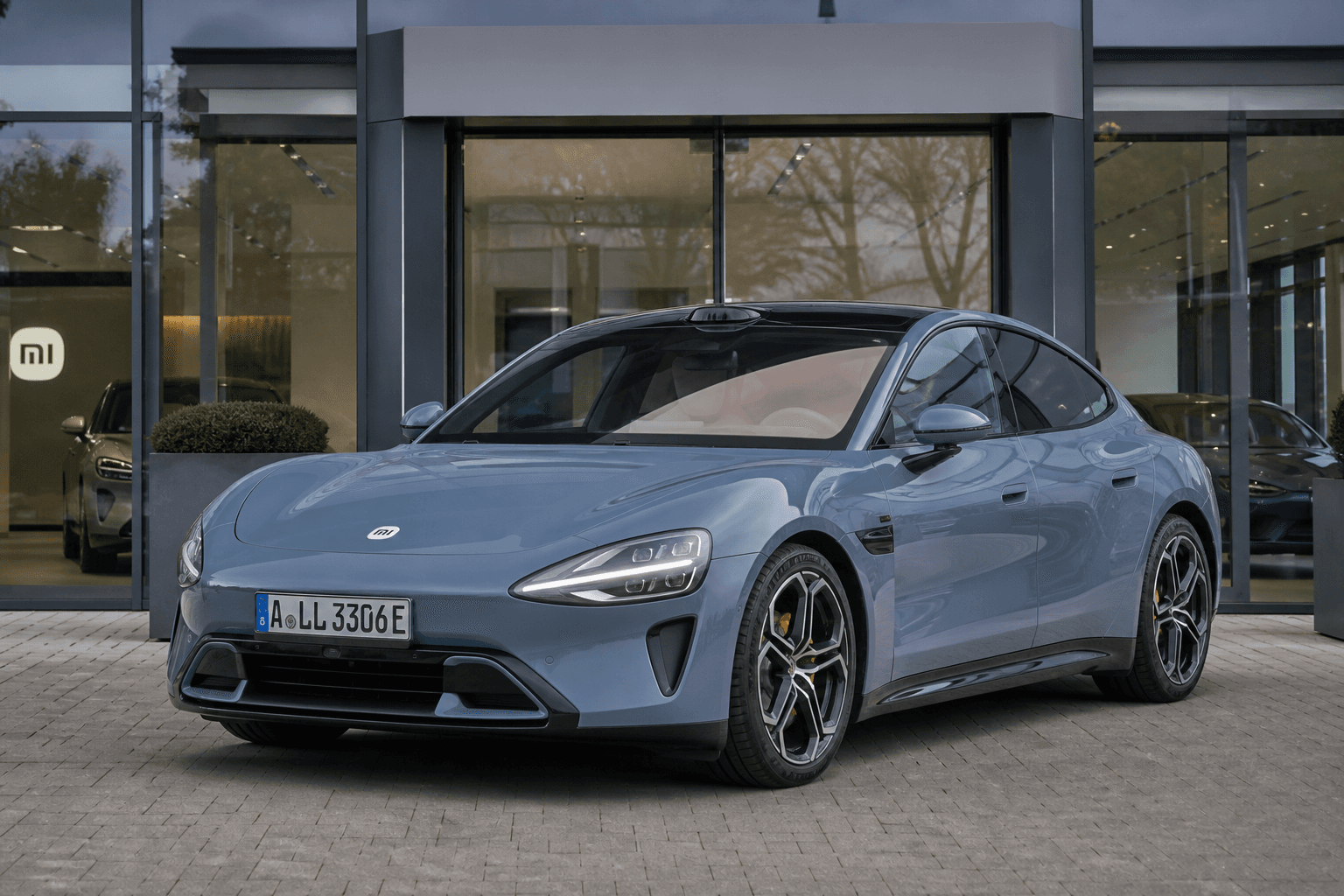
There has not yet been official confirmation of which model will be the first to go on regular sale in Germany in 2027. However, the focus is on the nearly five-meter-long Xiaomi SU7 electric sedan, the model with which Xiaomi first became an automaker.
Xiaomi is already showcasing the SU7 internationally but notes that the SU7 and SU7 Ultra are not currently sold outside China. The key question for Europe is therefore which variants and equipment configurations will ultimately be homologated.
Technical specifications: high power and large batteries, but CLTC is not WLTP
The updated SU7 generation, in its current Chinese-market form, is 4.997 m long and has a 3.0 m wheelbase. In China, it is available in Standard, Pro, and Max versions, with two rear-wheel-drive variants and a top-of-the-range all-wheel-drive version.
| Variant (China) | Drivetrain | Power | Battery | Range (CLTC) |
|---|---|---|---|---|
| Standard | Rear-wheel drive | 235 kW | from 73 kWh | up to 720 km |
| Pro | Rear-wheel drive | 235 kW | depending on version | depending on version |
| Max | All-wheel drive | 508 kW | up to 101.7 kWh | up to 902 km |
An important point when interpreting these figures: The range estimates come from China’s CLTC test cycle, which is generally considerably more optimistic than the WLTP standard used in Europe. For Germany, the homologated WLTP figures will therefore be what ultimately matters, not the Chinese numbers.
Fast charging: Xiaomi claims 10% to 80% in around 12 minutes, but that is a best-case scenario
For the more powerful versions, Xiaomi promises fast charging at up to 5.2C and, under ideal conditions, around 12 minutes to charge from 10% to 80%. Such figures sound impressive, but in practice they depend heavily on cell chemistry, thermal management, charging route planning, and the charging infrastructure actually available.
For Europe, the decisive factors will therefore be which battery variants Xiaomi offers and how charging performance is optimized for local high-power charging networks. Readers interested in the fundamental differences between platforms can find an overview in our comparison 800V vs. 400V: which EV architecture makes sense in 2026.
Design comparison with the Porsche Taycan: understandable, but not the whole story
Visually, the SU7 is often compared with the Porsche Taycan, particularly because of its silhouette and proportions. This is not unusual: Many designs in the performance sedan segment converge because aerodynamics and packaging strongly influence their appearance.
The market positioning will be more interesting. Xiaomi is likely to enter with aggressive pricing, but in Europe it will also have to account for tariffs, homologation, and its dealer and service network. As a result, the value-for-money proposition familiar from China could shift noticeably.
Grey imports will become less appealing after the official launch
Even before the official market launch, there were attempts to bring the SU7 to Germany through independent importers. However, Xiaomi publicly clarified that it would not cooperate with this type of import operation. With an official dealer and service network in place from 2027, the appeal of grey imports is likely to decline anyway: Warranty coverage, software updates, parts, and recall handling will then be managed much more clearly.
Why Xiaomi’s timing matters for Europe
Since launching its automotive division in early 2024, Xiaomi reports that it has delivered a total of more than 700,000 vehicles, including over 500,000 SU7s in around 28.5 months. This shows that Xiaomi is not merely a hardware newcomer with prototypes: It has already demonstrated control over high-volume production and its supply chain.
For Europe, this means another competitor will arrive in 2027 that could put pricing pressure on premium manufacturers. At the same time, only the final EU specifications will reveal how well the software, driver-assistance systems, charging integration, and service quality perform in everyday use. Readers generally interested in new Chinese market entrants can also consult our overview of EV trends and market shares in Europe for broader context.