Walmart Reaches 100 Company-Owned High-Power Charging Locations in the US
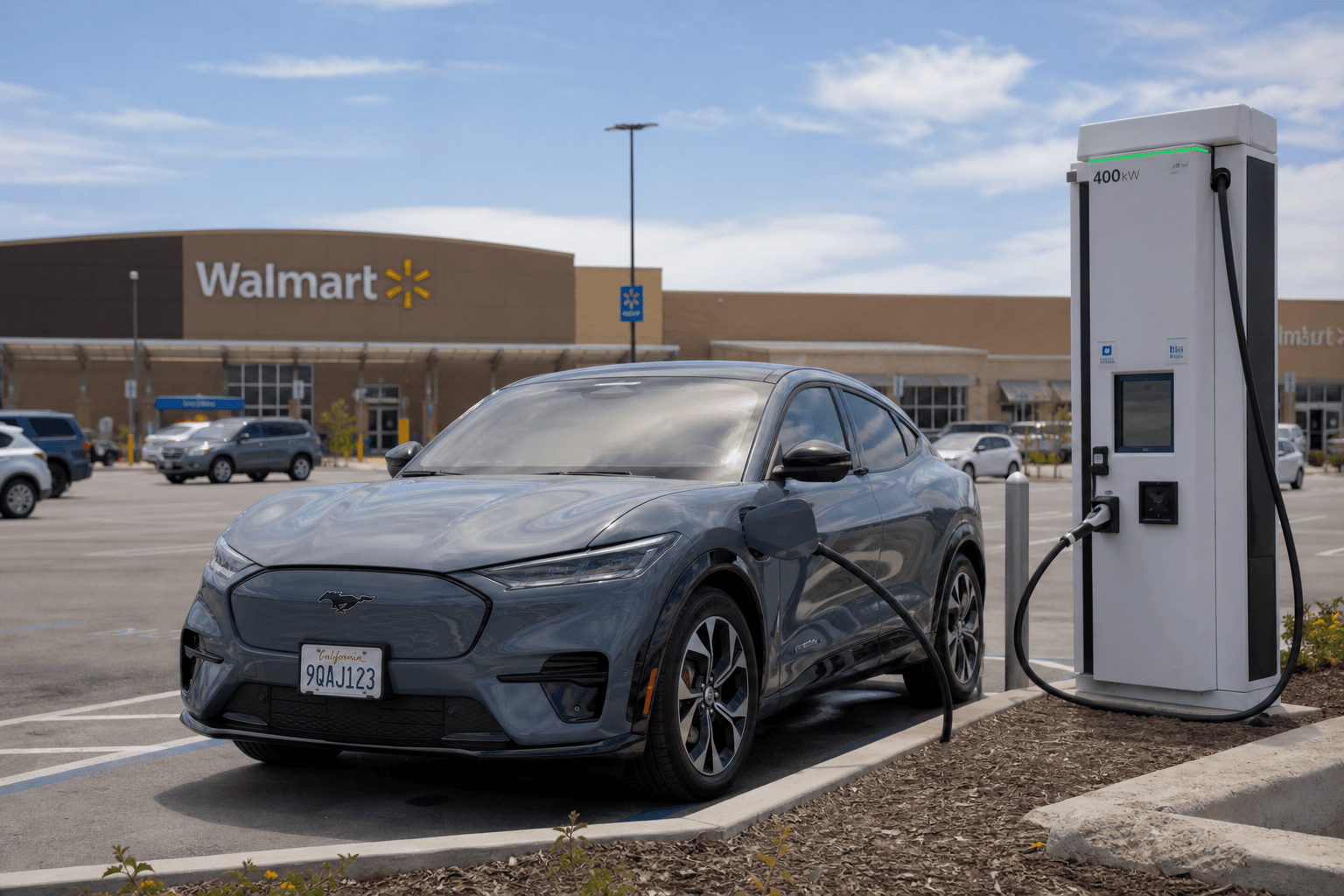
Walmart has opened its 100th company-owned fast-charging location in the US. Its charging network now spans 100 stores across 20 states. While this is not a service available in the DACH region—Germany, Austria and Switzerland—it clearly shows how actively major retailers are becoming involved in charging infrastructure.
The milestone location is at a Walmart Supercenter in Monument, Colorado. It has eight charging points designed to deliver up to 400 kW of DC charging power. One practical caveat: 400 kW is the maximum rating, and only a few vehicles can currently take advantage of it.
Station Layout: 8 to 16 Charging Points With a Mix of CCS and NACS
Walmart describes its standard setup as locations with 8 to 16 charging points. These are typically divided between CCS and NACS, Tesla’s charging standard, which is becoming increasingly dominant in North America. The Monument location is one of the smaller configurations, with eight connectors split evenly between CCS and NACS.
For European readers, this is an interesting illustration of the differences between the markets: CCS2 is the established standard in the EU, while NACS is increasingly becoming the common denominator in the US. NACS is already the norm for Tesla drivers there, and many other manufacturers are now following suit.
Hardware: 400 kW Chargers From ABB and Alpitronic
Walmart is relying on established manufacturers for its hardware stack: ABB (A400 All-in-One) and Alpitronic (HYC400 Hypercharger). These are conventional high-power charging systems capable of dynamically distributing their output. In practical terms, one system can, for example, supply two vehicles simultaneously with up to 200 kW each or deliver full power to a single vehicle, provided the car and battery can accept it.
For everyday use, the maximum figure matters less than the combination of high sustained power, reliable cooling, good availability and a sensible number of charging bays. At retail locations in particular, it is also important that charging spaces are not constantly blocked by vehicles that are not charging and that navigation systems provide reliable directions to the chargers.
Software and Operation: Walmart Integrates Charging Into Its Own App
Notably, Walmart says it has developed the software platform itself. The platform connects the chargers, collects live availability and performance data, processes payments, and sends station information to popular maps and charging directories.
For customers, charging is handled through the standard Walmart app. Drivers can use it to find charging points, start sessions, pay and monitor charging without having to install a separate charging app. Walmart+ members also receive a charging discount.
From a user perspective, however, one issue remains crucial: when in doubt, many drivers simply want to plug in and pay by card without being forced to create an account. Walmart has announced additional payment options, which would be an important step for occasional users.
Why a Retailer-Owned Charging Network Matters So Much in the US
Walmart has vast amounts of space at heavily frequented locations across the US. The company previously announced a goal of equipping thousands of locations with charging points by 2030. With 100 company-owned locations now operating, it still has a considerable way to go, but the development shows the direction of travel: charging is moving to places where people already spend time, such as shopping, eating or running quick errands.
This is fundamentally positive for Tesla and other EV brands because more fast-charging locations mean fewer bottlenecks in everyday use. A network supporting both NACS and CCS also effectively provides a bridge between Tesla drivers and the rest of the North American market.
What 400 kW Really Delivers in Practice
- High peak power primarily benefits vehicles with 800-volt architectures and effective thermal management.
- Many models charge at significantly lower rates, making stable charging power over several minutes more important.
- Power sharing can help a location remain more predictable even during periods of higher demand.
View From the DACH Region: No Walmart Network, but the Principle Is Relevant
Walmart is not a charging provider in Germany, Austria or Switzerland, and the connector issue has been resolved differently here anyway. Nevertheless, the topic remains relevant: when retailers scale up fast charging, they create a model that can also work in Europe, provided that sites, grid connections and billing systems are suitable. Close app integration can be convenient, but it must not become a barrier to access.
Ultimately, the milestone of 100 locations demonstrates one thing above all: expanding high-power charging is no longer the exclusive domain of traditional charge point operators. Retail sites are increasingly becoming infrastructure, and that could make everyday charging noticeably easier.