VW ID. Tiguan Takes on a Key Role
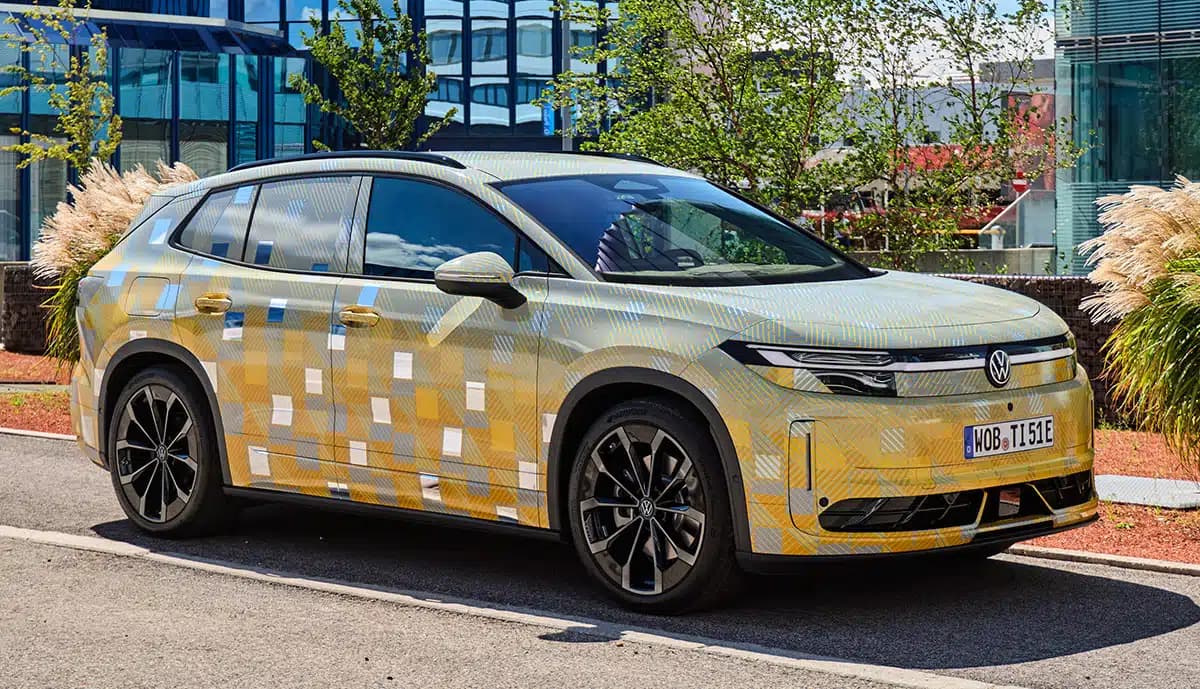
Volkswagen is reorganizing its electric SUV lineup. The approximately 4.62 m-long VW ID. Tiguan is due to launch in early 2027 and replace the current ID.4 and ID.5. Its world premiere has been announced for early October, and the model will remain camouflaged until then.
The electric Tiguan will be offered alongside the combustion-powered and plug-in hybrid versions of the model range. VW is thus continuing the strategy it began with the ID. Polo and ID. Cross of also using familiar model names for fully electric cars.
The Tiguan name is intended to immediately convey to customers what size, everyday practicality, and market positioning they can expect from the new electric SUV.
That makes sense: With more than 8.3 million Tiguans produced, the model range is one of the group’s most important products. Its electric starting point is also strong, as combined deliveries of the ID.4 and ID.5 have exceeded 950,000 since 2021.
MEB+ and Three Planned Power Levels
Technically, the ID. Tiguan is expected to be based on the enhanced MEB+ platform. According to currently available information, three variants are expected at launch. The following figures have not yet been fully confirmed officially and may change before the premiere.
| Variant | Power | Battery | Range | 0 to 100 km/h | DC Charging |
|---|---|---|---|---|---|
| Base rear-wheel drive | 140 kW | 58 kWh LFP | up to 450 km WLTP | 8.5 seconds | up to 105 kW |
| Rear-wheel drive | 210 kW | 77 kWh NMC | up to 600 km WLTP | 6.6 seconds | up to 165 kW |
| 4Motion all-wheel drive | 220 kW | 77 kWh NMC | up to 560 km WLTP | 6.3 seconds | up to 165 kW |
The base version is expected to be electronically limited to 160 km/h, while the two more powerful models will be limited to 180 km/h. The LFP battery may already be an appealing option for commuters and drivers who mainly travel in urban areas. Those who frequently cover long distances will get more range and faster charging with the 77 kWh pack.
Charging Times Are Solid Rather Than Record-Breaking
The smaller battery is expected to charge from 10% to 80% in around 26 minutes. Despite its higher peak charging power, the larger pack is expected to take about 29 minutes. The decisive factor is not only the maximum rate but also the charging curve throughout the entire session.
Automatic battery preconditioning is intended to bring the battery to a favorable temperature in good time. Set a fast charger as the navigation destination → the battery is prepared. Especially in winter, this can make the difference between the promised charging power and what is actually achievable.
A Familiar Name Instead of an Abstract Model Number
With the renaming, VW is not abandoning the ID. family, but it is linking it more closely with familiar model ranges. The ID. Tiguan is intended to have a distinctive design while adopting the strengths of the established SUV: plenty of space, straightforward operation, and clear positioning in the mass-market segment.
The move could make it easier for the model to gain traction in the market. While the ID.4 and ID.5 first had to establish themselves as new names, the Tiguan has long been well known in the German-speaking DACH region of Germany, Austria, and Switzerland. In the future, combustion-powered, plug-in hybrid, and electric versions will cater to different powertrain preferences under one familiar name.
ID. Tiguan Price Still Undecided
No official prices have been announced yet. In Germany, the current ID.4 serves as a benchmark and is presently available from €46,765. Whether the base LFP version of the ID. Tiguan will start below that price is likely to depend primarily on equipment, production costs, and the pricing strategy at launch.
No pricing information is available for Austria or Switzerland yet either. What is already clear is that with up to 600 km of WLTP range, rear-wheel or all-wheel drive, and two battery chemistries, VW aims to cover a broad spectrum ranging from a practical family car to a powerful long-distance SUV.