VW ID. Aura T6 launches in China: the technology behind it
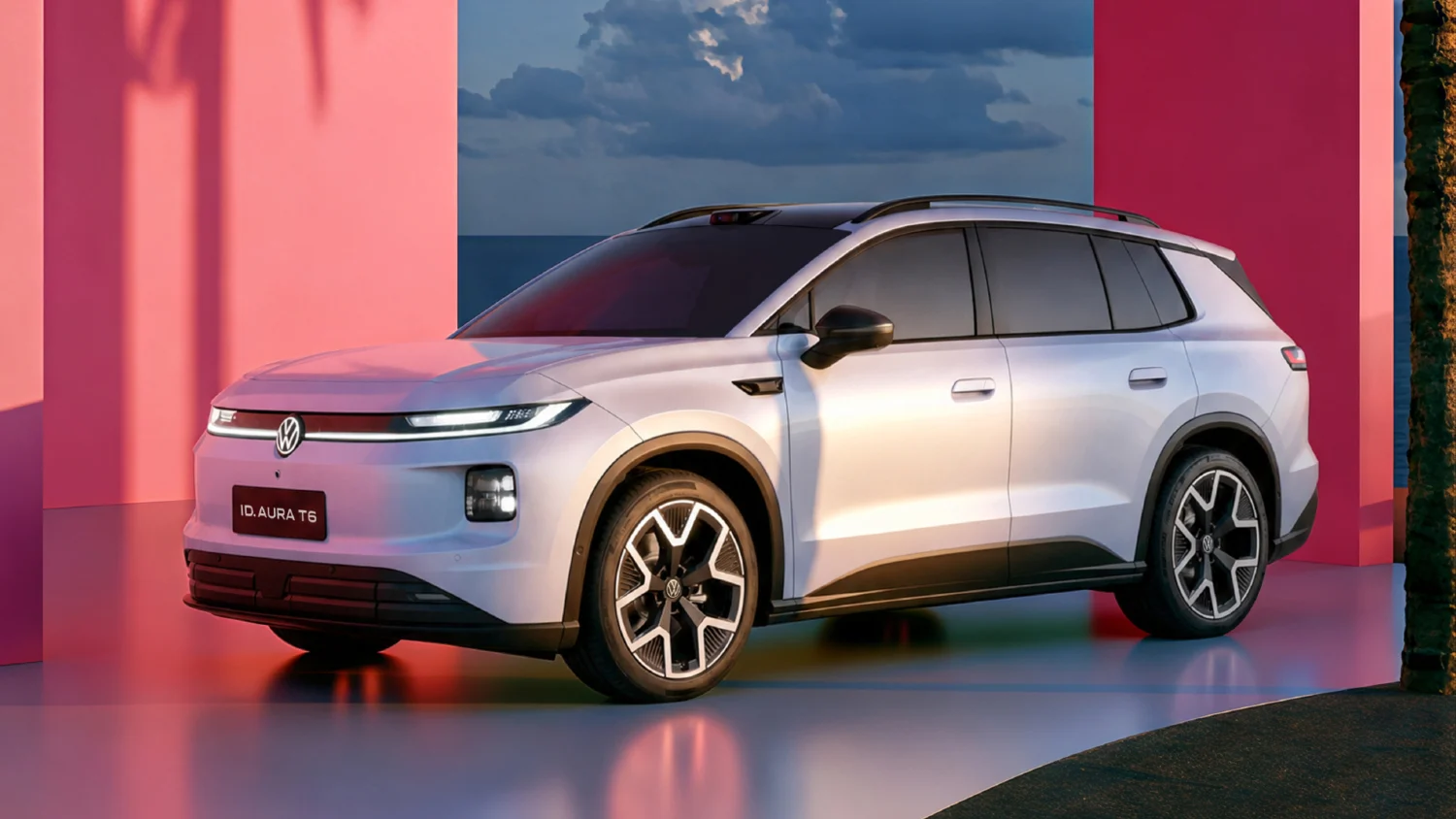
Volkswagen has opened pre-orders in China for the new ID. Aura T6. The model comes from its joint venture with FAW and is positioned as a five-seat midsize electric SUV. The entry-level price is 135,900 yuan (roughly equivalent to around 20,000 euros, depending on exchange rates and taxes).
For those of us in the German-speaking DACH region—Germany, Austria and Switzerland—it is particularly interesting as a signal of Volkswagen’s technology and strategy: The ID. Aura T6 is based on the CEA architecture, which Volkswagen developed together with Xpeng. That does not automatically mean a derivative will come to Europe, or indicate when one might arrive, but the direction is clear: China’s development speed, software and modern driver-assistance hardware are intended to move into mass-market models more quickly.
Dimensions, aerodynamics and design details
At 4,811 mm long, 1,879 mm wide and 1,648 mm tall, the ID. Aura T6 is not a compact SUV, but clearly sits one size above. Its wheelbase measures 2,836 mm, which generally translates into generous space in the second row.
VW quotes a drag coefficient of 0.245. This is supported by typical aerodynamic measures such as a closed front end, an active air intake and partially flush door handles. Depending on the version, 19-inch or 20-inch wheels are available, while certain trim levels feature a clearly visible LiDAR sensor on the roof.
Powertrain and battery: rear motor plus two LFP options
VW uses a single electric motor on the rear axle producing 170 kW. According to the manufacturer, the base model accelerates from 0 to 100 km/h in 7.2 seconds. This means the ID. Aura T6 is tuned more for confident everyday driving than for outright performance.
There are two LFP battery options: 59.9 kWh and 77.5 kWh. The stated range is 540 to 660 km (CLTC). Importantly, China’s CLTC test cycle is generally much more optimistic in real-world use than Europe’s WLTP, so the figures would be noticeably lower under European testing. Even so, the combination of LFP chemistry and a large battery reflects what the Chinese market currently prioritizes: robust cell chemistry and low costs per kWh.
Interior: large displays plus AR head-up display
Inside, VW follows the approach that has become established in China: large screens and few conventional buttons. The equipment includes a 15.6-inch central display, a 10.25-inch instrument cluster and a 25.8-inch augmented-reality head-up display.
The infotainment system runs on a 4 nm chip with a stated peak performance of 20 TOPS. It also offers wireless features such as Apple CarPlay, along with local platforms including HiCar and Carlink, which are primarily aimed at the Chinese market.
Practicality: 576-liter trunk plus frunk
The ID. Aura T6 is offered exclusively as a five-seater. The trunk is said to hold 576 liters, increasing to as much as 1,796 liters with the rear seats folded. There is also a 90-liter frunk under the hood.
Higher trim levels also include features that can quickly become everyday essentials: heated, ventilated and massaging front seats, plus an audio system with 18 speakers.
LiDAR assistance: Highway NOA and Urban Pilot
The driver-assistance equipment is particularly notable from a technical perspective: Certain versions feature a LiDAR-based system combined with the Horizon Robotics Journey 6H, which offers a stated computing performance of 420 TOPS. It is intended to support functions such as Highway NOA (navigation-assisted driving on expressways) and Urban Pilot for urban environments.
An important point from a European perspective is that such feature packages depend heavily on local software, map data and regulations. What operates as “Urban Pilot” in China cannot be transferred directly to the DACH region, but it clearly illustrates the competition to bring more advanced driver-assistance features to the mass market. Those looking to assess the topic in a European context will find that Tesla has pursued a different approach for years, focused more heavily on cameras and software; see, for example, Tesla FSD v15 and HW4.
Versions and prices at a glance
| Version | Stated range (CLTC) | Price (yuan) | LiDAR |
|---|---|---|---|
| ID. Aura T6 540 Pro | 540 km | 135,900 | No |
| ID. Aura T6 660 Pro | 660 km | 149,900 | No |
| ID. Aura T6 660 Max LiDAR | 660 km | 159,900 | Yes |
| ID. Aura T6 660 Ultra LiDAR | 660 km | 169,900 | Yes |
Why this matters for VW and Europe
Volkswagen is under enormous competitive pressure in China, and the ID. Aura T6 is another example of how quickly the product landscape is shifting there: LFP batteries, large infotainment displays, advanced driver-assistance systems and aggressive pricing. Such vehicles are not automatically “the next ID.” to arrive at European dealerships, but they demonstrate which technology building blocks Volkswagen could transfer to future MEB+ platforms or their successors.
If you are currently comparing models that are actually available in our market, it is worth looking at today’s midsize and compact SUV segment. Our overview Electric compact SUVs for 2026 provides a useful assessment, while the long-running VW ID.3 serves as a reference point. And for those using Tesla as a benchmark for efficiency and range, our comparison reference is the Tesla Model Y.