New Volvo safety alerts via update: wildlife, cyclists, roadworks and crashes
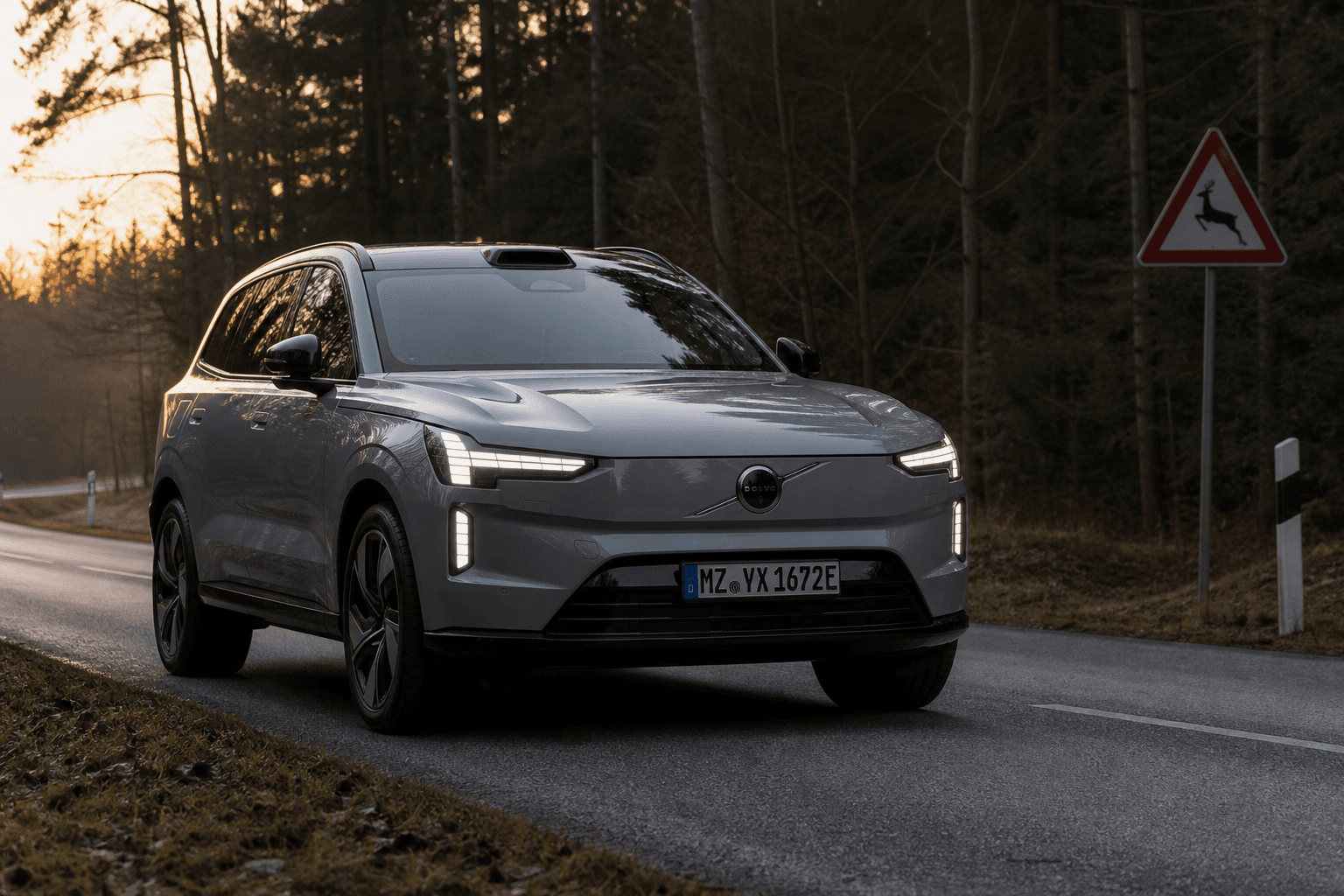
Volvo is expanding its connected safety features through a software update. In North America, the all-electric EX60, EX90 and ES90 will receive additional alerts based on hazards already detected and reported by other vehicles. The key benefit is that the car can warn you about situations beyond the crest of a hill or around a blind corner.
An important point for readers in the DACH region—Germany, Austria and Switzerland—is that the new alerts have initially been announced for the US and Canada. However, the basic principle is already familiar in Europe, where similar data ecosystems and partnerships between manufacturers exist. According to Volvo, whether and when these new alert types will arrive here in exactly this form depends on the model and regional implementation.
Which new alerts are coming and how they help in everyday driving
The update adds four new alert categories. They build on the existing Connected Safety approach and do not replace any features, but expand the package to cover additional, specific hazards.
- Large Animal Alert: Warns of large animals on or near the road, such as deer or moose.
- Vulnerable Road User Alert: Alerts drivers to vulnerable road users such as cyclists or pedestrians, including in higher-speed environments.
- Roadwork Alert: Reports roadworks before you can see signs, barriers or altered lanes.
- Accident Ahead Alert: Warns of crashes or crash sites farther ahead on the route.
The real-world impact is fairly clear: receiving information earlier gives you more time to react. Particularly when animals cross the road or roadworks begin unexpectedly, an earlier warning can make the difference between controlled braking and a frantic evasive maneuver. “Not visible” becomes “known” → reducing both stress and risk.
How Volvo’s “Connected Safety” works and why it is about more than sensors
These alerts do not mean that your car can “see through walls.” Instead, the concept works like a swarm: vehicles detect events and share them anonymously so that drivers approaching later can be warned sooner. In Europe, Volvo can draw on a collaborative data environment that combines safety and road data from different manufacturers and vehicle types.
This usefully complements conventional sensors, including cameras, radar and, depending on the model, other systems. After all, even the best vehicle sensors cannot physically see around the next corner. Connected alerts close precisely this gap, provided the data is current, plausible and filtered correctly.
What is already available and what changes with the update
Volvo already offered connected warning features, including alerts about slippery roads or hazard lights activated by other vehicles. The new alerts extend this concept to cover typical hazards that appear suddenly and are often underestimated in everyday driving.
Anyone interested in the models can also find our detailed page on the Volvo EX90. And if you generally want to know why range and journey planning are usually less stressful in everyday use than many people expect, take a look at our guide to EV range anxiety.
Assessment: Software-delivered safety updates are becoming the new standard
The fact that Volvo is adding safety features through updates is a positive sign for the industry as a whole. Tesla established this approach in everyday use, and other manufacturers are following suit and making features more dynamic. What matters most is not the marketing term, but the quality of the data and how effectively alerts are prioritized so that they help rather than annoy drivers.
To see how software and platform decisions shape charging and everyday usability, take a look at our comparison of 800V vs. 400V EV architectures. It explains why some updates and features only become possible or worthwhile with certain vehicle architectures.
Connected alerts are not autopilot magic, but they shift the critical moment from “seen too late” to “prepared in time.”
Volvo says the exact rollout will vary by model. For buyers in Germany, Austria and Switzerland, the key questions are therefore how the new alert types will be introduced in Europe and which regional data sources will be integrated.