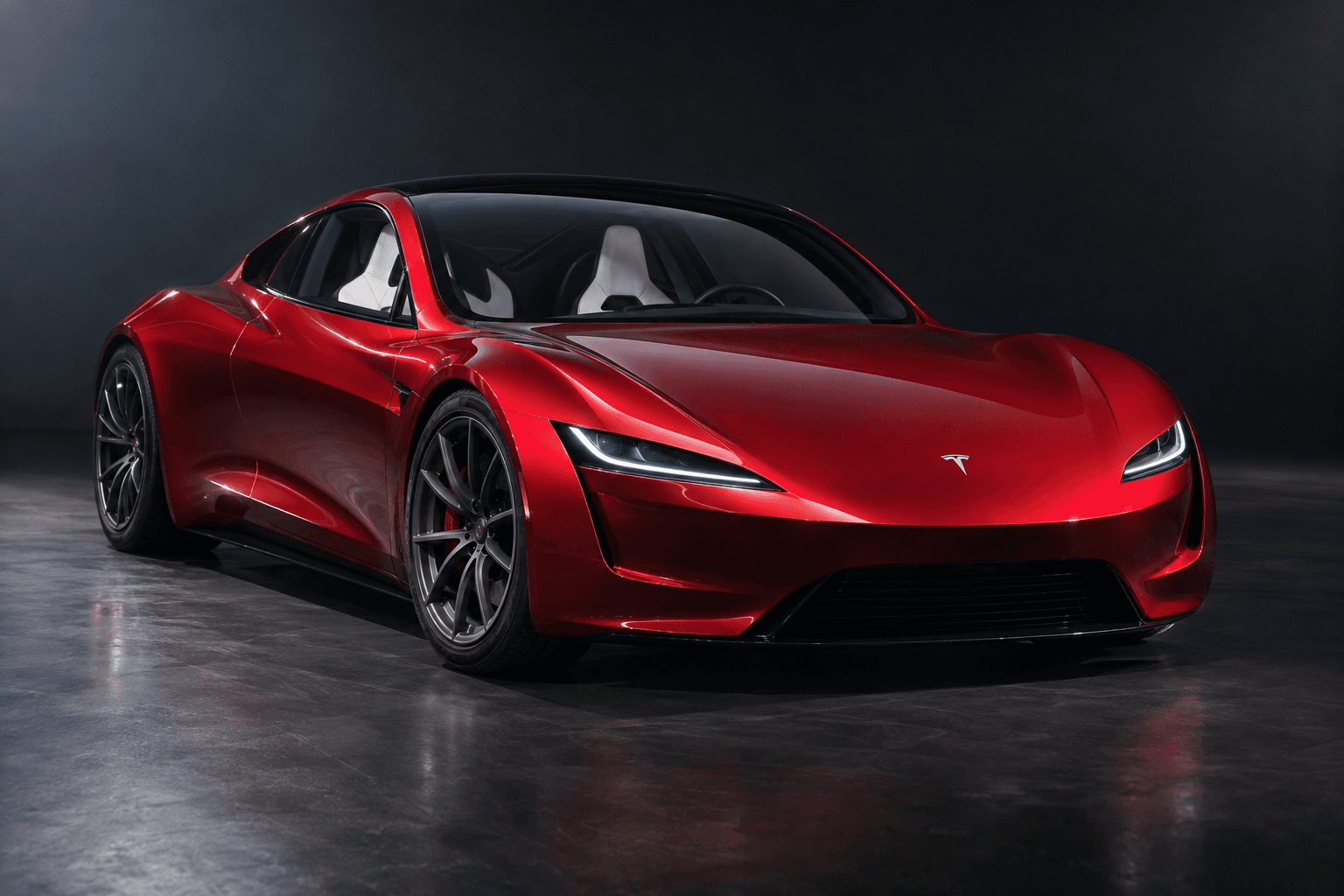
Tesla Roadster returns to the stage on October 1
Almost nine years after first unveiling the second-generation Roadster, Tesla plans to provide more concrete details. A new reveal has been announced in Texas for October 1, 2026, and initial invitations are reportedly already being sent to reservation holders.
However, that does not automatically mean production is about to begin. Tesla is likely to focus on showing how much the vehicle has changed technically and visually since the 2017 concept. Key questions about pricing, standard equipment and the delivery date remain unanswered.
The presentation has been announced, but many of the Roadster’s most spectacular features have so far only been hinted at through statements, patents and teasers.
What is already known about the new Tesla Roadster
The Roadster is intended to be positioned as an uncompromising flagship above the Tesla Model S. Rather than simply offering more power, Tesla appears to be pursuing a comprehensive approach combining lightweight construction, active aerodynamics, electronic steering and additional thrust from compressed gas.
| Technology | Current status | Potential benefit |
|---|---|---|
| Cold-gas thrusters | Announced as an option for years | Additional thrust during acceleration |
| Active ground effect | Described in a Tesla patent | More downforce without a large rear wing |
| Steer-by-wire | Corresponding system documented in a patent | Variable steering ratio depending on speed |
| One-piece sport seats | Patent shows a lightweight composite structure | Lower weight with high rigidity |
| Revised design | Only partly visible in teasers | Sharper styling and active aerodynamics |
Cold-gas thrusters could push beyond the limits of tire traction
The most striking Roadster promise remains the so-called SpaceX package. It would use several thrusters to expel gas stored at high pressure. Unlike a rocket, there is no combustion; thrust is generated by the controlled release of compressed gas.
Such a system could supplement the tires’ traction during acceleration. Tesla previously suggested a time of around one second to just under 100 km/h for the most powerful configuration. There is still no confirmed time for the standard 0–100 km/h sprint.
The repeated claim that the Roadster could fly should not be confused with an actual flying car. A very brief lift-off or hop during a demonstration would be more realistic. Whether such a feature could be offered in a customer vehicle and approved in Germany, Austria and Switzerland—the DACH region—would depend on factors including noise, safety, pressure vessels and the protection of bystanders.
Ground effect instead of a huge rear wing
A Tesla patent describes an airflow system extending from the front underbody to the rear diffuser. By directing the movement of air, the system is intended to create lower pressure beneath the vehicle. This would pull the Roadster more firmly toward the road and increase the available grip.
The principle is reminiscent of historic fan-car concepts from motorsport. For a road car, the main advantage would be the ability to generate high downforce without fitting a particularly large rear wing that creates substantial drag.
However, more downforce does not automatically mean more range. Depending on the implementation, fans require energy, while additional downforce increases the load on the tires. Tesla would therefore need to control the system intelligently: maximum ground effect on the racetrack and a more efficient setting for normal road use.
Steer-by-wire could make steering response variable
Another patent shows a steer-by-wire system with a significantly wider steering-angle range. Steering commands are transmitted electronically rather than through a conventional continuous steering column. The ratio can change depending on speed and driving mode.
Small movements of the steering wheel would be sufficient when maneuvering, while the steering could respond less nervously at high speeds. This range of adjustment is particularly appealing for an extremely powerful sports car. Redundant sensors, power supplies and actuators would be essential for production use.
Lightweight seats designed as structural components
Tesla also appears to be looking to reduce weight in the interior. A patent application shows a one-piece seat shell made from a composite material such as carbon-nylon or Kevlar-nylon. An integrated flexible joint is intended to provide adjustment without requiring numerous heavy individual components.
The concept follows Tesla’s approach of integrating multiple components into larger structures. For everyday use, however, the seat would still need to combine comfort, crash safety and adjustability. The patent alone does not indicate whether this exact design will enter production.
Sharper design, but no confirmed Cyber look
A dark teaser shows an active rear spoiler, pronounced rear fenders and a full-width light bar. The shapes appear more angular than those of the 2017 Roadster concept. However, it would be premature to infer a fully Cybertruck-inspired design from this.
Nor is the distinctive typeface on the Roadster website reliable evidence of the final design language. The only certainty is that, after such a long development period, Tesla is unlikely to release the vehicle unchanged from its 2017 form.
The Roadster faces a new generation of electric supercars
The competitive landscape has changed considerably since the Roadster was first unveiled. Models such as the Porsche Taycan have made high-performance electric cars practical for everyday use, while new hypercars are achieving ever-higher total outputs and shorter charging times. The announced Denza Z also illustrates just how intense the competition has become.
Tesla therefore needs to deliver more than an impressive acceleration figure. Repeatable performance, thermal management, brakes, handling and charging speed will be crucial. On the racetrack in particular, what matters is not the quickest individual sprint but performance that can be sustained consistently.
Production and pricing remain the biggest unknowns
According to previous information, production is planned for Gigafactory Texas. Development of test vehicles is reportedly already underway, but Tesla has not yet announced a binding date for customer deliveries.
There is also no current final price. In Germany, Austria and Switzerland, additional questions remain regarding homologation, taxation and the availability of individual technology packages. The compressed-gas thrusters in particular could be treated differently in each market.
The October 1 event is therefore likely to mark not the end of the Roadster’s long story, but the beginning of its decisive phase. If Tesla delivers a functioning, near-production demonstration and provides firm production details, the Roadster could once again become the brand’s technological showcase.