Supercharger Expansion in Sweden Gets Back on Track
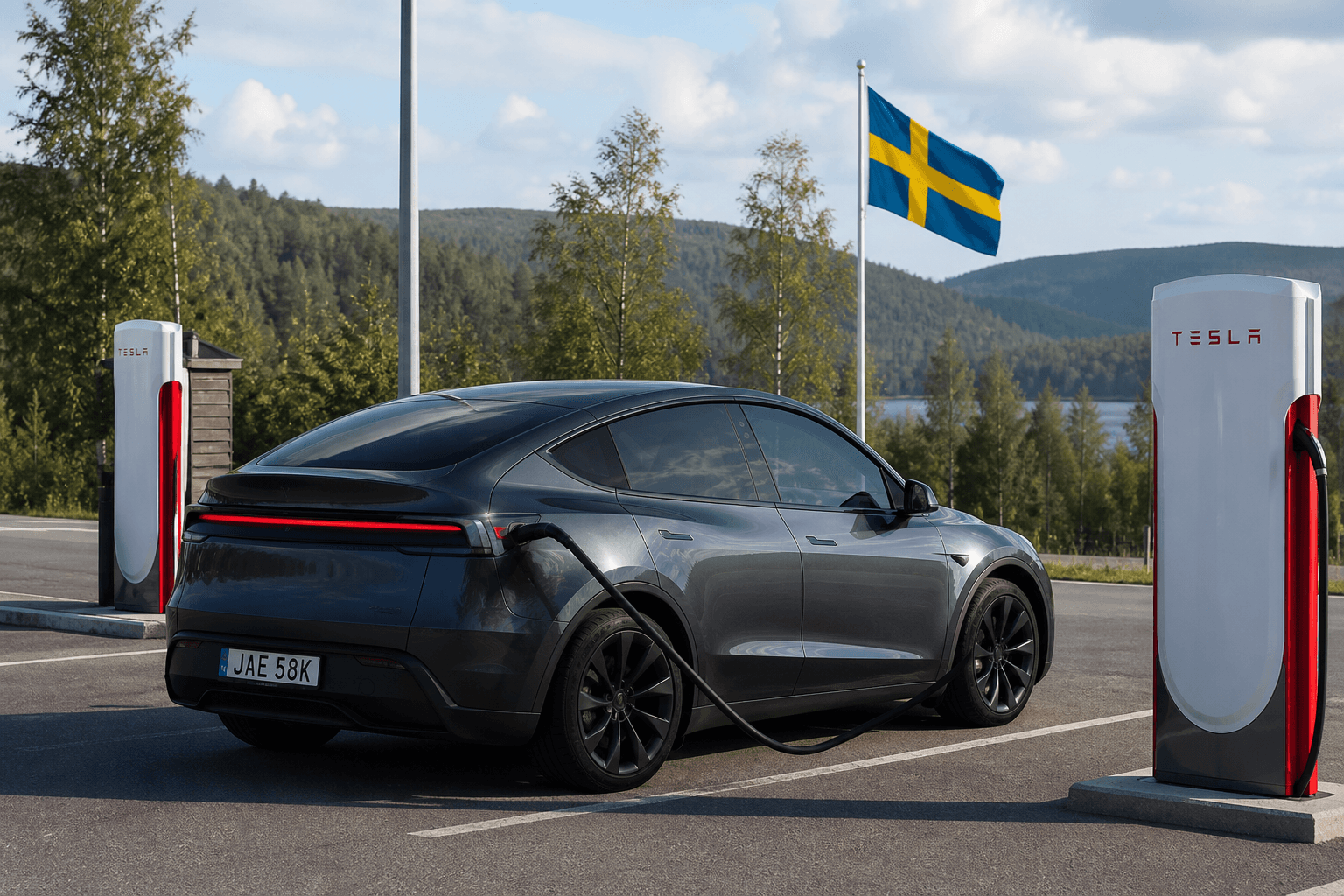
Tesla is immediately resuming its Supercharger rollout in Sweden. Following the official end of the labor dispute involving IF Metall, 264 Supercharger stalls at 20 locations can now enter service after being blocked for an extended period.
The first location has already been activated: Eight Superchargers have gone online in Falköping. A site in Ljungby with 20 stalls is expected to follow next. Although construction was completed long ago, Tesla says it was not allowed to connect to the power grid for around 30 months.
Why the Charging Sites Could Not Connect to the Grid for So Long
The reason was a labor dispute that had been simmering for years. IF Metall launched a strike against Tesla in October 2023 after the automaker refused to sign a collective bargaining agreement. There were also solidarity actions that, among other things, delayed the commissioning of new Supercharger locations.
This phase has now ended because IF Metall stated that no striking Tesla employees remained. This also clears the way for the completed sites to be activated and opened for public use.
What This Means in Practice: More Capacity, Less Charging Stress
Tesla expects the activations to expand Sweden’s Supercharger network by more than 20%. The country is then expected to have more than 1,600 Supercharger stalls at over 100 locations. In practical terms, this primarily means more redundancy along travel routes and less risk of encountering lines at the relatively few heavily used stations.
The impact beyond the Tesla community is also noteworthy. Many Superchargers in Sweden are now open to drivers of other brands, so the additional DC charging capacity will benefit a larger share of the electric vehicle fleet.
What This Means for Germany, Austria and Switzerland
The specific dispute is distinctly Swedish, but the lesson is also relevant to the DACH region—the German-speaking markets of Germany, Austria and Switzerland: The availability of fast-charging infrastructure depends not only on construction progress and hardware, but equally on grid connections, permits and, in some cases, political or labor-law conditions. When an operator can suddenly activate hundreds of charging points that have already been built, the effect is immediately measurable.
Open to Other Brands: Superchargers as a “Network Booster”
Tesla’s decision to open its Supercharger network to other brands in many places makes expansion drives like this particularly significant. Anyone interested in charging standards and compatibility can find more information in our overview: EV Connector Types Explained: Understanding AC and DC Charging.
For Tesla drivers, the rule in everyday use is simple: The denser the network, the less you need to “plan” charging stops because alternatives are within reach. If range-related stress is a general concern for you, this guide may also help: EV Range Anxiety: Causes, Facts and Strategies.
Which Tesla Models Will Benefit Most?
The additional Supercharger capacity will be most noticeable on long-distance trips in Tesla’s high-volume models, particularly the Tesla Model Y and the Tesla Model 3. More locations and more stalls will not only reduce waiting times but also make detours to alternative high-power charging providers less common.
| Metric | Update in Sweden |
|---|---|
| Supercharger stalls ready for activation | 264 |
| Locations | 20 |
| Network growth from activation | more than 20% |
| Total Supercharger stalls in Sweden after expansion | more than 1,600 |
| Total Supercharger locations in Sweden after expansion | more than 100 |
When completed fast-charging sites all connect to the grid at once, it is one of those rare infrastructure developments that drivers notice immediately.